Nearly half your genome is made of transposable elements - ancient viral hitchhikers that copy-pasted themselves across your DNA millions of years ago. Biologists used to call them "junk DNA," which, in hindsight, was like calling the quiet kid in class harmless right before they flip the table. A massive new study in Cell just showed that as the mouse brain ages, these dormant genomic squatters start waking up - and they don't wake up the same way in every cell type (Zeng et al., 2026).
200,000 Brain Cells Walk Into a Sequencer
The Ecker lab at the Salk Institute didn't mess around with sample sizes here. They profiled 132,551 single-cell methylomes and 72,666 joint chromatin conformation-methylome nuclei from aging mouse brains, then layered in transcriptomic data, chromatin accessibility, and spatial transcriptomics from nearly 900,000 cells. The result is basically Google Maps for the aging brain's epigenome - zoom in on any of 36 cell types and see exactly what's falling apart and where.
What makes this possible is a technology called snm3C-seq, which reads both DNA methylation and 3D genome structure from the same nucleus simultaneously. That's like checking both the text and the page layout of a book at once, except the book is written in four billion letters and you're reading 70,000 copies of it.
The Transposon Alarm Clock
Here's the punchline: transposable element methylation alone could tell researchers whether a brain cell came from a young mouse or an old one. No need to check gene expression, protein levels, or whether the mouse had started complaining about its knees. Just look at how well the cell is keeping its transposons on lockdown.
Young cells keep these elements smothered under methyl groups - chemical tags that essentially tell transposons to sit down and shut up. But with age, that silencing erodes. The methylation peels off in a pattern that's frustratingly cell-type-specific: excitatory neurons lose it differently than inhibitory neurons, which lose it differently than oligodendrocytes, which lose it differently than astrocytes. Non-neuronal cells (the glia, a.k.a. the brain's unsung support staff) actually showed more dramatic epigenetic aging than the neurons everyone obsesses over.
When transposons wake up, bad things follow. Their RNA transcripts trigger innate immune sensors, kicking off inflammatory cascades. It's your own genome accidentally setting off its own burglar alarm - except instead of calling the cops, it calls neuroinflammation.
Your Genome's Filing System Gets... Tighter?
The study's second big finding involves TADs - topologically associating domains - which are basically the genome's filing folders. DNA within the same TAD interacts with itself more than with DNA in neighboring TADs, and the boundaries between folders are maintained by a protein called CTCF acting as a divider tab.
Counter-intuitively, aging didn't make the filing system sloppier. TAD boundaries actually got stronger with age, with CTCF binding sites becoming more accessible. Think of it as the organizational equivalent of triple-stapling every folder in a filing cabinet: everything is technically more structured, but good luck pulling anything out when you need it. This rigidity could explain why aging brains struggle with the flexible gene regulation that healthy cognition requires.
Where You Are Matters As Much As What You Are
Using spatial transcriptomics across those 895,296 cells, the team discovered something that should keep neuroscientists busy for years: the same cell type ages differently depending on where it sits in the brain. Non-neuronal cells in the hindbrain showed way more inflammation-related changes than identical cell types in the forebrain. Same cell, different zip code, different aging trajectory. If you've ever wanted to map out complex relationships between variables to make sense of high-dimensional data like this, you understand why the team needed deep learning to untangle it all.
The AI That Reads Wrinkles in DNA
Speaking of deep learning - the researchers built models that predict age-related gene expression changes from multi-modal epigenetic inputs (methylation patterns, chromatin accessibility, 3D genome structure). These aren't just black-box predictors; they provide mechanistic insights into which epigenetic features actually drive which gene expression changes. It's the difference between knowing your car won't start and knowing the alternator is dead.
Why This Matters Beyond Mice
The entire dataset is freely available on AWS, which means any lab on the planet can dig into it. The Salk team is already scaling this approach to human brains through a $126 million NIH grant. If transposon reactivation and TAD remodeling turn out to be conserved across species - and early human data from Alzheimer's patients suggests they are (Cavalier et al., 2025) - we might finally have druggable targets for slowing brain aging at its epigenetic roots.
The quiet parts of your genome aren't so quiet anymore. And for the first time, we have a cell-by-cell, region-by-region map of exactly where the noise is coming from.
References
-
Zeng, Q., Wang, W., Tian, W., et al. (2026). Cell-type-specific transposon demethylation and TAD remodeling in aging mouse brain. Cell. DOI: 10.1016/j.cell.2026.02.015. PMID: 41819104.
-
Liu, H., Zeng, Q., Zhou, J., et al. (2023). Single-cell DNA methylome and 3D multi-omic atlas of the adult mouse brain. Nature, 624, 366 - 377. DOI: 10.1038/s41586-023-06805-y. PMID: 38092913.
-
Jin, K., Yao, Z., van Velthoven, C.T.J., et al. (2025). Brain-wide cell-type-specific transcriptomic signatures of healthy ageing in mice. Nature, 638. DOI: 10.1038/s41586-024-08350-8. PMID: 39743592.
-
Cavalier, A.N., Smith, M.E., et al. (2025). Epigenetic dysregulation of transposable elements in cognitive impairment and Alzheimer's disease. GeroScience. DOI: 10.1007/s11357-025-01765-9. PMID: 40779089.
-
Sun, E.D., Nagvekar, R., Pogson, A.N., & Brunet, A. (2025). Brain aging and rejuvenation at single-cell resolution. Neuron, 113(1), 82 - 108. DOI: 10.1016/j.neuron.2024.12.007. PMID: 39788089.
-
Shaban, H.A. & Gasser, S.M. (2025). Dynamic 3D genome reorganization during senescence: defining cell states through chromatin. Cell Death & Differentiation. DOI: 10.1038/s41418-023-01197-y. PMID: 37596440.
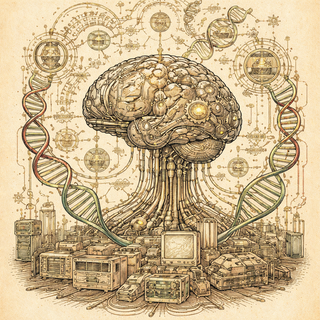
Disclaimer: This blog post is a simplified summary of published research for educational purposes. The accompanying illustration is artistic and does not depict actual model architectures, data, or experimental results. Always refer to the original paper for technical details.