3 reasons this paper matters, starting with the least obvious.
First: it is about parenting electrons. Not metaphorically, unfortunately. The whole pitch of 2D materials powered neuromorphic computing is that if you make hardware thin enough, tunable enough, and weird enough, you can coax tiny devices into behaving a little like synapses: strengthening, weakening, remembering, forgetting, and generally acting like a toddler who absolutely can learn, but only after making everyone repeat the routine 87 times.
The review by Kazmi and colleagues looks at atomically thin materials - transition metal dichalcogenides, hexagonal boron nitride, black phosphorus, tellurene, and friends - as building blocks for brain-inspired AI hardware Kazmi et al., 2026. The big idea is simple: instead of shuttling data back and forth between separate memory and processing units like a sleep-deprived parent walking between the crib and the kitchen, put memory and computation closer together.
The Computer Is Tired, Too
Most computers use von Neumann architecture, where memory and processing live in separate rooms and communicate through a narrow hallway. This has worked beautifully for decades, but modern AI keeps asking for more snacks, more blankets, more matrix multiplications, and somehow another story before bed.
That hallway becomes the bottleneck. Moving data burns energy. A lot of it. Neuromorphic computing tries a different setup: build circuits that act more like networks of neurons and synapses, where memory and computation happen in the same neighborhood. Wikipedia-level background frames neuromorphic computing as hardware inspired by nervous systems, often using artificial neurons, synapses, and event-driven signals rather than regular old binary clockwork (Neuromorphic computing).
The 2D materials angle is where things get spicy, in a very tiny, lab-coat way. These materials can be just atoms thick. Some conduct. Some insulate. Some respond beautifully to light, strain, ions, or electric fields. Stack them together and you can build van der Waals heterostructures, which sounds like a Scandinavian furniture line but is actually a way to layer materials without forcing them into the same crystal rules.
Synapses, But Make Them Extremely Flat
A biological synapse changes strength depending on activity. One famous learning rule is spike-timing-dependent plasticity, where the timing between two neuron spikes decides whether a connection gets stronger or weaker (STDP background). In parenting terms: if the kid cries and the bottle appears immediately, the association strengthens. If the bottle appears three hours later, everyone has learned only despair.
Artificial synaptic devices try to mimic this behavior electronically. In 2D materials, resistance, charge trapping, ion motion, and optoelectronic effects can produce short-term plasticity, long-term potentiation, paired-pulse facilitation, and other brain-ish behaviors. The review argues that these features could help build ultra-low-power AI systems for edge devices, wearables, sensory processors, and brain-machine interfaces.
That matters because AI is currently very good at doing chores with the energy discipline of a teenager leaving every light on. If some learning and inference can happen locally, on flexible sensors or tiny chips, you get faster responses and less cloud dependence. A wearable device could process signals on the body. A smart sensor could classify events without sending every raw twitch to a server. A neural interface could translate signals with lower latency. Everyone gets a nap.
The Lab Bench Is Not a Factory
The review is also honest about the mess. These devices are promising, but not ready to babysit the global AI infrastructure tomorrow morning.
The hard parts are reproducibility, scalable synthesis, long-term stability, defect control, and integration with existing CMOS manufacturing. A single beautiful device in a paper is nice. Ten million consistent devices on a wafer is the part where the toddler refuses shoes, pants, and linear regression.
Recent work shows the field is pushing toward that practical layer. Kim and colleagues reviewed 3D integration strategies for 2D neuromorphic hardware, focusing on how atomically thin layers could help stack memory and compute densely (10.1038/s41699-024-00509-1). Hadke, Kang, Sangwan, and Hersam surveyed 2D materials for brain-inspired computing hardware in Chemical Reviews, laying out device classes, mechanisms, and fabrication barriers (10.1021/acs.chemrev.4c00631). Choi and colleagues reviewed 2D material neuromorphic devices from synapses to system demonstrations (10.1038/s44335-025-00023-7). Zhang and colleagues covered all-in-one sensing, memory, and computing hardware using 2D materials (10.1039/D5CS00251F). Plummer and colleagues added a spintronics route, looking at magnetic 2D systems for scalable neuromorphic devices (arXiv:2503.17376).
There is also movement beyond review papers. A 2025 Nature paper reported a full-featured 2D NOR flash chip integrated with CMOS, hitting 20 ns operation and 0.644 pJ per bit with high tested yield (10.1038/s41586-025-09621-8). That is not the same as a commercial neuromorphic AI chip, but it is a real sign that 2D materials are learning to sit at the grown-up table.
Why This One Is Worth Reading
Kazmi and colleagues pull together the material science, synaptic device behavior, wearable and neural-interface applications, and the quantum-neuromorphic angle into one map. That is useful because this field can feel like opening a daycare where every child speaks a different physics dialect.
The best case is not "a fake brain on a chip." Please do not invite that phrase into the house. The better vision is hardware that handles noisy, local, adaptive signals with much less energy than today’s AI pipeline. Tiny sensors that learn. Flexible electronics that process touch or motion. Brain-machine interfaces that do less waiting around. Maybe even hybrid quantum-classical systems for high-dimensional problems, assuming the engineering behaves itself after snack time.
The catch is that materials must become boring in the best possible way: repeatable, manufacturable, stable, and well-characterized. Until then, 2D neuromorphic hardware remains a brilliant preschooler: full of promise, occasionally astonishing, and still not allowed near the scissors unsupervised.
References
- Kazmi, J. et al. “2D Materials Powering Neuromorphic Intelligence.” Nano-Micro Letters (2026). DOI: 10.1007/s40820-026-02253-1
- Hadke, S., Kang, M.-A., Sangwan, V. K., & Hersam, M. C. “Two-Dimensional Materials for Brain-Inspired Computing Hardware.” Chemical Reviews 125, 835-932 (2025). DOI: 10.1021/acs.chemrev.4c00631
- Kim, S. J. et al. “2D materials-based 3D integration for neuromorphic hardware.” npj 2D Materials and Applications 8, 70 (2024). DOI: 10.1038/s41699-024-00509-1
- Choi, Y. et al. “Advanced AI computing enabled by 2D material-based neuromorphic devices.” npj Unconventional Computing 2, 8 (2025). DOI: 10.1038/s44335-025-00023-7
- Zhang, G. et al. “All-in-one neuromorphic hardware with 2D material technology.” Chemical Society Reviews 54, 8196-8242 (2025). DOI: 10.1039/D5CS00251F
- Plummer, D. Z. et al. “2D Spintronics for Neuromorphic Computing with Scalability and Energy Efficiency.” arXiv: 2503.17376
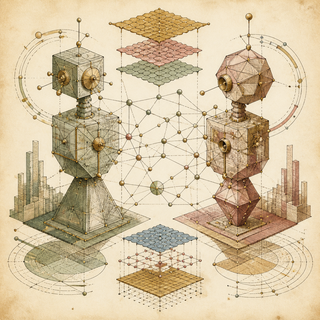
Disclaimer: This blog post is a simplified summary of published research for educational purposes. The accompanying illustration is artistic and does not depict actual model architectures, data, or experimental results. Always refer to the original paper for technical details.