The punchline is that the chemistry lab’s new fortune teller does not read tea leaves - it reads the energy bill for every suspicious little intermediate hiding backstage.
Friends, gather close to the wireless, because today’s episode features a familiar villain: the reaction yield. That innocent-looking percentage tells you how much product you actually got after the molecules finished their tiny bar fight. Chemists want it high. Reality often says, “Best I can do is a disappointing smear in a flask.”
Machine learning has been drafted into this struggle for years. Feed it reaction data, ask it to predict yield, and hope it does not behave like a racetrack tipster with a GPU. The trouble is that many models use descriptors - numerical summaries of molecules - that work statistically but do not always explain themselves chemically. They can predict, yes. But when asked why, they stare at you like a radio with a loose tube.
Doba, Harabuchi, Nagata, and Maeda’s new JACS paper tries a more civilized arrangement: make the model look at physically meaningful chemistry from the start.
Tonight’s Mystery: Where Did the Yield Go?
The team’s idea is beautifully direct. Instead of describing a reaction using handpicked molecular features, they build an “energy descriptor” from possible reaction intermediates. In plain English: they ask, “What molecular pit stops might exist along the route, and how energetic are they?”
That matters because reaction mechanisms are not just decorative arrows in a textbook. A mechanism is the proposed step-by-step path from reactants to products, including short-lived intermediates and high-energy transition states. Those intermediates can make or break a reaction. Some are helpful stepping stones. Others are chemical side streets with bad lighting.
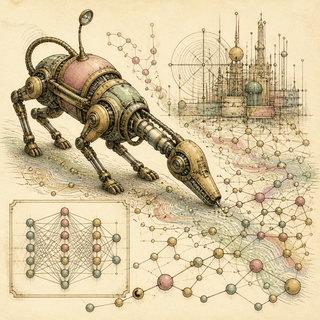
To find these possible intermediates, the authors used single-component artificial force induced reaction, or SC-AFIR. AFIR is an automated reaction path search method that nudges molecular structures around to explore possible reaction routes without demanding that a human guess every pathway in advance. Think of it as sending a very stubborn mechanical bloodhound through the reaction landscape, except the bloodhound has no nose and runs on quantum chemistry.
The Model Wears a Name Tag
Once the SC-AFIR search produced candidate intermediates, the authors used their calculated energies as inputs to regression models for yield prediction. Regression is the old, dependable business of estimating relationships between inputs and an output. Here, the output is reaction yield.
The charming part is that the best performers were not giant neural networks in sunglasses. Linear models with regularization did well on hold-out samples, reaching RMSE below 7% yield. Regularization is the statistical equivalent of telling the model, “Easy there, Marlon Brando, do not overact every tiny fluctuation in the training data.”
Because the model is linear, its coefficients are readable. A coefficient can suggest whether raising or lowering the energy of a particular intermediate is associated with better yield. That is the big appeal: the model does not merely say, “Yield: 73%, trust me.” It points toward mechanistic suspects.
This puts the paper in conversation with a broader movement in chemical AI. Recent work has pushed reaction prediction toward more interpretable, chemistry-aware representations, including knowledge-based graph models for yield and selectivity, large-scale pretraining systems like ReaMVP, and mechanism-level deep learning approaches such as PMechRP. The field seems to be learning the same lesson every detective learns by Act Two: fingerprints help, but motive helps more.
Why This Is More Than a Parlor Trick
If this approach holds up across more reaction classes, it could make ML-guided chemistry less like throwing darts at a periodic table and more like collaborating with a junior mechanistic chemist who never sleeps. That could help with pharmaceutical synthesis, catalyst screening, materials chemistry, and any place where failed reactions burn time, solvents, reagents, and morale.
The real-world promise is not “AI replaces chemists.” Kindly remove that headline from the premises. The better promise is: chemists get sharper maps. A model that predicts yield and hints at mechanistic causes could help researchers choose which intermediates to stabilize, which pathways to suppress, and which reaction variants deserve precious bench time.
Mind the Static on the Line
There are limits, naturally. Automated path exploration costs computation. Quantum-chemical energies depend on method choices. Experimental yields can be noisy. And a hold-out test inside one study is not the same as universal chemical wisdom descending from the clouds with a trumpet section.
Still, the paper makes a persuasive case for a simple principle: interpretability improves when the numbers you feed the model already mean something. If your descriptors are rooted in reaction energetics, the model’s explanations have a fighting chance of sounding like chemistry instead of numerology wearing a lab coat.
So, friends, tonight’s broadcast closes with a modest but lively revelation: sometimes the cleverest machine learning model is not the biggest one. Sometimes it is the one that knows where the intermediates are buried.
References
-
Takahiro Doba, Yu Harabuchi, Yuuya Nagata, and Satoshi Maeda. “Construction of an Interpretable Regression Model for Yield Prediction and Mechanistic Insight Enabled by Automated Reaction Path Exploration.” Journal of the American Chemical Society (2026). DOI: 10.1021/jacs.6c05203. PMID: 42319962
-
Shu-Wen Li et al. “Reaction performance prediction with an extrapolative and interpretable graph model based on chemical knowledge.” Nature Communications 14, 3569 (2023). DOI: 10.1038/s41467-023-39283-x
-
“Prediction of chemical reaction yields with large-scale multi-view pre-training.” Journal of Cheminformatics (2024). DOI: 10.1186/s13321-024-00815-2
-
“When Yield Prediction Does Not Yield Prediction: An Overview of the Current Challenges.” Journal of Chemical Information and Modeling (2023). DOI: 10.1021/acs.jcim.3c01524
-
Ryan J. Miller et al. “Interpretable Deep Learning for Polar Mechanistic Reaction Prediction.” arXiv: 2504.15539 (2025)
-
Satoshi Maeda et al. “Computational Catalysis Using the Artificial Force Induced Reaction Method.” Accounts of Chemical Research (2016). DOI: 10.1021/acs.accounts.6b00023
Disclaimer: This blog post is a simplified summary of published research for educational purposes. The accompanying illustration is artistic and does not depict actual model architectures, data, or experimental results. Always refer to the original paper for technical details.