Trap a few water molecules between layers thinner than your DNA, and they start acting like they've never heard of the rules. That's the premise behind a new study that caught water red-handed behaving bizarrely inside MXenes - those trendy two-dimensional materials that materials scientists can't stop talking about.
The Squeeze Is Real
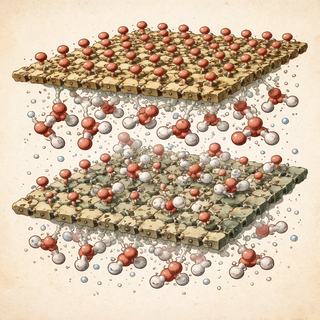
MXenes (pronounced "maxenes," because scientists love confusing pronunciation) are atomically thin sheets of titanium carbide that stack together like a deck of cards made for ants. The gaps between these sheets? About 6 to 12 angstroms wide - we're talking a handful of water molecules at most. At this scale, water doesn't just flow differently; it fundamentally changes what it is.
The research team, led by scientists from Nanjing University of Aeronautics and Astronautics and Oak Ridge National Laboratory, wanted to understand exactly what happens to water molecules when they're crammed into these impossibly tight spaces [1]. The catch: you can't just peek inside with a microscope. These gaps are too small and the dynamics too fast.
When Your Simulation Budget Needs Machine Learning
Here's where things get clever. Traditional quantum mechanical simulations (ab initio molecular dynamics, for the technically curious) are accurate but computationally expensive - like hiring a team of accountants to count every grain of sand on a beach. The researchers trained a machine learning model on high-quality quantum data, then let it do the heavy lifting. The result? Simulations that run 1,000 times faster while keeping the accuracy that makes physicists sleep soundly at night.
They combined these accelerated simulations with actual experiments: X-ray diffraction to see how water molecules arrange themselves, and inelastic neutron scattering to watch how they move and vibrate. Theory met experiment, and for once, they agreed.
Water's Identity Crisis
The findings reveal that confined water isn't just "slower water" or "denser water." It's structurally different depending on what's coating the MXene surfaces.
When the surfaces are decorated with oxygen groups (-O), water molecules line up in orderly layers, almost crystalline in their arrangement. With hydroxyl groups (-OH), things get messier - the surface chemistry competes with water's natural tendency to hydrogen-bond with itself, creating a frustrated molecular tug-of-war. Fluorine-coated surfaces (-F) produce yet another distinct arrangement.
The diffusion rates tell an even stranger story. In some configurations, water moves faster along the plane of the sheets than bulk water does in your coffee cup - despite being squeezed into a space barely wider than the molecules themselves. In other configurations, water practically freezes in place even at room temperature.
Why Should You Care About Claustrophobic Water?
Beyond satisfying scientific curiosity about matter at the nanoscale, this research has practical teeth. MXenes are prime candidates for next-generation batteries, supercapacitors, and water desalination membranes. Understanding how water behaves in these confined spaces directly impacts how well these technologies work.
For energy storage, the way ions (which drag water molecules along for the ride) move through electrode materials determines how fast you can charge your phone. For water purification, selective transport through nanochannels could separate salt from seawater more efficiently than current methods. The researchers specifically note that their findings could help design MXene membranes that either speed up or slow down water transport on demand - essentially giving engineers a tuning knob for molecular plumbing.
The Method Is the Message
What makes this study particularly useful isn't just the water findings - it's the workflow. The machine learning potential they developed could be applied to other 2D materials and confined fluid systems. As materials science increasingly deals with phenomena at scales where quantum effects matter but full quantum simulations are impractical, these hybrid approaches become essential.
The team validated their simulations against experimental neutron and X-ray data, which provides confidence that the computational predictions reflect reality. Too often, simulations live in their own theoretical universe; this study keeps one foot firmly planted in experimental ground truth.
The Takeaway
Water confined in MXenes doesn't just get squished - it transforms. Its structure and dynamics depend sensitively on surface chemistry, confinement width, and the delicate balance of competing molecular interactions. And thanks to machine learning making quantum-accurate simulations actually feasible, we can now predict and understand these behaviors with unprecedented detail.
Next time you drink a glass of water, consider this: those same molecules, given slightly different circumstances, might arrange themselves into something you wouldn't recognize. At the nanoscale, water is still full of surprises.
References
-
Tang, J., Sun, W., Chen, C., Bannenberg, L., Wang, X., Zhu, T., Sun, L., Wang, J., Ying, G., Xie, Y., Osti, N.C., Kolesnikov, A.I., Mamontov, E., Tyagi, M., Huang, J., & Kent, P.R.C. (2025). Altered morphology and diffusivity of water confined in MXenes: Machine learning-accelerated computations combined with experiments. Science Advances. DOI: 10.1126/sciadv.adz1780 | PMID: 41880490
-
Naguib, M., Kurtoglu, M., Presser, V., Lu, J., Niu, J., Heon, M., Hultman, L., Gogotsi, Y., & Barsoum, M.W. (2011). Two-dimensional nanocrystals produced by exfoliation of Ti3AlC2. Advanced Materials, 23(37), 4248-4253. DOI: 10.1002/adma.201102306
-
VahidMohammadi, A., Rosen, J., & Gogotsi, Y. (2021). The world of two-dimensional carbides and nitrides (MXenes). Science, 372(6547), eabf1581. DOI: 10.1126/science.abf1581
-
Fumagalli, L., Esfandiar, A., Fabregas, R., Hu, S., Ares, P., Janez, A., Yang, Q., Radha, B., Taniguchi, T., Watanabe, K., Gomila, G., Novoselov, K.S., & Geim, A.K. (2018). Anomalously low dielectric constant of confined water. Science, 360(6395), 1339-1342. DOI: 10.1126/science.aat4191
Disclaimer: This blog post is a simplified summary of published research for educational purposes. The accompanying illustration is artistic and does not depict actual model architectures, data, or experimental results. Always refer to the original paper for technical details.