Remember when "touch grass" became the internet's favorite insult? Turns out if you actually do touch grass - and then keep going a few inches underground - you run into one of the biggest biological cable systems on Earth. Not fiber optic. Fungal. Specifically, arbuscular mycorrhizal fungi, the underground pit crew that helps plants swap sugar for nutrients while the rest of us stomp around above them like confused giants.
A new Science paper asks a blunt mechanic's question: how much fungal wiring is actually under the hood of the planet's soils? And the answer is: a lot. Like, "maybe we should all sit down for this" a lot. Stewart and colleagues combined data from 322 studies, covering more than 16,000 soil cores across nine biomes, then used machine-learning models plus robotic imaging of over 300,000 hyphae to estimate the global density and biomass of these fungal networks [1].
Pop the hood: what are these fungi doing?
Arbuscular mycorrhizal fungi - AM fungi if you do not feel like saying that three times fast - live in partnership with about 70% of plant species [1,2]. The deal is old, weird, and wildly successful. Plants make carbon-rich sugars through photosynthesis. Fungi mine the soil for nutrients like phosphorus and help move water around. Everyone gets paid, nobody sends invoices.
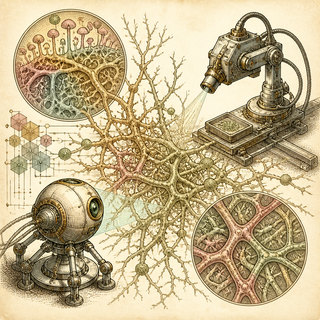
The key hardware here is the hypha: a microscopic fungal filament that works like a tiny flexible pipe. Bundle enough of those together and you get an underground distribution network. Not a brain, not a secret group chat, not a magical forest consciousness with a podcast deal - just a very effective nutrient-and-carbon transport system that biology has been tuning for hundreds of millions of years [2,3].
This matters because AM fungi are thought to move roughly 1 billion metric tons of carbon per year into soils [1]. That is not a side hustle. That is core engine activity in the carbon cycle.
The paper's main trick: counting the pipes without digging up Earth
If you wanted to map the world's fungal threads directly, you would need infinite patience, infinite money, and probably a therapist. So the researchers did something smarter.
They gathered measurements from hundreds of previous studies, then trained machine-learning models to predict fungal hyphal density across the globe [1]. Think of it like diagnosing an engine by combining shop records from thousands of cars, then building a model that predicts what is happening inside all the ones you have not opened yet. After that, they used robotic imaging of more than 300,000 hyphae to calibrate biomass estimates.
That combo let them move from "fungi are important" to "here is our best estimate of how much fungal infrastructure sits in topsoil worldwide." This is the kind of boring-sounding upgrade that quietly changes the whole dashboard. You cannot manage carbon well if you do not know where a major chunk of the plumbing is.
So how big is the underground machine?
The headline estimate is enormous: global topsoils contain about 1.10 × 10^9 metric tons of biomass from these arbuscular mycorrhizal fungal networks [1]. That is billion-with-a-b territory.
The bigger point is not just the number. It is that these fungal networks appear to represent a massive, previously under-quantified part of terrestrial ecosystems. Climate models and land management debates often focus on trees, roots, leaves, and soil carbon pools in broad strokes. Fair enough. But this paper is a reminder that the transmission is not just the engine block. The little moving parts matter too, especially when they are moving carbon and nutrients at planetary scale.
Why this matters outside the mushroom fan club
If these estimates hold up, they could sharpen how we think about agriculture, restoration, and carbon storage.
In farming, AM fungi can affect nutrient uptake, especially phosphorus, and may help crops deal with stress [2,4]. That does not mean "fungi solve agriculture now," because nature hates simple marketing slogans. Field outcomes depend on soil conditions, crop type, management, and local microbial drama. But understanding where these networks thrive could help tune fertilizer use and soil practices more intelligently.
In ecology and climate science, better fungal maps could improve models of how carbon moves into and stays in soil [3,5]. That is a pretty important gasket in the climate engine. Miss it, and your whole forecast starts leaking.
And for anyone who likes tools that make hidden systems visible, this is the same basic appeal as a good mind map. If you were trying to sketch how nutrients, roots, and fungal networks connect, something like mapb2.io would fit the vibe - just with fewer spores and less dirt under your nails.
The check-engine light
Before we crown fungi the secret rulers of Earth, a little caution.
These are model-based global estimates, not a direct census of every fungal strand in every soil [1]. The data came from many studies with different methods, locations, and levels of coverage. Global extrapolation is always a bit like tuning an engine by listening through a wall - you can get surprisingly close, but you should not pretend you removed every bolt yourself.
Also, biomass is not the same thing as function. A lot of fungal network does not automatically tell you exactly how much nutrient exchange, carbon storage, or ecosystem resilience is happening in every place at every time. Biology loves exceptions the way old engines love mystery rattles.
Still, this paper gives researchers something they badly needed: a much better estimate of the scale of the machinery.
The part you should remember
Under your lawn, a wheat field, a forest floor, probably that sad plant outside your apartment building - there is a sprawling fungal transport network helping run the planetary nutrient economy. This paper does not turn fungi into magic. It does something better. It measures the hardware.
And once you know how much tubing is in the system, you can stop talking about soil like it is just brown background scenery. It is an active assembly of pipes, pumps, trades, and microbial subcontractors, all keeping the biosphere from stalling out.
Which, frankly, makes dirt seem a lot less boring.
References
-
Stewart JD, Bisot C, Cargill RIM, van Nuland ME, Hawkins HJ, Oyarte Galvez L, et al. Global density and biomass of arbuscular mycorrhizal fungal networks. Science. 2025;387(6735):886-893. doi:10.1126/science.adu4373. PubMed: 42275513
-
Brundrett MC, Tedersoo L. Misdiagnosis of mycorrhizas and inappropriate recycling of data can lead to false conclusions. New Phytologist. 2023;239(1):18-24. doi:10.1111/nph.18929
-
Soudzilovskaia NA, van Bodegom PM, Terrer C, et al. Global mycorrhizal plant distribution linked to terrestrial carbon stocks. Nature Communications. 2019;10:5077. doi:10.1038/s41467-019-13019-2
-
Begum N, Qin C, Ahanger MA, et al. Role of arbuscular mycorrhizal fungi in plant growth regulation: implications in abiotic stress tolerance. Frontiers in Plant Science. 2019;10:1068. doi:10.3389/fpls.2019.01068. PMCID: PMC6756252
-
Tedersoo L, Bahram M, Zobel M. How mycorrhizal associations drive plant population and community biology. Science. 2020;367(6480):eaba1223. doi:10.1126/science.aba1223
Disclaimer: This blog post is a simplified summary of published research for educational purposes. The accompanying illustration is artistic and does not depict actual model architectures, data, or experimental results. Always refer to the original paper for technical details.