If we keep guessing comet sizes from their glow alone, we risk charting the early Solar System like a half-frozen sea captain doing dead reckoning in a fog bank. That matters because comets are not just pretty sky lint. They are old cargo from the system's earliest days, and if we misjudge how big they are, we misread where they came from, how many are out there, and what kind of gravitational bar fight shaped the outer planets.
A new Nature Communications paper from Zhao, Shi, Lei, Hui, and Shi tackles exactly that mess with deep learning, and the result is a proper jolt to the map: the distant Oort Cloud may be nearly 1,000 times more populated than the Scattered Disk, far above many standard instability models' expectations (Zhao et al., 2026).
The Coma Is a Liar
Here is the snag. A comet's nucleus, the actual icy rock-bit at the center, often hides inside a fuzzy coma of gas and dust. So when astronomers judge a comet by brightness alone, they can wind up measuring the cosmic equivalent of a ship by the size of its foghorn.
Zhao and colleagues sidestepped that by using AI-based activity modeling on water emission variations for 28 comets. Instead of asking, "How bright does this thing look?" they asked, more or less, "How does its water output change, and what nucleus size best explains that behavior?" That is a smarter compass, because the coma may be flashy, but the gas physics still leaves a wake.
Their headline result: long-period comets from the Oort Cloud seem to have larger nuclei than short-period comets from the Scattered Disk, even when both have similar absolute brightness. Same lantern glow, very different ship beneath the deck.
Two Reservoirs, Very Different Fleets
Quick chart for the landlubbers. Short-period comets usually swing in and out of the inner Solar System on relatively regular schedules and are generally linked to the Scattered Disk beyond Neptune. Long-period comets arrive from the far more distant Oort Cloud, a huge spherical reservoir thought to surround the Solar System at enormous distances.
That basic picture is old news, but the head count has been ugly. Observations have long implied that the Oort Cloud sends us far more comets, relative to the Scattered Disk, than classic giant-planet-instability models comfortably predict. Earlier dynamical work has wrestled with that mismatch for years (Jewitt & Hui, 2023).
This new paper argues that part of the problem may be embarrassingly simple: we were comparing reservoirs using size estimates that were getting fooled by comet activity. Once the size estimates improve, the population ratio shifts hard enough to suggest the outer Solar System had a rougher upbringing than tidy models prefer.
The Early Solar System Was Probably Rowdier Than Advertised
If the Oort Cloud really is that overstocked, something extra helped load the hold. Zhao and colleagues point toward processes like stellar flybys. In plain English, nearby stars passing the young Sun may have given the outer debris field a few well-timed shoves, helping fling icy bodies into distant storage.
That idea fits with recent work showing that cluster environments, embedded birth settings, and odd dynamical histories can heavily sculpt distant comet reservoirs (Wajer et al., 2024; Raymond et al., 2023). Other studies suggest long-period comet behavior can also be altered by outbursts and volatile physics, which is a polite scientific way of saying these little icebergs are not exactly calm, obedient buoys (Belousov & Pavlov, 2024).
So the paper does not merely say, "Hey, neat use of AI." It says our origin story may need new rigging.
Why You Should Care Even If You Do Not Spend Evenings Thinking About Comet Reservoirs
Better comet sizes mean better models of how the Solar System formed, better forecasts for what future surveys will find, and better planning for missions that hope to meet fresh visitors from the deep freeze. ESA's Comet Interceptor, for example, is being built to encounter a long-period comet or maybe even an interstellar one. If you are going to sail out to inspect an ancient iceball, you would rather not discover too late that your target is more galleon than dinghy.
It also says something broader about AI in science. Sometimes machine learning is sold like a mystical oracle in a hoodie. Here it is doing a much more respectable job: helping untangle a messy measurement problem that humans have been fighting for years. Less crystal ball, more very patient deckhand sorting ropes in the rain.
That said, keep your anchor down. This study used 28 comets, which is meaningful but not gigantic, and the inference depends on modeling assumptions about comet activity. The result is intriguing because it sharpens a long-running mismatch, not because it ends the argument forever. Science rarely arrives with trumpets. More often it rows in wet, tired, and carrying better error bars.
References
Zhao S, Shi X, Lei H, Hui MT, Shi J. Deep learning-enabled size estimation of comets indicates a more dynamic early solar system. Nature Communications. 2026. DOI: 10.1038/s41467-026-72646-8
Jewitt D, Hui MT. What long-period comets tell us about the Oort Cloud. Astronomy & Astrophysics. 2023;676:A104. DOI: 10.1051/0004-6361/202243728
Belousov DV, Pavlov AK. Cometary outbursts in the Oort cloud. Icarus. 2024;415:116066. DOI: 10.1016/j.icarus.2024.116066
Wajer P, Portegies Zwart S, del Valle L, et al. Oort Cloud and sednoid formation in an embedded cluster, I: Populations and size distributions. Icarus. 2024;415:116065. DOI: 10.1016/j.icarus.2024.116065
Raymond SN, Izidoro A, Kaib NA. Oort cloud (exo)planets. Monthly Notices of the Royal Astronomical Society: Letters. 2023;524(1):L72-L77. DOI: 10.1093/mnrasl/slad079, arXiv: 2306.11109
Bertini I, Fulle M, Mazzotta Epifani E, et al. Inbound evolution of 21 long period comets. Monthly Notices of the Royal Astronomical Society. 2025. DOI: 10.1093/mnras/stag550
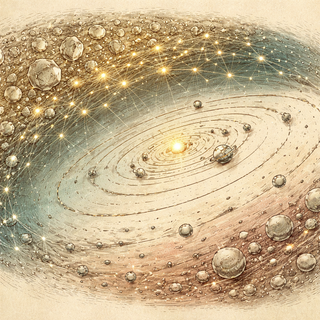
Disclaimer: This blog post is a simplified summary of published research for educational purposes. The accompanying illustration is artistic and does not depict actual model architectures, data, or experimental results. Always refer to the original paper for technical details.