The researchers put genetically similar mice into tiny semi-natural apartments, tracked them for days, recorded dopamine neurons, built reinforcement-learning “e-mice,” and then casually asked whether social roles emerge from brain chemistry, chance, and snack logistics. Subtle little weekend project.
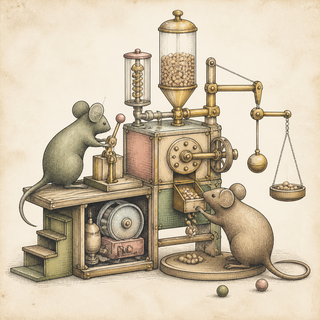
The paper, “Dopaminergic mechanisms of dynamical social specialization”, published in Nature, studies a deceptively simple setup: mice can press a lever to release food, but the dispenser sits somewhere else. In a group, that opens the door to a classic social problem. One mouse can do the work. Another can hang around the dispenser like the office guy who “just happened” to be near the cake.
The big question: do roles like worker and freeloader reflect fixed personality types, dominance rank, or something more slippery?
The answer appears to be: yes, but also no, and please meet dopamine, the brain’s reward-accounting department with questionable HR policies.
The Snack Machine Becomes a Society
When mice were alone, the researchers saw two broad strategies. Some became “Achievers,” pressing the lever and collecting food promptly. Others became “Storers,” pressing the lever but leaving pellets around for later, which is bold if your roommates are awake and possess teeth.
Then the researchers moved to triads. That is where things got weird.
Male groups tended to split into “Workers” and “Scroungers.” Workers pressed the lever and often lost pellets to others. Scroungers pressed less and collected food triggered by cage mates. Female groups, meanwhile, mostly converged on the Storer strategy. Not exactly a Disney moral, more like a tiny economics department with bedding.
The catch: these roles were not simply dominance rank in a lab coat. Tube-test hierarchy did not explain who became the lever-presser or the dispenser lurker. That matters because animal social roles often get treated as stable traits. This paper argues they can emerge dynamically from interaction history, reinforcement, and the structure of the task itself.
In other words, the mouse is not necessarily “a Scrounger.” The situation may be teaching it to become one. Somewhere, a behavioral psychologist just adjusted their glasses very slowly.
Dopamine: Not Just the “Yay Chemical”
Dopamine gets abused in pop science as the “pleasure chemical,” which is like calling a smartphone “a rectangle that screams.” In reinforcement learning terms, dopamine often acts more like a prediction-error signal: it helps update behavior when reality differs from expectation. Classic work tied dopamine to reward prediction error, and newer neuroscience keeps complicating that story in useful ways.
Recent work in mice, for example, shows striatal dopamine tracks perceived cue-action-outcome associations during changing task rules (Bernklau et al., 2024). Another study found mice mix incremental reinforcement learning with short-term strategies when learning stimulus-action links (Chase et al., 2024). Humans are not exempt from the mess: dopamine and serotonin signals have even been measured during economic exchange in Parkinson’s patients undergoing brain surgery, because neuroscience apparently saw “awkward social negotiation” and said, “add electrodes” (Batten et al., 2024).
Here, Solié and colleagues focused on dopamine neurons in the ventral tegmental area, or VTA. Workers showed dopamine responses tied to their own lever presses. Scroungers showed responses to other mice’s lever presses. That is deliciously suspicious. The same food machine event had different neural meaning depending on the animal’s role.
The Model Says: Blame Feedback Loops
The team built a Q-learning model, a reinforcement-learning framework where agents update action values based on rewards. If you have seen machine-learning agents learn by trial and error, same general neighborhood, minus the GPU bill and plus whiskers.
A key parameter was beta, controlling exploration versus exploitation. Low beta means more wandering and variability. High beta means stronger commitment to known good actions. In the simulations, high-beta agents in groups could split into Worker and Scrounger roles through a symmetry-breaking process. Translation: two similar agents start almost alike, but small early differences get amplified until one becomes “the lever person” and the other becomes “the snack intercept specialist.”
That part is intriguing and also where your skeptical eyebrow should clock in. Models can explain behavior beautifully after the fact, sometimes with the confidence of a GPS that just drove you into a lake. But the researchers did not stop at modeling. They changed group composition and manipulated dopaminergic activity, and the role distributions shifted in predicted ways. That gives the story more bite.
Still, caveats remain. These were controlled mouse microsocieties, not general animal society, not humans, and definitely not your workplace Slack channel. Dopamine manipulations can affect arousal, motivation, stress, and social drive, not just tidy reinforcement-learning parameters. The authors acknowledge this, which is refreshing. Nobody needs another “we found the one brain knob for society” paper.
Why AI People Should Care
This paper is not an AI benchmark, but it speaks fluent reinforcement learning. It shows how agent behavior can specialize through feedback between internal learning rules and social constraints. Multi-agent AI systems face similar problems: agents may divide labor, exploit loopholes, or stabilize into roles nobody explicitly programmed. Sure, 95% cooperation sounds great until the remaining 5% discovers the dispenser.
The lesson is not “mice are tiny robots.” The lesson is sharper: when learners share an environment, the reward structure may create roles by accident. If you are designing AI agents, animal experiments like this are a reminder that interaction effects are not decorative sprinkles. They are often the cake.
References
- Solié, C. et al. “Dopaminergic mechanisms of dynamical social specialization.” Nature 654, 163-172 (2026). https://doi.org/10.1038/s41586-026-10301-4
- Bernklau, T. W. et al. “Striatal dopamine signals reflect perceived cue-action-outcome associations in mice.” Nature Neuroscience 27, 747-757 (2024). https://doi.org/10.1038/s41593-023-01567-2
- Chase, J. et al. “Adolescent and adult mice use both incremental reinforcement learning and short term memory when learning concurrent stimulus-action associations.” PLOS Computational Biology 20, e1012667 (2024). https://doi.org/10.1371/journal.pcbi.1012667
- Batten, S. R. et al. “Dopamine and serotonin in human substantia nigra track social context and value signals during economic exchange.” Nature Human Behaviour 8, 718-728 (2024). https://doi.org/10.1038/s41562-024-01831-w
- Jensen, K. T. “An introduction to reinforcement learning for neuroscience.” arXiv:2311.07315 (2023). https://arxiv.org/abs/2311.07315
Disclaimer: This blog post is a simplified summary of published research for educational purposes. The accompanying illustration is artistic and does not depict actual model architectures, data, or experimental results. Always refer to the original paper for technical details.