Two neural networks walked into a neuroscience lab, got into an argument about what consciousness looks like, and accidentally figured out how to treat coma. That's the absurdly compressed version of a new study in Nature Neuroscience - and somehow, the real version is even wilder.
The Setup: AI vs. AI, Winner Gets to Explain Your Brain
Researchers at UCLA, led by Martin Monti and Daniel Toker, built something that sounds like a sci-fi premise: two AI systems forced into an intellectual cage match over what makes a brain "conscious" versus "lights on, nobody home" (Toker et al., 2026).
Here's how it works. One AI - a deep neural network - was trained on a genuinely staggering dataset: over 680,000 ten-second clips of brain electrical activity from 565 patients, healthy volunteers, and even animals (monkeys, rats, bats - basically anyone with neurons and a willingness to wear electrodes). This network learned to tell the difference between a conscious brain and an unconscious one with impressive accuracy.
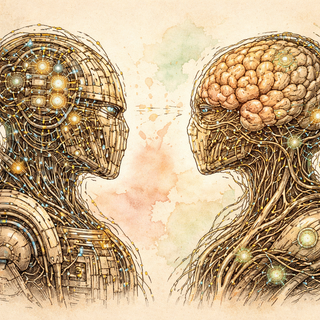
Then they built its opponent: an interpretable neural field model, which is basically a simulated brain you can take apart and inspect. This model's job was to generate fake brain signals - simulations of both conscious and comatose states - realistic enough to fool the first AI.
Think of it like an art forger (the simulator) trying to trick a museum curator (the detector). The forger has to learn exactly what makes a "conscious" brain painting look authentic. And in learning to fake it convincingly, the simulator accidentally reveals the actual ingredients of consciousness. Sneaky.
What the Dueling AIs Found (Nobody Programmed This)
The adversarial framework produced simulations so biologically realistic they matched real neurophysiology across humans, monkeys, rats, and bats. But the genuinely jaw-dropping part: without anyone telling it to, the model retroactively predicted known responses to brain stimulation in consciousness disorders. The AI basically said "I bet if you zap this part of the brain, you'd see this response" - and it was right about things scientists already knew. That's a strong vote of confidence before you even get to the new predictions.
And those new predictions? Two of them got validated in the same paper:
Prediction #1: The basal ganglia's indirect pathway is selectively disrupted in coma. The basal ganglia are a set of deep brain structures classically associated with movement - think of them as your brain's traffic controller, deciding which signals get through to the cortex and which get filtered out. The "indirect pathway" is the brake pedal, normally helping suppress unwanted neural activity. The AI predicted this brake line gets cut in disorders of consciousness. Diffusion MRI scans from 51 patients with consciousness disorders confirmed it (Toker et al., 2026).
Prediction #2: Inhibitory neurons start over-connecting to each other. In a conscious brain, inhibitory neurons (the ones that tell other neurons to quiet down) are carefully balanced. The AI predicted that in comatose brains, these inhibitory neurons form too many connections with each other - essentially, the brain's "shush" system starts shushing itself, creating a feedback loop of silence. RNA sequencing from brain tissue of 6 human coma patients and a rat stroke model backed this up (Toker et al., 2026).
The Treatment Nobody Thought to Try
Here's where it gets practical. The model also predicted that high-frequency stimulation of the subthalamic nucleus - a tiny structure deep in the brain already famous as a target for Parkinson's disease treatment - could help restore consciousness in DOC patients.
The catch? Nobody has ever tried deep brain stimulation targeting the subthalamic nucleus for consciousness disorders. It's like the AI pointed at a door everyone walked past for decades and said "have you tried this one?"
Toker found clever validation: data from patients who already had DBS devices implanted for cervical dystonia (a movement disorder). Their electrophysiology data supported the model's prediction, adding real-world evidence to the AI's suggestion (Toker et al., 2026; Cao et al., 2024). A separate 2025 study in Nature Communications on brain networks linked to consciousness restoration after DBS further strengthens the case that precise stimulation targets matter enormously (Hollunder et al., 2025).
Why This Matters Beyond the Lab
Disorders of consciousness - vegetative states, minimally conscious states, coma - affect hundreds of thousands of people worldwide, and treatment options have been brutally limited. One of the biggest problems has been that you can't exactly run experiments on consciousness the way you'd test a new blood pressure medication. There's no animal model where you can just flip a switch and say "okay, now be conscious again."
This adversarial AI framework essentially creates a virtual lab for consciousness research. The simulated brains can be prodded, broken, and repaired in ways that would be impossible or unethical with real patients. If you want to map out how different types of brain damage lead to unconsciousness, or test whether a particular stimulation pattern might help, you can run the experiment in silicon first.
And the approach isn't limited to consciousness. The same adversarial architecture - pitting a powerful but opaque AI against an interpretable model - could work for any complex system where you need both prediction accuracy and mechanistic understanding. If you're trying to map out complex systems visually, tools like mapb2.io can help diagram the kind of multi-layered network relationships this research depends on.
The Fine Print
The RNA sequencing validation involved only 6 human patients - a small sample, though the rat model data adds biological plausibility. And while the subthalamic nucleus stimulation prediction is supported by existing data, it hasn't been tested in an actual clinical trial for DOC yet. The model simulates neural dynamics at a population level, not individual neurons, so there's a gap between "the math works" and "this will definitely help patient X."
Still, the fact that an adversarial AI framework - with no prior knowledge of consciousness neuroscience baked in - independently arrived at biologically validated mechanisms? That's the kind of result that makes you sit up a little straighter.
The hard problem of consciousness remains unsolved. But the hard problem of figuring out what goes wrong when consciousness breaks? Two bickering AIs just made it a lot more tractable.
References
-
Toker, D., Zheng, Z.S., Thum, J.A., et al. (2026). Adversarial AI reveals mechanisms and treatments for disorders of consciousness. Nature Neuroscience. DOI: 10.1038/s41593-026-02220-4
-
Cao, Y., et al. (2024). Clinical neuromodulatory effects of deep brain stimulation in disorder of consciousness: A literature review. CNS Neuroscience & Therapeutics, 30(2), e14559. DOI: 10.1111/cns.14559
-
Hollunder, B., et al. (2025). A human brain network linked to restoration of consciousness after deep brain stimulation. Nature Communications. DOI: 10.1038/s41467-025-61988-4
-
Hays, S.P., et al. (2025). Neural field modeling and analysis of consciousness states in the brain. Neuroscience of Consciousness, 2025(1), niaf055. DOI: 10.1093/nc/niaf055
-
Parra, L.C. (2026). AI predicts how brain injuries disrupt consciousness - and how to restore it once it's disordered. Nature Neuroscience. DOI: 10.1038/s41593-026-02223-1
Disclaimer: This blog post is a simplified summary of published research for educational purposes. The accompanying illustration is artistic and does not depict actual model architectures, data, or experimental results. Always refer to the original paper for technical details.