The blob on the monitor had just snapped into a tiny gear shape, and somewhere in that lab a researcher probably had the scientific equivalent of, "Hang on, run that again." That little moment is the whole hook of Light-switchable swarming of biohybrid microrobots [1]: millions of living-synthetic microrobots, guided by light, assembling into patterns on command and then breaking apart when the light changes. It is less "robot army conquers Earth" and more "algae startup discovers product-market fit inside a wound."
Tiny Swimmers, Big Founder Energy
The basic setup is delightfully weird. The researchers used Chlamydomonas reinhardtii, a single-celled green alga that swims with two flagella and naturally responds to light, a behavior called phototaxis [6]. Think of it as a microscopic intern that already knows how to move, sense, and survive, which is a better starting point than building a motor from scratch at 10 micrometers wide.
Then they attached biodegradable polymer nanoparticles to these algae. Those particles act like tiny cargo packs, the sort of accessory that says, "Yes, I am a microbe, but I also have a delivery roadmap." The result is a biohybrid microrobot: part living cell, part engineered payload carrier [1,3].
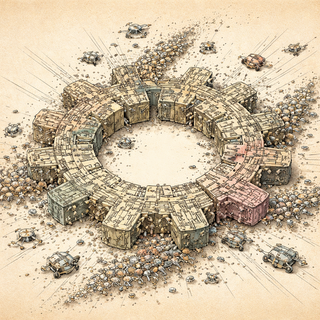
Here is the clever bit. Under one wavelength of light, the algae-based robots gather into swarms. Under another, they disperse. By projecting light through masks, the team could make the swarm form different shapes and move those shapes around. Blue and red light became a remote control for collective behavior, which is a strong sentence to be able to say with a straight face [1].
Why This Is Hard, and Why Anyone Cares
At the microscale, physics is rude. Water behaves less like a swimming pool and more like cold honey. Diffusion is slow when you need something delivered precisely, and steering tiny devices through messy biological environments is a nightmare in a lab coat. One microrobot alone can carry only so much, move only so strategically, and generally has the operational capacity of a very ambitious breadcrumb.
That is why swarming matters. A swarm can cover more area, carry more stuff, and adapt as a group. Reviews in the field have been making this case for a while: collective behavior is one of the most promising ways to make micro/nanorobots actually useful outside PowerPoint [2,3]. If a single microrobot is a freelancer, a swarm is a logistics company with a suspiciously good burn rate.
This new paper tackles a core bottleneck: not just making tiny robots move, but making them assemble, reconfigure, and disassemble in a programmable way without toxic chemical fuels [1]. That is a real moat. Not a VC moat, obviously. More of a "please survive contact with real tissue" moat.
The Wound-Care Angle Is the Real Demo Day
The flashiest proof-of-concept was wound targeting. The team used an AI-assisted system to identify wound geometry and generate the light patterns needed to steer the swarm into the exposed area, where the particle cargo could be delivered [1]. That is the part where this stops being a cool microscopy video and starts sounding like an early demo for adaptive bandages or localized therapy platforms.
And this is not coming out of nowhere. Closely related work has already shown algae-based biohybrid microrobots delivering drug-loaded nanoparticles into mouse lungs to fight metastatic tumors [4]. Another 2025 study pushed picoeukaryote-based biohybrid microrobots into the kidney, which is basically microrobotics on hard mode because the spaces are tiny and the fluid flow is not there to help [5]. A 2026 Matter paper from overlapping authors also showed that combining light and magnetic control can sort and steer different algae-based microrobots independently [7].
In startup terms, the flywheel is obvious: better control leads to better targeting, which makes the robots more useful, which justifies better payload design, which makes control even more valuable. Somebody is absolutely pitching "programmable living micro-delivery infrastructure" over coffee right now.
Before We Start Valuing the TAM of All Wounds on Earth
There are still serious limitations. A proof-of-concept on model systems is not the same thing as reliable therapy in a living human body. Real wounds are wet, irregular, inflamed, and biologically chaotic. Light penetration is limited. Manufacturing consistent biohybrid swarms at scale is hard. Long-term safety, immune interactions, and precise dose control still need much more work [2,3].
There is also a deeper question: can these swarms stay robust when the environment stops cooperating? Lab lighting patterns are one thing. Tissue, mucus, blood flow, and patient-to-patient variability are another. Microrobots, like every ambitious founder, look amazing in the deck and get judged in production.
Still, this paper earns attention because it shows something you can actually imagine extending. Not magic. Not sci-fi wallpaper. A controllable swarm of living microrobots that can gather, reshape, and deliver cargo where diffusion alone would struggle. That is a strong zero-to-one move for the field.
References
-
de la Asunción-Nadal V, Nisula C, Cuntín-Abal C, et al. Light-switchable swarming of biohybrid microrobots. Science Advances. 2026;12:eaed0994. DOI: 10.1126/sciadv.aed0994
-
Law J, Yu J, Tang W, et al. Micro/Nanorobotic Swarms: From Fundamentals to Functionalities. ACS Nano. 2023;17(14):12971-12999. DOI: 10.1021/acsnano.2c11733. PMID: 37432675
-
Zarepour A, Khosravi A, Iravani S, Zarrabi A. Biohybrid Micro/Nanorobots: Pioneering the Next Generation of Medical Technology. Advanced Healthcare Materials. 2024;13(31):e2402102. DOI: 10.1002/adhm.202402102. PMCID: PMC11650542
-
Li Z, Wang D, Luan H, et al. Biohybrid microrobots locally and actively deliver drug-loaded nanoparticles to inhibit the progression of lung metastasis. Science Advances. 2024;10:eadn6157. DOI: 10.1126/sciadv.adn6157. PMID: 38865468
-
Li Z, Wang D, Luan H, et al. Picoeukaryote-based biohybrid microrobots for active delivery in the kidney. Science Advances. 2025;11(28). DOI: 10.1126/sciadv.adw8578
-
Harris EH. A Series of Fortunate Events: Introducing Chlamydomonas as a Reference Organism. Plant Cell. 2001;13(10):2211-2215. DOI: 10.1105/tpc.13.10.2211
-
de la Asunción-Nadal V, et al. Photo-magnetically actuated biohybrid microrobots. Matter. 2026;9(2):102531. DOI: 10.1016/j.matt.2025.102531
Disclaimer: This blog post is a simplified summary of published research for educational purposes. The accompanying illustration is artistic and does not depict actual model architectures, data, or experimental results. Always refer to the original paper for technical details.