Google DeepMind unleashed GNoME and predicted 2.2 million new crystal structures through sheer brute-force deep learning, essentially throwing a massive neural network at the periodic table and seeing what stuck (Merchant et al., Nature, 2023). Meanwhile, a team led by Yongxin Lyu and collaborators at City University of Hong Kong looked at that approach and said: what if, instead of predicting everything and hoping for the best, we started with what we want and worked backwards to the molecule that delivers it?
That philosophical reversal - from "here's a material, what does it do?" to "here's a property, what material gives it to me?" - is the beating heart of their new paper in Science Advances (Lyu et al., 2025). And the way they pulled it off is quietly brilliant.
The Molecular ID Card Nobody Thought to Create
The team works with two-dimensional hybrid perovskites, specifically the Dion-Jacobson variety. Think of these as crystalline layer cakes: sheets of metal and halide atoms stacked neatly, with organic molecules wedged between them like filling. Those organic "spacers" aren't just structural glue - they fundamentally control the material's electronic behavior, dictating how light gets absorbed and where electrons go (Ahmad et al., Joule, 2019).
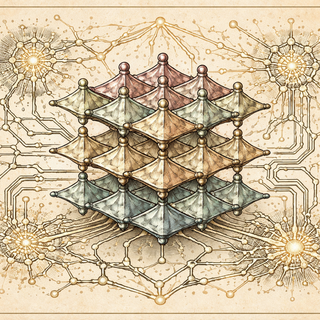
The problem? There are millions of possible organic spacer molecules, and the field has been picking them the way you pick wine at a restaurant - a mix of educated guessing, prior experience, and hoping you don't embarrass yourself. Only about 21 spacers have actually been tested in DJ perovskites, which is like exploring a continent by visiting three cities and calling it a day.
So the researchers created what amounts to a molecular fingerprint system: a compact 12-digit code that captures the essential physical character of any conjugated diammonium spacer. Molecular weight, conjugation length, electronic structure, geometric features - all distilled into a vector that's both machine-readable and, critically, invertible. That last word matters enormously. Most molecular representations are one-way streets: you can turn a molecule into numbers, but you can't easily go from numbers back to a molecule. This fingerprint works in both directions, which means a machine learning model can dream up an ideal fingerprint and the researchers can decode it back into an actual, synthesizable chemical structure.
Four Million Candidates, Whittled Down by AI
Armed with this fingerprint scheme, the team generated representations for roughly four million hypothetical spacer molecules. Then came the pipeline: high-throughput density functional theory calculations to compute electronic properties, interpretable machine learning to map fingerprints to energy level alignment, and a synthesis feasibility filter to ensure the surviving candidates weren't just theoretically perfect but actually makeable in a lab.
The goal was specific and pragmatic - finding spacers that produce a particular type of energy level alignment between the organic and inorganic layers. This alignment determines whether charge carriers get trapped or flow freely, which is the difference between a material that looks promising on paper and one that actually works in a solar cell or LED.
What makes this philosophically interesting is the question of representation itself. In an era when deep learning models happily consume raw atomic coordinates or SMILES strings, this team argued that how you describe a molecule to an algorithm matters as much as what the algorithm does with it. A physically meaningful, compact representation outperformed the kitchen-sink approach - fewer features, more insight. There's something almost epistemological about it: the model doesn't need to know everything about a molecule, just the right things.
Why This Matters Beyond the Lab
Two-dimensional perovskites are already reshaping the solar energy landscape, with 2D/3D hybrid devices pushing toward 30% efficiency while solving the notorious stability problems that plague pure 3D perovskites (Key Advancements and Emerging Trends of Perovskite Solar Cells in 2024-2025, Nano-Micro Letters, 2025). Another recent Science paper used a similar inverse-design philosophy to discover hole-transport materials hitting 26.2% certified efficiency (Wang et al., Science, 2024). The trend is clear: AI-driven materials design is shifting from forward prediction to targeted creation.
But the deeper implication is about how we navigate chemical space itself. If you can compress a molecule's identity into a meaningful fingerprint and then invert it, you've built a translation layer between human intent and molecular reality. The researchers screened four million possibilities with a workflow that a single lab group could run - no billion-dollar compute cluster required.
For anyone who's ever tried to organize complex information visually - say, mapping the relationships between molecular features and material properties - tools like mapb2.io offer a sense of how visual thinking can untangle multidimensional problems, even outside the lab.
If a 12-digit code can capture the soul of a molecule well enough to design materials we've never seen before, it raises a question worth sitting with: what other vast, unexplored spaces are we ignoring simply because we haven't found the right way to describe them yet?
References:
-
Lyu, Y., Zhou, Y., Zhang, Y., Yang, Y., Zou, B., Weng, Q., Xie, T., Cazorla, C., Hao, J., Yin, J., & Wu, T. (2025). Fingerprinting organic molecules for the inverse design of two-dimensional hybrid perovskites with target energetics. Science Advances. DOI: 10.1126/sciadv.aeb4144
-
Merchant, A., Batzner, S., Schoenholz, S.S., et al. (2023). Scaling deep learning for materials discovery. Nature, 624, 80-85. DOI: 10.1038/s41586-023-06735-9
-
Wang, Z., et al. (2024). Inverse design workflow discovers hole-transport materials tailored for perovskite solar cells. Science, 386, 1256-1264. DOI: 10.1126/science.ads0901
-
Ahmad, S., Fu, P., Yu, S., et al. (2019). Dion-Jacobson Phase 2D Layered Perovskites for Solar Cells with Ultrahigh Stability. Joule, 3(3), 794-806. DOI: 10.1016/j.joule.2018.11.026
-
Key Advancements and Emerging Trends of Perovskite Solar Cells in 2024-2025. (2025). Nano-Micro Letters. DOI: 10.1007/s40820-025-02022-6
-
Chen, Z., et al. (2025). Design guidance and band gap prediction of two-dimensional hybrid organic-inorganic perovskites by ensemble learning and graph convolutional neural network. Digital Discovery. DOI: 10.1039/D5DD00163C
Disclaimer: This blog post is a simplified summary of published research for educational purposes. The accompanying illustration is artistic and does not depict actual model architectures, data, or experimental results. Always refer to the original paper for technical details.