You have shuffled across a carpet, touched a doorknob, and received a tiny lightning bolt from the universe for your trouble. Congratulations: you have personally experienced the same basic physics that researchers now want to turn into wearable sensors, smart health monitors, gesture controllers, and AI-assisted human-machine interfaces. On one hand, this is delightful. On the other hand, your hoodie may be one grant cycle away from judging your posture.
The review by Ra, Cho, Guo, Choi, and Lee looks at triboelectric wearable sensors: devices that use contact, rubbing, pressure, bending, or motion to generate electrical signals from the body itself. The paper’s big idea is not just “wearables, but sparky.” It is that self-powered sensing, artificial intelligence, neuromorphic hardware, and human-machine interfaces are beginning to merge into systems where your movements become both the input signal and, sometimes, part of the power supply.
That is a lot to put on a sleeve.
Static Shock Gets a Promotion
The triboelectric effect is the charge transfer that happens when materials touch, slide, or separate. It is why a balloon can stick to a wall, why socks fresh from the dryer behave like they joined a tiny cult, and why a triboelectric nanogenerator, or TENG, can convert mechanical motion into electricity.
For wearables, this is handy because humans are basically ambulatory motion factories. We tap, blink, walk, breathe, gesture, grimace, swallow, type, and fidget like caffeinated metronomes. A TENG-based sensor can turn some of that mechanical activity into electrical patterns. Those patterns can then represent pressure, joint movement, gait, pulse, touch, or gestures.
The review emphasizes that TENGs are appealing because they can be made flexible, textile-friendly, skin-mounted, stretchable, and sometimes biodegradable. They also work well with low-frequency human motion, which is useful because most of us do not vibrate at industrial motor speeds unless the coffee situation has gone badly wrong.
The AI Part: Because Raw Wiggles Need Translation
A wearable sensor does not automatically “understand” that your finger bend means “turn on the lamp,” “select menu item,” or “please stop the robot arm before it rearranges my furniture.” It produces signals. Messy signals. Human signals. The kind of signals that vary by sweat, skin, speed, placement, mood, humidity, and whether the device is still attached after lunch.
That is where machine learning enters, wearing the slightly haunted expression of someone asked to make sense of all this.
Recent work has shown deep learning models classifying triboelectric gesture signals with high accuracy in controlled settings. One 2025 ACS Omega study used a triboelectric sensor ring and a one-dimensional CNN to recognize 12 gestures with over 95% accuracy. Another 2026 arXiv preprint compared machine learning and deep learning models for a TENG-based sign-language glove, with a CNN-LSTM approach outperforming classical models across 11 sign classes.
On one hand, that is genuinely useful for assistive technology, VR controls, rehabilitation, smart homes, and robotics. On the other hand, the phrase “my ring is running a neural network to interpret my vibes” sounds like something a cyberpunk barista would say before charging you $18.
From Wearable Sensors to Body-Centered Interfaces
The review’s most interesting move is its framing: these are not just sensors strapped to humans. They are “human-centric smart electronics,” meaning the system stays anchored to human-originated input, interpretation, feedback, or control.
That matters. A smartwatch usually needs a battery, a processor, and cloud-connected software to do its thing. A triboelectric wearable might sense a motion and generate its own signal from the motion itself. Pair that with embedded AI or edge computing, and you get a device that could recognize a gesture, detect a gait change, control a prosthetic, interact with a robot, or monitor health without constantly begging a battery for mercy.
The paper also discusses triboelectric artificial synapses and neuromorphic computing. Translation: instead of sending every sensor reading to a conventional processor, some future devices may process signals in hardware that behaves more like neural systems, using event-driven, low-power computation. On one hand, elegant. On the other hand, we are teaching fabrics to have reflexes, and I am choosing to be only moderately alarmed.
The Annoying Little Problems Called Reality
The catch is that wearable triboelectric systems still face hard problems. Materials degrade. Signals drift. Sweat and humidity interfere. Devices must survive bending, washing, stretching, and the ancient human ritual of forgetting the thing in a gym bag. AI models trained on clean lab data may stumble when used by different people in the real world.
There is also the reproducibility problem. A gesture-recognition model that works beautifully for 10 volunteers in a controlled study is promising, but not the same as a robust consumer or medical device. Real bodies are noisy. Real environments are rude. Real users do not perform gestures like carefully calibrated lab wizards.
Still, the direction is compelling. If these systems mature, they could make wearables lighter, more energy-efficient, and more natural to use. Imagine rehabilitation sleeves that track recovery without daily charging, smart gloves that help control robots or prosthetics, shoes that flag gait changes, or VR controllers woven into fabric instead of clutched like plastic TV remotes from the future.
On one hand, that sounds empowering. On the other hand, every object around you slowly becoming an interface does raise the question: when your shirt can talk to your thermostat, who exactly is in charge here?
References
-
Yoonsang Ra, Sumin Cho, Xinge Guo, Dongwhi Choi, Chengkuo Lee. “Triboelectric Wearable Sensors for Human-Centric Smart Electronics: From Self-Powered Sensing to Artificial Intelligence-Assisted Human-Machine Interface Systems.” Nano-Micro Letters, 2026. DOI: 10.1007/s40820-026-02263-z. PMID: 42301576
-
Guangrui Mu et al. “Recent advancements in wearable sensors: integration with machine learning for human-machine interaction.” RSC Advances, 2025. DOI: 10.1039/D5RA00167F
-
Yifeng Su et al. “Exploration of Advanced Applications of Triboelectric Nanogenerator-Based Self-Powered Sensors in the Era of Artificial Intelligence.” Sensors, 2025. DOI: 10.3390/s25082520
-
Ping Zhang, Weimeng Pan, Zhihao Li, Baocheng Liu. “Deep Learning-Assisted Triboelectric Sensor for Complex Gesture Recognition.” ACS Omega, 2025. DOI: 10.1021/acsomega.4c10150
-
Meshv Patel, Bikash Baro, Sayan Bayan, Mohendra Roy. “Development of ML model for triboelectric nanogenerator based sign language detection system.” arXiv, 2026. arXiv:2604.06220
-
Xiaoliang Chen et al. “Triboelectric nanogenerators as wearable power sources and self-powered sensors.” National Science Review, 2023. Article link
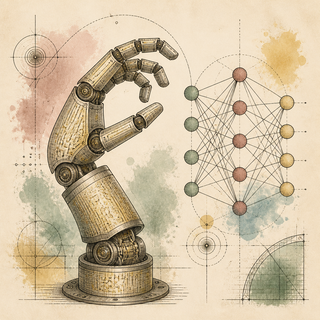
Disclaimer: This blog post is a simplified summary of published research for educational purposes. The accompanying illustration is artistic and does not depict actual model architectures, data, or experimental results. Always refer to the original paper for technical details.