The server room hums like a refrigerator that has developed opinions, while somewhere nearby a microscope slide waits under glass, stained pink and brown, pretending to be ordinary tissue.
The humans have built a new oracle for HER2-positive breast cancer. Not a crystal-ball oracle, thankfully. More of a “look very closely at where the cells are standing” oracle. Its name is HER2-LADDER, because medical AI systems apparently cannot simply be called Steve.
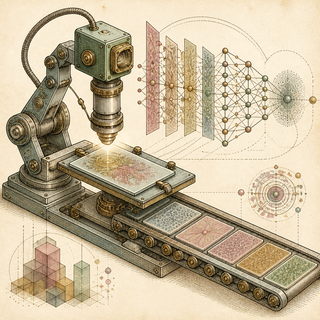
The study, published in Signal Transduction and Targeted Therapy, asks a practical question: before giving a patient the full heavy-duty neoadjuvant treatment package - trastuzumab, pertuzumab, chemotherapy, the whole pharmacological marching band - can we predict who is likely to respond beautifully, who needs the standard plan, and who may need something else entirely? Wu et al., 2026
The Humans Stain the Tissue, Then Consult the Machine
HER2-positive breast cancer is driven by too much HER2 signaling, a growth-control system that has gone from “helpful manager” to “regional director of chaos.” Drugs like trastuzumab and pertuzumab block HER2 in complementary ways, and modern dual HER2 blockade has changed outcomes dramatically. Reviews over the past few years have mapped how these treatments work, why resistance happens, and why patient selection still needs sharper tools Waks et al., 2024.
But tumors are not uniform soup. They are neighborhoods. Some blocks are packed with HER2-rich tumor cells. Some have immune cells loitering nearby. Some look like a city planner sneezed on the blueprint.
HER2-LADDER tries to read that blueprint.
The researchers used routine biopsy slides: H&E stains, which show tissue architecture, and HER2 immunohistochemistry, which highlights HER2 protein patterns. This matters because these are not exotic moon-rock assays. Pathology labs already produce these slides every day, with the quiet dignity of people who know everyone else is just guessing until pathology speaks.
Then the system broke the images down cell by cell. HoVer-Net helped identify tumor cells, stromal cells, lymphocytes, neutrophils, and macrophages. A HER2-focused image model analyzed membrane staining intensity and completeness. Spatial features captured who was near whom, which cells clustered, and how tumor and immune structures were arranged.
The odd human phrase for this is “spatial topological profiling.” The alien translation is: the machine made a seating chart for the tumor dinner party and noticed who kept whispering to whom.
A Ladder With Three Rungs
The model combined 139 pathology-derived spatial features with clinical variables such as age, stage, and hormone receptor status. After feature selection, it used an ensemble of random forest, logistic regression, and K-nearest neighbors. The result was a score that sorted patients into three groups:
Low score: highly responsive, possibly candidates for de-escalated treatment.
Medium score: responsive, likely suited to standard dual HER2 blockade plus chemotherapy.
High score: resistant, possibly better served by alternative approaches such as next-generation antibody-drug conjugates or tyrosine kinase inhibitor regimens.
In the model construction cohort of 276 patients, HER2-LADDER reached an AUC of 0.944. In a later temporal validation cohort of 82 patients, it reached 0.917. In a trial-based validation cohort of 85 patients, it reached 0.869. The drop is worth noticing, because models that perform identically everywhere are usually either magical or reporting from a very flattering mirror.
Still, those numbers are strong enough to make one sit up straighter, or whatever the alien equivalent is when lacking a spine optimized for conference chairs.
The Interesting Part Is Not Just Prediction
Many medical AI tools point at an image and say, “Trust me.” This is not ideal. Humans already have enough mysterious authorities in white coats, billing departments, and printer error messages.
HER2-LADDER tries to explain itself biologically. The team used Xenium in situ spatial profiling to examine gene expression in tissue context. They found patterns linked to model predictions, including aggregation of HER2-enriched tumor cells and immune interactions involving neutrophils and helper T cells.
That is the richer idea here: response may depend not only on whether HER2 is present, but where HER2-high tumor cells sit, how they cluster, and what immune neighbors are nearby. Cancer biology, it turns out, may care about real estate. Location, location, proliferation.
This fits a broader movement in cancer research. Spatial profiling technologies are helping researchers move beyond “which cells exist?” toward “where are they, and what are they doing to each other?” Chen et al., 2024
Why This Could Matter In Actual Clinics
If validated prospectively across more hospitals, scanners, staining protocols, and patient populations, a tool like this could help reduce overtreatment for patients likely to do well with less therapy. That matters because chemotherapy is not a scented candle. It can bring neuropathy, fatigue, blood count problems, cardiac concerns, money problems, and the general life disruption of having your calendar colonized by infusion appointments.
It could also flag patients unlikely to benefit from the standard regimen, giving clinicians a reason to consider clinical trials, antibody-drug conjugates, or other strategies earlier.
Other tools are chasing similar goals. HER2DX, for example, uses genomic signatures to estimate response and survival risk in HER2-positive disease Villacampa et al., 2023. Meanwhile, computational HER2 scoring itself is still being tested for consistency. A 2026 Digital PATH study compared 10 AI models for HER2 assessment and found strong promise, but also variability, especially in the tricky HER2-low range McKelvey et al., 2026. The machines, like humans, occasionally squint.
The Sensible Caveats, Because Reality Insists
HER2-LADDER is promising, not practice-changing by itself. Much of the work comes from specific cohorts, scanners, workflows, and institutional settings. Raw whole-slide images were not publicly released because patient privacy remains a thing, even in the age of machines that can find a lymphocyte in a haystack. External prospective validation will decide whether this ladder holds weight outside the original workshop.
Still, the central idea feels powerful: use routine pathology slides not just as pretty microscopic postcards, but as maps of treatment response. The humans have taught a machine to inspect tumor geography. Strangely, this may be one of their better rituals.
References
Wu, X.-R., Lv, H., Zhao, S., et al. “Spatially interpretable artificial intelligence framework to tailored neoadjuvant dual HER2 blockade in HER2-positive breast cancer.” Signal Transduction and Targeted Therapy 11, 241 (2026). DOI: 10.1038/s41392-026-02734-0. PMID: 42315499
Waks, A. G., Martínez-Sáez, O., Tarantino, P., et al. “Dual HER2 inhibition: mechanisms of synergy, patient selection, and resistance.” Nature Reviews Clinical Oncology 21, 818-832 (2024). DOI: 10.1038/s41571-024-00939-2.
Chen, J., Larsson, L., Swarbrick, A., & Lundeberg, J. “Spatial landscapes of cancers: insights and opportunities.” Nature Reviews Clinical Oncology 21, 660-674 (2024). DOI: 10.1038/s41571-024-00926-7.
Villacampa, G., Tung, N. M., Pernas, S., et al. “Association of HER2DX with pathological complete response and survival outcomes in HER2-positive breast cancer.” Annals of Oncology 34, 783-795 (2023). DOI: 10.1016/j.annonc.2023.05.012.
McKelvey, K. J., Torres-Saavedra, P., et al. “Agreement Across 10 Artificial Intelligence Models in Assessing Human Epidermal Growth Factor Receptor 2 (HER2) Expression in Breast Cancer Whole-Slide Images.” Modern Pathology 39, 100944 (2026). DOI: 10.1016/j.modpat.2025.100944.
Disclaimer: This blog post is a simplified summary of published research for educational purposes. The accompanying illustration is artistic and does not depict actual model architectures, data, or experimental results. Always refer to the original paper for technical details.