If your apartment wall could slurp up spare solar power at breakfast, dump it into your e-bike before lunch, and still behave like a respectable piece of infrastructure, I would usually mark that spec as "needs clarification." After reading Wang, Samartzis, Wang, and Dai's review of synthetic porous carbons for supercapacitors, I am not approving the wall-battery fantasy yet, but I am reopening the ticket [1].
Blocking: Batteries Are Slow, Capacitors Are Hungry
Supercapacitors sit in the awkward middle seat between regular capacitors and batteries. They charge fast, discharge fast, and survive absurd numbers of cycles. Very useful. Also annoying: they usually store much less energy than batteries. Classic engineering tradeoff. The universe looked at "fast" and "lots" and said, "pick one, junior."
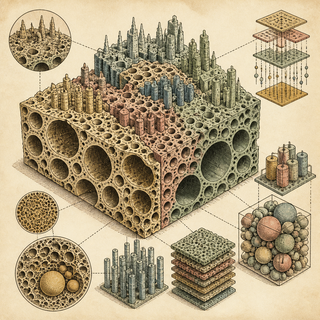
Most carbon supercapacitors store charge at the surface, where electrolyte ions line up against an electrode like commuters waiting at a train door. This is called electric double-layer capacitance. Add certain chemical sites and you can also get pseudocapacitance: fast, reversible surface reactions that add extra charge storage without turning the whole thing into a battery soap opera.
The review's core point is clean: better supercapacitors need carbon architectures that are not just "very porous," but deliberately porous. Micropores store charge. Mesopores move ions. Macropores help traffic. If you only maximize surface area, congratulations, you made a nano-maze with terrible signage.
Nice Patch: Pores With A Job Description
Wang and colleagues focus on synthetic porous carbons, especially those made from well-defined molecular and polymeric precursors [1]. Translation: instead of burning random stuff and hoping the char is useful, chemists start with molecules that give them more control over pore size, connectivity, and surface chemistry.
This matters because a carbon electrode is not a black sponge in the casual kitchen sense. It is more like a microscopic city. Tiny apartments for ions, wider roads for movement, and chemical storefronts where charge-transfer reactions can happen. Bad urban planning gives you dead-end pores, wasted volume, and ions stuck in traffic muttering about public infrastructure.
Recent work backs up that design-first view. A 2024 Science paper found that structural disorder, not just pore size, strongly correlates with capacitance in nanoporous carbons [3]. Nit: "disorder helps" is the kind of result that sounds like an excuse from a messy developer, but the data make the case. Meanwhile, a 2026 Nature Materials study showed that pore-network tortuosity controls fast charging [4]. In other words, it is not enough to have pores. The ions need paths that do not resemble a legacy codebase with no comments.
The ML Intern Gets One Good Commit
The AI angle here is not a chatbot writing electrolyte fan fiction. It is machine learning used as a materials scout. Researchers feed models past experimental data - surface area, pore distributions, oxygen and nitrogen content, electrolyte type, capacitance - and ask which combinations look worth synthesizing.
That approach has already produced useful results. A 2023 Nature Communications paper used machine learning to guide the discovery of oxygen-rich, highly porous carbon materials for aqueous supercapacitors, reporting a specific capacitance around 610 F/g in sulfuric acid electrolyte [2]. That is the kind of number that makes materials chemists quietly check the methods section twice.
Still, blocking comment: ML only helps if the dataset is sane. Published materials data can be sparse, inconsistent, and decorated with enough experimental variation to make a spreadsheet cry. Reviews of ML for batteries and supercapacitors keep flagging the same issues: limited data, high-dimensional feature spaces, and models that can overfit harder than a junior engineer optimizing for one benchmark [6].
Heteroatoms: Tiny Dopants, Big Opinions
The review also spends serious time on heteroatom doping: adding atoms like nitrogen, oxygen, sulfur, or phosphorus into carbon. These atoms can improve wettability, tune electronic structure, and create pseudocapacitive sites. Nit: this is powerful, but not free. Too much chemistry can reduce stability, block pores, or create side reactions. Clever but unmaintainable if you ship it without lifetime testing.
The best designs balance several things at once: high accessible surface area, fast ion transport, enough conductivity, stable surface groups, scalable synthesis, and realistic electrode thickness. That last one matters. A heroic result on a dusting of active material is not the same as a practical device. Lab metrics with tiny mass loadings are the demo branch, not production.
Approved With Reservations
If this field gets the recipe right, the payoff is not "batteries are cancelled." Please stop filing that ticket. The better story is hybrid energy storage: supercapacitors handling bursts, braking recovery, power smoothing, backup pulses, grid buffering, and electronics that need quick dumps of power without aging like milk in August.
The broader trend is also getting less absurd in the real world. Carbon-cement supercapacitor work has pushed the idea of structural materials that store energy, which makes the wall-with-a-side-hustle premise feel slightly less like sci-fi and slightly more like civil engineering with a mischievous streak.
Final review: Wang and colleagues do not present a single magic electrode. They map the design space and point toward better abstractions: bottom-up synthesis, hierarchy in pore networks, controlled surface chemistry, operando characterization, and ML-guided screening. LGTM conceptually. Needs scale-up, standard testing, better datasets, and fewer papers pretending one flattering Ragone plot is a business plan.
References
-
Wang, F.; Samartzis, N.; Wang, T.; Dai, S. "Synthetic Porous Carbons for High-Energy, High-Power Supercapacitors." Chemical Reviews, 2026. DOI: 10.1021/acs.chemrev.6c00037. PMID: 42383893.
-
Wang, T. et al. "Machine-learning-assisted material discovery of oxygen-rich highly porous carbon active materials for aqueous supercapacitors." Nature Communications 14, 4607, 2023. DOI: 10.1038/s41467-023-40282-1.
-
Liu, X. et al. "Structural disorder determines capacitance in nanoporous carbons." Science 384, 321-325, 2024. DOI: 10.1126/science.adn6242.
-
Kress, T.; Liu, X.; Forse, A. C. "Pore network tortuosity controls fast charging in supercapacitors." Nature Materials 25, 440-446, 2026. DOI: 10.1038/s41563-025-02404-6.
-
Pan, Z. et al. "Recent Advances in Porous Carbon Materials as Electrodes for Supercapacitors." Nanomaterials 13, 1744, 2023. DOI: 10.3390/nano13111744.
-
Jha, S. et al. "Machine learning-assisted materials development and device management in batteries and supercapacitors: performance comparison and challenges." Journal of Materials Chemistry A 11, 3904-3936, 2023. DOI: 10.1039/D2TA07148G.
Disclaimer: This blog post is a simplified summary of published research for educational purposes. The accompanying illustration is artistic and does not depict actual model architectures, data, or experimental results. Always refer to the original paper for technical details.