16. That is how many direct service points Sony's table-tennis robot Ace scored against elite human players in the Nature study, which is the sort of statistic that makes you put your coffee down and stare at the wall for a second. Not because a robot won a few ping-pong points. Because table tennis is nasty. The ball moves fast, spins like it has unresolved anger, and gives you barely enough time to think, "ah, this seems bad," before it is already past you. And now a machine can handle that chaos well enough to beat elite players under official rules. On one hand, incredible. On the other hand, I would like all household appliances to stay humble.
Ping-pong, but make it existential
Ace is not a cute toy with a plastic paddle. It is a high-speed robotic system built to see, predict, move, and hit in milliseconds. In matches against five elite players and two professionals, Ace won 3 of 5 matches against the elite group and even stayed competitive against pros. It also returned shots up to 14 meters per second consistently, with more than a 75% return rate for spins up to 450 radians per second (Dürr et al., 2026).
That matters because table tennis is one of those tasks that looks easy until you try it and immediately begin negotiating with physics. A lot of AI triumphs live on screens. Beat a board game champion? Impressive. Beat a racing game champion? Also impressive. Beat a human in a real-world sport where the ball can clip the net, spin weirdly, and turn your timing into soup? That is a different flavor of trouble.
Nature's accompanying News & Views put it nicely: this is evidence that autonomous systems can handle complex, fast, interactive physical tasks, not just neat lab demos with the difficulty settings turned down (Ribeiro and Colombini, 2026).
The robot did not "want it more"
Ace works by combining high-speed perception with reinforcement learning. Reinforcement learning, for the non-robotics gremlins among us, is the setup where an agent learns by trial and error, chasing rewards and avoiding failure. Think less "robot studies textbook" and more "digital athlete develops habits by being repeatedly humbled in simulation until it stops doing the dumb thing" (Wikipedia, Reinforcement Learning).
The perception side is a big deal too. Ace uses event-based vision sensors, which do not behave like ordinary cameras snapping whole frames at fixed intervals. They focus on changes in the scene, which helps when your target is a tiny white ball moving like it owes money. That kind of sensing has been reviewed as especially useful for high-speed, low-latency tasks (Gallego et al., 2022).
The weirdly charming part is that Ace does not win by becoming some titanium version of a power hitter. The paper reports that humans mostly won points with especially fast topspin attacks, while Ace's "returned" and "won" shots looked more similar. In plain English: the robot won by being annoyingly consistent. Which, frankly, is how many of us lose to that one person at the office league.
Why this feels bigger than sports
On one hand, this is "just" table tennis. On the other hand, it is a brutal benchmark for real-world AI. To succeed, the system has to track an object, estimate spin, predict trajectories, plan movement, avoid collisions, and execute precise control in fractions of a second. That bundle of skills shows up in places far less fun than ping-pong.
The authors explicitly point to manufacturing and service robotics as next targets (Dürr et al., 2026). If a robot can handle a spiteful little spinning ball in real time, maybe it can also handle fast sorting, delicate handoffs, or reactive manipulation around humans. Maybe. That "maybe" is doing a lot of work here, but still.
Recent robot table-tennis work shows how fast this field is moving. Google DeepMind reported amateur human-level competitive robot table tennis in 2024, using a hierarchical policy setup and real-time adaptation to unseen opponents (D'Ambrosio et al., 2024). A 2025 preprint called HITTER pushed toward humanoid table tennis with whole-body control and rallies of up to 106 consecutive shots (Su et al., 2025). The road from "robot can kind of rally" to "robot can beat elite players" suddenly looks less like a road and more like a skateboard ramp.
The part where we keep our heads
Before anyone declares the age of robot Federer, a few brakes are needed. Ace is specialized hardware in a controlled setup. It is not a general sports genius. It lost both April 2025 matches against professional players in the main study, even if later reporting suggests the system improved after submission. And table tennis, for all its chaos, is still a narrower problem than, say, folding laundry in a cluttered apartment, which remains one of the universe's meanest trick questions for robotics.
Still, the unsettling part is real. Physical AI is escaping the screen. The overworked interns doing all the actual math, also known as GPUs, are no longer just helping models write emails and generate cursed headshots. They are helping machines react in the world at human timescales. On one hand, that could make robots genuinely useful in factories, labs, and maybe one day hospitals. On the other hand, your last comforting thought, "well, at least they can't handle spin," has now been deleted.
References
Dürr P, et al. Outplaying elite table tennis players with an autonomous robot. Nature. 2026;652:886-891. DOI: 10.1038/s41586-026-10338-5
Ribeiro CHC, Colombini E. Robot can beat elite players at table tennis. Nature. 2026;652:864-865. DOI: 10.1038/d41586-026-01045-2
D'Ambrosio DB, et al. Achieving Human Level Competitive Robot Table Tennis. arXiv. 2024. arXiv:2408.03906
Su Z, et al. HITTER: A HumanoId Table TEnnis Robot via Hierarchical Planning and Learning. arXiv. 2025. arXiv:2508.21043
Gallego G, et al. Event-based vision: a survey. IEEE Trans Pattern Anal Mach Intell. 2022;44(1):154-180. DOI: 10.1109/TPAMI.2020.3008413
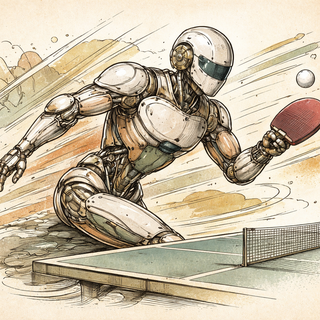
Disclaimer: This blog post is a simplified summary of published research for educational purposes. The accompanying illustration is artistic and does not depict actual model architectures, data, or experimental results. Always refer to the original paper for technical details.