Ten years ago, researchers tried teaching computers to spot cancer like tireless apprentice pathologists. It didn't work. This paper explains why and fixes it.
Well, "fixes it" in the sober scientific sense: not with one magic spell, but with a map, a lantern, and several warnings about not letting the algorithm wander into the clinic wearing a fake mustache.
Rizwan and colleagues' new primer in the Journal of the National Cancer Institute is less a single experiment and more a field guide for clinicians and scientists entering the noisy bazaar of AI in cancer diagnostics. The authors cover digital pathology, medical imaging, liquid biopsy, genomics, electronic health records, clinical decision support, and the dragon everyone keeps pretending is merely a lizard: real-world implementation.
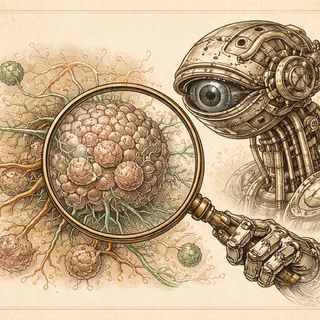
The Glass Slide Becomes a Crystal Ball
Cancer diagnosis has long depended on experts peering at tissue under microscopes. Digital pathology changes the stage: glass slides become enormous scanned images, sometimes gigapixel monsters so large your laptop would wheeze like a medieval cart full of anvils.
AI models can search these images for patterns: tumor cells, tissue architecture, immune cells, subtle visual clues linked to prognosis or treatment response. Modern foundation models such as CHIEF and Virchow-style pathology systems now learn from vast slide collections, then adapt to many tasks rather than one narrow trick. That matters because cancer is not one villain. It is a whole rogues' gallery with disguises, side quests, and terrible naming conventions.
The promise is not "the machine replaces the pathologist." The better version is: the model flags suspicious regions, measures features consistently, helps triage workload, and gives clinicians another set of eyes. Preferably eyes that do not need coffee.
Speaking of sharper images, browser tools like combb2.io use related image-enhancement ideas for ordinary photos. Pathology, of course, raises the stakes from "please rescue my blurry vacation picture" to "please do not hallucinate a biomarker."
The Blood Test Side Quest
The primer also enters the realm of liquid biopsy, where clinicians study tumor signals in blood rather than always cutting a new tissue sample. Circulating tumor DNA, or ctDNA, can reveal mutations, resistance patterns, and signs of minimal residual disease. Imagine a tumor shedding tiny plot spoilers into the bloodstream. Rude, but useful.
AI can help interpret these weak, messy signals. That is the key word: messy. Blood contains many biological whispers, not one trumpet blast. Models may combine mutation patterns, methylation, fragment sizes, protein markers, imaging, and clinical history to improve detection or monitoring.
If validated carefully, this could help doctors track whether treatment is working earlier than scans can. But the bard must now cough politely: early detection is hard. False positives can terrify healthy people, false negatives can falsely comfort sick people, and both outcomes are bad enough without a glossy AI brochure making promises in a velvet cape.
The Oracle Must Be Audited
The paper's most useful message is wonderfully unglamorous: deployment is the real trial. A model that performs beautifully in one hospital may stumble in another because scanners differ, stains differ, patient populations differ, and clinical workflows differ. Behold, the mighty benchmark beast is defeated by a slightly different shade of pink.
This is why reproducibility, external validation, calibration, bias testing, and prospective clinical studies matter. A model must prove not only that it can score well on historical data, but that it helps real clinicians make better decisions for real patients. The authors also stress interpretability, privacy, regulation, and keeping humans in the loop. In oncology, "trust me, bro" is not a validation strategy.
Clinical decision support adds another layer. AI may help summarize records, recommend trial matches, estimate risk, or suggest treatment options. But recommendations need context: comorbidities, patient preferences, available therapies, insurance realities, and the fact that medicine is practiced by people, not spreadsheets wearing stethoscopes.
Why This Primer Matters
This paper matters because it translates the kingdom's scattered prophecies into a usable map. For clinicians, it explains what AI can actually do. For data scientists, it explains why the clinic is not just a leaderboard with fluorescent lighting. For policy makers, it points to the gates that need guards: evidence, equity, safety, and accountability.
The most intriguing future is multimodal AI: systems that combine pathology slides, radiology scans, genomic data, liquid biopsy signals, lab values, notes, and treatment history. That could move cancer care toward more precise diagnosis and monitoring. Not because the model "understands cancer" like a wise old wizard, but because it can detect statistical patterns across more evidence than one person can comfortably juggle.
The quest is promising. The road is muddy. The horses are regulatory frameworks. And the treasure, if earned honestly, is not flashy automation. It is better decisions, earlier warnings, fewer missed clues, and more personalized care.
References
-
Rizwan AM, Makhlouf HR, Bharti S, et al. Artificial intelligence in cancer diagnostics: a primer for clinicians and scientists. Journal of the National Cancer Institute. 2026. DOI: 10.1093/jnci/djag143. PMID: 42097285.
-
Chen RJ, et al. Towards a general-purpose foundation model for computational pathology. Nature Medicine. 2024. DOI: 10.1038/s41591-024-02857-3.
-
Wang X, et al. A pathology foundation model for cancer diagnosis and prognosis prediction. Nature. 2024. DOI: 10.1038/s41586-024-07894-z.
-
Xu H, et al. A whole-slide foundation model for digital pathology from real-world data. Nature. 2024. DOI: 10.1038/s41586-024-07441-w.
-
Ma L, Guo H, Zhao Y, et al. Liquid biopsy in cancer: current status, challenges and future prospects. Signal Transduction and Targeted Therapy. 2024. DOI: 10.1038/s41392-024-02021-w.
Disclaimer: This blog post is a simplified summary of published research for educational purposes. The accompanying illustration is artistic and does not depict actual model architectures, data, or experimental results. Always refer to the original paper for technical details.