If researchers were allowed to title papers like mechanics write repair tickets, this one would be: "We popped the hood on a battery polymer and found lithium ions, electrons, and a nitrile chain all sharing the same timing belt."
The official title is more formal: Concerted Electron-Ion Transport by Polyacrylonitrile Elucidated with Reactive Deep Learning Potentials. Fair enough. Journals like their tuxedos pressed.
But the shop-floor version is better, because this paper is really about watching a polymer engine run under stress. The polymer is polyacrylonitrile, or PAN, a chain-like material already familiar in carbon fiber chemistry and battery electrolyte research. The authors wanted to understand how PAN moves charge when lithium ions and chemical reactions get involved. Not in the glossy brochure sense. In the "where exactly is the clunk coming from?" sense.
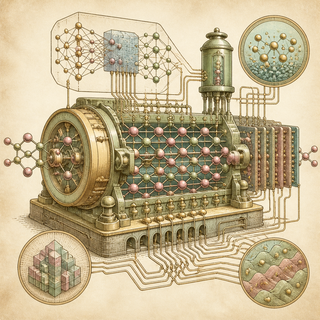
Pop the Hood: What Is PAN Doing?
PAN is a long molecular chain decorated with nitrile groups, those carbon-nitrogen triple-bond side parts that behave a bit like stiff little brackets bolted along the frame. In battery materials, PAN can coordinate lithium ions through those nitrile groups, which makes it relevant for polymer electrolytes and energy storage.
The headache is that polymers are not neat little machines sitting on a workbench. They wiggle, fold, stretch, snag on themselves, and generally behave like a drawer full of extension cords. Traditional simulations can either be accurate and tiny, like inspecting one bolt with a microscope, or larger and cheaper, like diagnosing an engine by listening from the driveway.
This study tries to get both: quantum-flavored accuracy without cooking the entire compute cluster until it smells like burnt toast.
The Deep Learning Wrench
Chahal-Crockett and colleagues built a reactive deep learning potential, trained on ab initio energies and forces from reactive PAN configurations DOI: 10.1021/jacs.6c05078, arXiv:2603.24798. Translation: they taught a neural network to estimate the forces between atoms well enough to simulate reactions where bonds form and break.
That matters because regular molecular dynamics often treats bonds like factory-installed parts that never come loose. Useful, but not when your whole question is whether the parts rearrange under load. Reactive machine learning potentials are the newer diagnostic scanner: not magic, occasionally fussy, but much better at catching fast chemical events without charging you quantum-mechanics labor rates for every second of simulation. Recent reviews have pointed to this exact sweet spot: reactive chemistry at larger scales than ab initio molecular dynamics can usually afford DOI: 10.1146/annurev-physchem-062123-024417.
The First Ring Is the Hard Start
Here is the mechanical sequence. Hydroxide, split from LiOH, attacks the terminal nitrile carbon on PAN. That first attack forms the first ring in a cyclization reaction. According to the paper, that first ring is the hard cold start, the part where the engine coughs twice and everyone in the garage goes quiet.
Once that first ring forms, the rest of the machine behaves differently. The authors report that this step triggers Li+-coupled electron transfer along the PAN backbone, and the following ring-forming steps run about 10,000 times faster.
That is not a minor tune-up. That is discovering the first gear was jammed, but once it catches, the transmission suddenly shifts like it owes you money.
The phrase "concerted electron-ion transport" means the lithium ion and electron movement are not separate errands. They are coupled. The ion helps shape the local chemistry, the electron redistribution helps the next reaction happen, and the polymer backbone carries the action forward. It is less like one courier delivering a package and more like a pit crew where nobody moves alone.
Shape Matters, Because Polymers Are Drama
The team also found that PAN works better in extended configurations, where dipole-dipole and hydrogen-bonding interactions are reduced. In plain terms: when the chain is stretched out instead of folded into a molecular traffic jam, the charge-transfer process can move more cleanly.
That matches earlier work from the same research group showing that deep learning interatomic potentials can connect PAN chain ordering to larger material properties like density and elastic modulus DOI: 10.1021/acsami.4c04491, PMID: 38958640. The polymer's shape is not cosmetic. It is the alignment, lubrication, and airflow all at once.
Battery researchers care because polymer electrolytes promise safer, more flexible energy storage systems, but ion transport remains one of the greasy, stubborn problems under the chassis. Reviews of polymer electrolytes keep circling the same issue: you want high ionic conductivity, stability, flexibility, and compatibility with electrodes, preferably without inventing a material that only works on the third full moon of a grant cycle DOI: 10.3390/polym15193907. Atomistic modeling and machine learning are becoming core tools for understanding these transport pathways in solid-state battery materials DOI: 10.1038/s41578-025-00817-y.
Why This Is Worth the Grease Under the Fingernails
The neat part is not just "AI helped chemistry," which is now such a common sentence it should come with a loyalty card. The useful part is that the model points to a design rule: polymer conformation can control coupled electron-ion motion during reactive transport.
If experiments and future simulations back this up across more PAN-like systems, chemists could design reactive polymers that conduct charge more efficiently by tuning chain structure, local coordination, and reaction pathways. Better battery electrolytes are the obvious target, but the broader lesson applies anywhere polymers need to move charge while their molecular parts are rearranging under the hood.
Limitations? Plenty. A learned potential is only as trustworthy as the chemical territory it has seen during training. The authors helped their case by validating computational predictions with IR and NMR experiments, but this is still a model-guided map, not the whole highway system. Scaling from simulated PAN segments to messy real devices will take more miles.
Still, this paper gives us a satisfying diagnosis: in PAN, the first chemical turn of the crank can unlock a fast, coupled charge-transfer run down the chain. Not bad for a polymer that looks, at first glance, like molecular spaghetti with nitrile accessories.
References
-
Rajni Chahal-Crockett, Michael D. Toomey, Logan T. Kearney, Yawei Gao, Joshua T. Damron, Amit K. Naskar, Santanu Roy. "Concerted Electron-Ion Transport by Polyacrylonitrile Elucidated with Reactive Deep Learning Potentials." Journal of the American Chemical Society, 2026. DOI: 10.1021/jacs.6c05078, PMID: 42227688, arXiv:2603.24798
-
Yinuo Yang, Shuhao Zhang, Kavindri D. Ranasinghe, Olexandr Isayev, Adrian E. Roitberg. "Machine Learning of Reactive Potentials." Annual Review of Physical Chemistry, 2024. DOI: 10.1146/annurev-physchem-062123-024417
-
Rajni Chahal, Michael D. Toomey, Logan T. Kearney, Ada Sedova, Joshua T. Damron, Amit K. Naskar, Santanu Roy. "Deep-Learning Interatomic Potential Connects Molecular Structural Ordering to the Macroscale Properties of Polyacrylonitrile." ACS Applied Materials & Interfaces, 2024. DOI: 10.1021/acsami.4c04491, PMID: 38958640
-
Ana C. C. Dutra, Benedek A. Goldmann, M. Saiful Islam, James A. Dawson. "Understanding solid-state battery electrolytes using atomistic modelling and machine learning." Nature Reviews Materials, 2025. DOI: 10.1038/s41578-025-00817-y
-
"Applications of Polymer Electrolytes in Lithium-Ion Batteries: A Review." Polymers, 2023. DOI: 10.3390/polym15193907
Disclaimer: This blog post is a simplified summary of published research for educational purposes. The accompanying illustration is artistic and does not depict actual model architectures, data, or experimental results. Always refer to the original paper for technical details.