The windows in this story are still windows, which is a useful thing for a window to remain.
That sounds obvious, but it is the little miracle hiding inside this paper. Baozhong Deng and colleagues are working on semitransparent organic photovoltaics, or ST-OPVs, which is the polite scientific way of saying “solar cells you can sort of see through.” These are meant for building-integrated photovoltaics: windows, façades, skylights, and other surfaces that usually just sit there collecting bird opinions and weather.
Now, back in my day, a solar panel knew its place. It sat on a roof, turned sunlight into electricity, and did not pretend to be architecture. But cities are full of glass, and glass is full of wasted sunshine. If we could turn some of that light into power while still letting daylight into the room, buildings could stop acting like energy sinks with nice lobbies.
The trouble is simple in the way a locked safe is simple: if a solar window absorbs more light, it makes more electricity, but it also gets darker. If it lets more light through, everyone inside gets a nicer room, but the device has less light left to harvest. Efficiency and transparency are tugging on the same blanket.
The Old Bargain: Power or View
Organic photovoltaics use carbon-based molecules to absorb light and move charge. Compared with traditional silicon, they can be lightweight, flexible, tunable in color, and potentially printable. Wikipedia-level background puts it plainly enough: organic solar cells can be engineered by changing molecular structures and layer thicknesses, which gives researchers many knobs to turn, and, naturally, many ways to make a mess before breakfast.
For semitransparent devices, the key score is often light utilization efficiency, or LUE. Think of it as asking: how much electricity do you get without turning the window into a cave? Recent work has been pushing this number upward. A 2025 Nature Communications paper reported ST-OPVs with 6.05% LUE and strong visible transparency, while a 2026 Nature Communications study tackled the less glamorous but very real problem of scaling these devices into larger modules without performance falling down the stairs.
Deng and colleagues report 6.09% LUE, which is a small-looking number with a big-looking implication. In solar-window land, nudging the frontier matters. This is not “my calculator runs on office lighting” territory. This is “what if the building skin joined the electrical team?” territory.
The Neural Network Gets a Chaperone
The paper’s central trick is not just a better material stack. It is a physics-enhanced deep learning framework, or PDL. Ordinary deep learning can be powerful, but if you feed it too little experimental data, it may start acting like a confident nephew explaining carburetors after watching two videos. The model sees patterns, sure, but it does not automatically know optics.
So the researchers gave the neural network some grown-up supervision: physical priors about how light behaves in layered devices. Instead of asking the model to rediscover optical physics from scratch, the framework embeds that knowledge into prediction and optimization. In plain terms, the AI does not wander the design forest with a blindfold and a granola bar. It gets a map.
That matters because OPV experiments are expensive, slow, and fussy. Every layer thickness, electrode choice, additive, and optical coating can shift the result. Machine learning has already become a useful scout in organic photovoltaics, but recent reviews warn that model performance depends heavily on good descriptors, rigorous evaluation, and not pretending a spreadsheet is a crystal ball. The physics-enhanced approach is attractive because it uses data and theory together, like an old mechanic listening to the engine while also reading the manual.
A Pinch of Chemistry, a Dash of Daylight
The team also uses a halogen-additive engineering strategy to improve the underlying opaque organic photovoltaic devices, reporting power conversion efficiency above 20%. That gives the semitransparent version a stronger starting point. You cannot make a fine soup from weak broth, and you cannot make a great solar window from a device that was wheezing before you made it transparent.
Then the PDL framework guides the optical design: how to manage photons so visible light can pass through while useful wavelengths still help generate current. This is photon accounting, and photons are notoriously slippery little accountants.
The researchers go one step further with building energy modeling. They estimate that, if deployed nationwide across China at large scale, these ST-OPVs could meet up to one-fifth of China’s total energy demand. That is the kind of claim we should treat with both interest and a sturdy pair of reading glasses. Scaling lab devices into durable, affordable, building-code-friendly products is hard. Weather exists. Manufacturing defects exist. Architects exist.
Still, the direction is compelling. Buildings consume enormous energy, and the surfaces we already build could do more than keep rain off the copier.
Why This Is Worth Watching
The best part of this research is not that “AI designed a solar window,” because that phrase sounds like it escaped from a trade show booth. The better story is that AI, when tied to physics, can help researchers search complicated design spaces with fewer costly experiments.
That could matter beyond OPVs. Any field with layered materials, optical trade-offs, and limited data could borrow the recipe: do not ask the model to be a wizard; give it the rules of the kitchen.
References
-
Baozhong Deng et al. “Physics-Enhanced Deep Learning Optimized Semitransparent Organic Photovoltaics for Building-Integrated Sustainable Energy.” Advanced Materials. DOI: 10.1002/adma.73762. PubMed: PMID 42307205.
-
Yongxi Li, Xinjing Huang, Hafiz K. M. Sheriff, and Stephen R. Forrest. “Semitransparent organic photovoltaics for building-integrated photovoltaic applications.” Nature Reviews Materials 8, 186-201, 2023. DOI: 10.1038/s41578-022-00514-0.
-
“Beyond molecular structure: critically assessing machine learning for designing organic photovoltaic materials and devices.” Journal of Materials Chemistry A, 2024. DOI: 10.1039/D4TA01942C.
-
“Semitransparent organic photovoltaics with wide geographical adaptability as sustainable smart windows.” Nature Communications, 2025. DOI: 10.1038/s41467-025-62546-8.
-
“Scalable semitransparent organic solar cells with robust film thickness tolerance for building-integrated photovoltaics.” Nature Communications, 2026. DOI: 10.1038/s41467-026-69537-3.
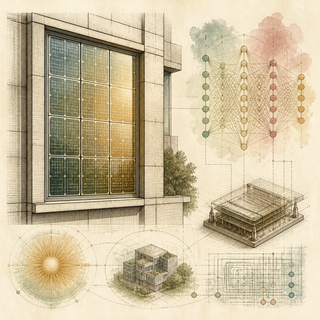
Disclaimer: This blog post is a simplified summary of published research for educational purposes. The accompanying illustration is artistic and does not depict actual model architectures, data, or experimental results. Always refer to the original paper for technical details.