If you've ever tried to assess brain health by photographing the back of an eye, you know how frustrating turning a tiny red-orange galaxy into medical signal is. This paper fixes that translation problem.
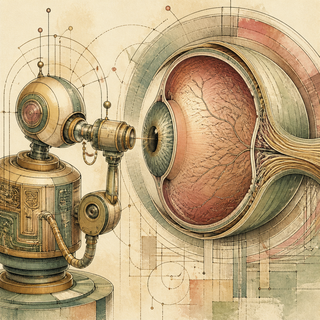
Well, "fixes" in the honest review-paper sense: it does not drop a magic algorithm from the clouds, wearing a tiny lab coat. Instead, Ran and colleagues map the fast-growing field of AI-based retinal imaging for brain health, then point at the potholes before everyone drives the clinical bus into them at full speed DOI: 10.1016/j.landig.2026.101020.
Your Retina Has Been Keeping Receipts
The retina is not just the thing your optometrist photographs while saying, "Look at the green dot." It is neural tissue, packed with blood vessels, sitting conveniently at the back of the eye like the brain accidentally left a window open.
That makes it tempting for medicine. Brain scans are expensive. Spinal fluid tests are nobody's idea of a spa day. Cognitive tests can miss early trouble or get tangled up with education, language, stress, and whether the patient slept like a normal mammal. Retinal imaging, by comparison, is quick, non-invasive, repeatable, and already common in eye clinics.
The big idea is called oculomics: using eye-derived measurements to infer health beyond the eye. Recent reviews describe retinal images as a way to study blood vessels, nerve fiber layers, and systemic disease patterns without sending the patient through the MRI tube of existential humming Wang et al., 2025.
Enter the Pattern Gobbler
AI is useful here because retinal images are loaded with subtle structure: vessel width, branching, tortuosity, capillary density, retinal layer thickness, tiny texture changes, and probably several features humans have not named because we were busy inventing more password rules.
Convolutional neural networks and newer multimodal models can scan fundus photos, optical coherence tomography (OCT), and OCT angiography (OCTA) for patterns linked to Alzheimer’s disease, mild cognitive impairment, stroke risk, Parkinson’s disease, multiple sclerosis, and brain aging. Think of the model as an overcaffeinated assistant who can compare thousands of retinal details without blinking, mostly because it has no eyelids.
Some prior studies show why people are excited. A 2022 Lancet Digital Health study trained a deep learning model on retinal photographs to detect Alzheimer’s disease dementia across multicenter datasets DOI: 10.1016/S2589-7500(22)00169-8. A 2024 npj Digital Medicine paper used OCTA images and a graph-based model, Eye-AD, to detect early-onset Alzheimer’s disease and mild cognitive impairment, with external-test AUCs around 0.90 and 0.80 respectively DOI: 10.1038/s41746-024-01292-5. Stroke work is also moving fast, with reviews reporting retinal vascular changes and AI models that may help estimate risk, subtype, and prognosis DOI: 10.3389/fncom.2025.1490603.
The Twist: Accuracy Is Not the Finish Line
Here is where the review earns its keep. The field has lots of promising technical performance, but technical performance is not the same as clinical usefulness. An AUC can look gorgeous in a paper and still flop in a clinic, like a sports car that cannot handle a grocery-store speed bump.
Ran and colleagues argue that the next phase needs boring-but-vital infrastructure: standardized benchmark datasets, clearer reporting, external validation, transparent models, diverse real-world populations, workflow integration, cost-effectiveness studies, business models, and regulatory standards.
That list may sound less glamorous than "AI sees dementia in your eye," but it is the difference between a clever demo and a tool a doctor can responsibly use. If the model performs worse in certain ethnic groups, camera types, age ranges, diabetes status, or eye diseases, that matters. If it gives a risk score nobody knows how to act on, that matters too. Medicine does not need a fortune cookie with a GPU.
Why This Could Actually Matter
If these systems become reliable, retinal AI could help screen people earlier and cheaper, especially in community clinics, primary care, optometry offices, and regions where MRI or specialist neurology access is limited. It might flag who needs deeper testing, monitor brain-health risk over time, or combine with blood biomarkers, wearables, genetics, and cognitive assessments.
It also fits a practical imaging trend: better images make better models. Tools like combb2.io already show how denoising, deblurring, and upscaling can make images more usable in everyday workflows. In medicine, though, enhancement has to be validated carefully, because "sharper" is not automatically "truer." The algorithm should not tidy up the evidence like a teenager cleaning only the part of the room visible on Zoom.
The Sensible Future
The most useful future is not one where an eye scan replaces neurologists. It is one where the retina becomes an early warning dashboard: cheap enough to repeat, rich enough to inform, and humble enough to know when it is only a screening clue.
This review basically says: the eye-brain connection is real, the AI tools are promising, and the field now needs grown-up plumbing. Less hype confetti. More benchmarks, validation, and clinical trials.
Which, honestly, is how you want brain-health technology to mature. Carefully. Reproducibly. With fewer press releases doing cartwheels in the hallway.
References
-
Ran AR, Zhu Z, Cheng KHL, Ng CF, Choi OYM, He Q, et al. Artificial intelligence-based retinal imaging for brain health assessment: a scoping review. The Lancet Digital Health. 2026. DOI: 10.1016/j.landig.2026.101020
-
Wang J, Wang YX, Zeng D, Zhu Z, Li D, Liu Y, et al. Artificial intelligence-enhanced retinal imaging as a biomarker for systemic diseases. Theranostics. 2025;15(8):3223-3233. DOI: 10.7150/thno.100786
-
Hao J, Kwapong WR, Shen T, Fu H, Xu Y, Lu Q, et al. Early detection of dementia through retinal imaging and trustworthy AI. npj Digital Medicine. 2024;7:294. DOI: 10.1038/s41746-024-01292-5
-
Khalafi PKP, Morsali SMS, Hamidi SH, Ashayeri H, Sobhi N, Pedrammehr S, et al. Artificial intelligence in stroke risk assessment and management via retinal imaging. Frontiers in Computational Neuroscience. 2025. DOI: 10.3389/fncom.2025.1490603
-
Agrawal L, Agrawal PK, Agrawal SS, Sonune MS, Kadu RK, Kulkarni MB, et al. AI-driven multimodal retinal imaging for early detection and risk stratification of vascular and neurodegenerative diseases. Graefe's Archive for Clinical and Experimental Ophthalmology. 2026. DOI: 10.1007/s00417-026-07273-6
Disclaimer: This blog post is a simplified summary of published research for educational purposes. The accompanying illustration is artistic and does not depict actual model architectures, data, or experimental results. Always refer to the original paper for technical details.