Before, liver fibrosis looked like a scar counted in broad steps. After, it starts to look like weather on a map.
That is the quiet charm of Wojciechowska and colleagues' new Hepatology paper on MASLD, the liver disease formerly known in many contexts as NAFLD. The team takes picrosirius red-stained biopsy slides, where collagen glows like warning thread in the tissue, and asks an AI system to do something more subtle than shout "stage 2" or "stage 3" from the balcony.
It looks for patterns.
The Old Ruler Was Too Chunky
Fibrosis staging is useful, but it is also beautifully blunt. A pathologist assigns a category, and that category carries a lot of clinical weight. The problem is that scar tissue does not read the scoring manual. It arrives unevenly, in strands, bridges, halos, knots, and quiet little architectural betrayals.
Collagen proportionate area, or CPA, improves on this by measuring how much collagen is present. But CPA is still basically asking, "How much scar is in the room?" It does not ask whether the scar is politely standing by the wall or rearranging the furniture like a tiny interior designer with boundary issues.
That missing geometry is the paper's main point.
The AI Notices the Brushwork
The researchers built an interpretable AI framework that identifies collagen deposition phenotypes, or CDPs, from PSR-stained liver slides. Think of these as recurring visual motifs in fibrosis: not just "more collagen," but different ways collagen organizes itself in tissue.
There is a wabi-sabi elegance here. The AI is not trying to make the biopsy pristine. It studies the imperfection. It treats the scar pattern as information, not visual clutter.
Under the hood, this lives in the broader world of computational pathology, where computer vision systems analyze whole-slide images and learn useful tissue features. Convolutional neural networks and related image models are the overworked interns doing the pixel math, scanning tiny neighborhoods of color and structure until the larger pattern appears. Very Zen, if your Zen garden requires a GPU and a staining protocol.
Why Shape Beats Bulk
The payoff comes when the CDPs are connected to transcriptomic and proteomic data. Compared with traditional fibrosis stage and CPA, the AI-derived phenotypes produced stronger and more biologically specific signals downstream.
That matters because multi-omics can be noisy. Genes, proteins, clinical labs, tissue structure - everyone is talking at once, like a group chat where half the participants are cytokines. A better tissue phenotype gives the analysis more ma, more useful negative space. Less noise. More signal.
In this study, CDPs 4 and 5 were linked with active extracellular matrix remodeling. That phrase sounds like a contractor's invoice, but in liver disease it means the scar is not just sitting there. The tissue is being actively rebuilt, stiffened, rearranged, and negotiated by cells. The authors also found phenotype correlations tied to liver functional status, suggesting these patterns may reflect something clinically meaningful rather than just decorative collagen calligraphy.
For visual thinkers, this is the kind of relationship map that makes tools like mapb2.io feel natural: phenotype here, pathway there, clinical status off to the side, all connected without turning your desk into a paper avalanche.
The Best Part: They Opened the Box
A lot of AI pathology tools live behind commercial walls. That can be fine for deployment, but it is awkward for academic reproducibility. Science gets twitchy when the method is "trust our proprietary rectangle."
This group made models and tools freely available, including code for CDP inference, collagen segmentation, and omics analyses. That choice gives the work an ikigai: a clear purpose beyond one paper. Other labs can inspect it, test it, argue with it, and maybe improve it. Peer review becomes less like admiring a locked teahouse from the sidewalk.
The Quiet Catch
The study is promising, not magical. Some selected CDPs showed prognostic associations in the discovery cohort, but the signal weakened in external validation. That is not failure. That is science doing the responsible thing where the second dataset walks in and says, "Cute story. Prove it again."
There are practical limits too. The pipeline depends on PSR-stained slides and, according to the project documentation, was implemented for 40x whole-slide imaging, with staining and acquisition differences still needing care. Biopsies themselves are invasive and sample only a tiny piece of liver, which is rude of biology but not surprising.
Still, the work fits a larger movement. Recent reviews in AI-assisted MASH pathology describe the field moving from coarse human scoring toward reproducible, quantitative tissue features. AIM-MASH has already shown that AI assistance can reduce variability in trial histology scoring. Other digital pathology studies suggest AI can detect fibrosis regression patterns that conventional staging may miss.
The understated lesson is simple: in fibrosis, architecture carries meaning. Not every connection needs to exist for the whole to be beautiful. Not every scar needs to be reduced to a number.
References
-
Wojciechowska MK, Thing M, Hu Y, et al. Decoding fibrosis: Transcriptomic and clinical insights via AI-derived collagen deposition phenotypes in MASLD. Hepatology. 2026. DOI: 10.1097/HEP.0000000000001811. PMID: 42341328
-
Ratziu V, Hompesch M, Petitjean M, et al. Artificial intelligence-assisted digital pathology for non-alcoholic steatohepatitis: current status and future directions. Journal of Hepatology. 2024;80(2):335-351. DOI: 10.1016/j.jhep.2023.10.015
-
Pulaski H, Harrison SA, Mehta SS, et al. Clinical validation of an AI-based pathology tool for scoring of metabolic dysfunction-associated steatohepatitis. Nature Medicine. 2025;31:315-322. DOI: 10.1038/s41591-024-03301-2
-
Abdurrachim D, Lek S, Ong CZL, et al. Utility of AI digital pathology as an aid for pathologists scoring fibrosis in MASH. Journal of Hepatology. 2025;82(5):898-908. DOI: 10.1016/j.jhep.2024.11.032
-
Yuan HY, et al. AI-based digital pathology provides newer insights into lifestyle intervention-induced fibrosis regression in MASLD: An exploratory study. Liver International. 2024;44(10):2572-2582. DOI: 10.1111/liv.16025
-
Song AH, Jaume G, Williamson DFK, et al. Artificial intelligence for digital and computational pathology. Nature Reviews Bioengineering. 2023;1:930-949. DOI: 10.1038/s44222-023-00096-8
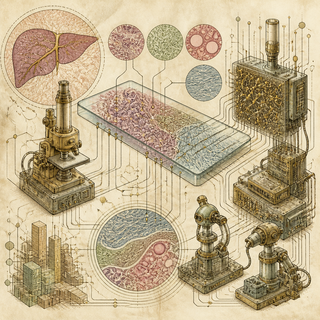
Disclaimer: This blog post is a simplified summary of published research for educational purposes. The accompanying illustration is artistic and does not depict actual model architectures, data, or experimental results. Always refer to the original paper for technical details.