The old approach was the leaky roof: scientists drowning in papers, datasets, protocols, reviewer comments, and that one spreadsheet named final_FINAL_reallyfinal.xlsx; Kristina Katsemonova's Nature correspondence is the repair plan, arguing that AI can help patch the thinking process faster, but the house still stands or falls on evidence from the lab bench (DOI: 10.1038/d41586-026-02069-4, PMID: 42380279).
That is the whole building in miniature. AI can draft the blueprint. It can compare materials. It can suggest where the plumbing might be hiding. But if the beam sags under real weight, no amount of confident chatbot plaster makes it structurally sound.
A Handsome Facade Is Not a Foundation
Katsemonova's point lands at a busy moment. In May 2026, Nature published two splashy examples of AI systems stepping deeper into the scientific workflow. Google's Co-Scientist uses multiple AI agents to generate, critique, and refine biomedical hypotheses, including ideas for drug repurposing and antimicrobial resistance mechanisms (Gottweis et al., 2026). FutureHouse's Robin links literature-search agents with data-analysis agents and reports lab-in-the-loop work on dry age-related macular degeneration, including candidate drugs ripasudil and KL001 (Ghareeb et al., 2026).
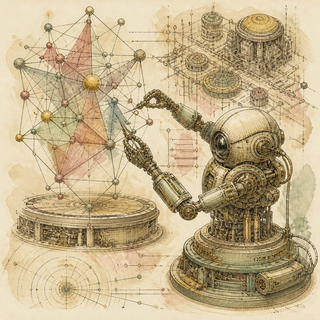
Architecturally, these systems are no longer single-room sheds. They are sprawling research complexes: one wing searches papers, another drafts hypotheses, another debates weak assumptions, another analyzes experimental data. The attention mechanism, if you squint, is the building inspector who actually reads the whole email chain before approving the cantilever.
But the facade can fool you. A language model is trained to predict plausible text, not to commune with the secret soul of biology over espresso. It can assemble a research plan that looks gorgeous from the street. The question is whether the load distribution survives contact with cells, molecules, instruments, noise, contamination, failed assays, and the universal scientific constant: the pipette tip that disappears exactly when needed.
The New Floor Plan: Faster Thinking
The useful part is not "AI replaces scientists," which is both boring and usually wrong. The useful part is "AI changes the floor plan."
A scientist can ask an AI system to scan literature, identify conflicting results, draft mechanisms, suggest controls, write analysis code, or point out blind spots. Multi-agent systems push this further by assigning different roles to different model instances: proposer, critic, planner, analyst. It is less like one genius robot in a lab coat and more like a design review where several interns, all caffeinated and slightly overconfident, argue over the stairwell.
That matters because modern research has a bottleneck problem. The literature pile is now less a library and more a geological formation. Tools that compress reading, map competing hypotheses, and keep track of reasoning chains can save real time. If you are diagramming one of these agent workflows, a visual thinking tool such as mapb2.io is honestly the right kind of boring-useful: boxes, arrows, dependencies, and fewer napkins sacrificed to the gods of complexity.
A 2025 EMNLP survey frames this progression as LLMs moving from tools, to analysts, to more autonomous scientific collaborators (arXiv:2505.13259). That taxonomy is helpful because it keeps the architecture honest. A wrench is not a contractor. A contractor is not a building code. An AI assistant is not automatically a scientific result.
The Lab Bench Has Excellent Sight Lines
The lab bench remains the sight line that matters. Co-Scientist's strongest claims come where hypotheses moved into experimental validation. Robin's strongest claims come where proposed therapeutic ideas met in vitro testing and follow-up RNA-seq analysis. Earlier work in autonomous chemistry made the same point: Coscientist could plan and execute chemistry tasks with tools and robotic interfaces, but the result mattered because reactions and instruments produced evidence, not because the prose sounded expensive (Boiko et al., 2023).
This is where Katsemonova's correspondence feels less like a wet blanket and more like good structural engineering. Speed is valuable. Speed without validation is just a very fast elevator in an unfinished building.
The challenges are not cosmetic. AI systems can hallucinate references, overfit to benchmarks, miss tacit lab knowledge, bury uncertainty under fluent language, and produce reasoning that looks clean while hiding weak joints behind drywall. Scientific discovery also depends on negative results, replication, careful controls, and domain judgment. Models are good at generating candidates. Nature is good at issuing rejection letters in the form of failed experiments.
A Better Building, Not an Empty One
If these systems keep improving and the results reproduce, the real-world impact could be substantial: faster drug repurposing, better experiment planning, more efficient literature review, and smarter use of expensive lab time. Small teams could get some of the benefits of a larger interdisciplinary group. That is not magic. It is better scaffolding.
The best version of AI-assisted science looks like a well-designed research building: clean lines, visible supports, flexible rooms, clear fire exits, and no decorative columns pretending to hold up the roof. Humans still choose the problem, judge the evidence, design the controls, and decide when the elegant hypothesis is actually a beautiful nonsense gazebo.
AI can speed up thinking. The lab bench still decides whether the thought deserves a foundation.
References
-
Katsemonova, K. "AI tools can speed up thinking, but evidence still comes from the lab bench." Nature 655, 274 (2026). DOI: 10.1038/d41586-026-02069-4. PMID: 42380279.
-
Gottweis, J. et al. "Accelerating scientific discovery with Co-Scientist." Nature (2026). DOI: 10.1038/s41586-026-10644-y.
-
Ghareeb, A. E. et al. "A multi-agent system for automating scientific discovery." Nature (2026). DOI: 10.1038/s41586-026-10652-y.
-
Swanson, K. et al. "The Virtual Lab of AI agents designs new SARS-CoV-2 nanobodies." Nature 646, 716-723 (2025). DOI: 10.1038/s41586-025-09442-9.
-
Boiko, D. A., MacKnight, R., Kline, B. & Gomes, G. "Autonomous chemical research with large language models." Nature 624, 570-578 (2023). DOI: 10.1038/s41586-023-06792-0.
-
Zheng, T. et al. "From Automation to Autonomy: A Survey on Large Language Models in Scientific Discovery." EMNLP 2025. arXiv: 2505.13259.
Disclaimer: This blog post is a simplified summary of published research for educational purposes. The accompanying illustration is artistic and does not depict actual model architectures, data, or experimental results. Always refer to the original paper for technical details.