Somewhere in a research lab, someone got tired of juggling four different AI models just to understand a single document. Text spotting? One model. Table recognition? Another model. Key information extraction? Yet another. Layout analysis? You guessed it - bring in model number four. It's like hiring four specialists to read your restaurant receipt.
OmniParser V2 from Alibaba Research said "enough" and crammed all four jobs into a single, unified framework. The secret sauce? Something called Structured-Points-of-Thought, or SPOT - which sounds like a meditation technique but is actually a clever prompting schema that turns the chaos of document parsing into a streamlined operation.
The Problem With Document AI's Split Personality
Here's the thing about teaching machines to read documents: it's messy. A scanned invoice contains text (obviously), but also tables, logos, handwritten signatures, and that weird coffee stain from accounting. Traditional approaches treated each element like it needed its own dedicated neural network with its own special training regimen.
The result? "Modal isolation" - a fancy way of saying your AI systems don't talk to each other. One model finds the text, another tries to figure out if it's in a table, a third attempts to extract the invoice total, and somehow you end up with complex pipelines that would make a plumber weep. Each task demanded its own architecture, its own loss functions, its own everything.
OCR technology has come a long way since the 1950s when researchers first tried teaching machines to read checks and sort mail. But modern documents - think receipts, contracts, medical forms - are exponentially messier than what those early systems ever imagined.
Enter SPOT: Teaching AI to Think in Structure
SPOT works through a two-stage generation strategy that's surprisingly elegant. First, the model generates center point sequences representing word-level or line-level text instances. Think of it as the AI saying "there's text here, here, and here" while preserving the underlying structure - whether that's JSON, HTML, or some other markup format.
The second stage takes those points and generates polygonal contours (the actual shapes around text) alongside recognition results. Both stages share the same encoder-decoder architecture, which is the key innovation here. No more separate models with separate objectives fumbling over the same document.
The researchers built this on a mixture-of-experts transformer decoder - essentially a neural network that routes different tasks through specialized sub-networks while keeping the overall structure unified. It's like having one very versatile employee who knows when to switch between their accountant hat and their layout designer hat.
The Results: State-of-the-Art Without the Complexity
Testing across eight datasets covering text spotting, key information extraction, table recognition, and layout analysis, OmniParser V2 hit state-of-the-art or highly competitive numbers on all four tasks. That's not just impressive - it's practical.
Why does this matter? Consider that the intelligent document processing market is expected to exceed $12.35 billion by 2030. Companies process millions of invoices, receipts, and forms monthly. Every percentage point of accuracy improvement or reduction in pipeline complexity translates to real money saved.
The researchers didn't stop there. They also tested whether SPOT could play nice with multimodal large language models - those massive systems that can see images and generate text. It worked. Plugging SPOT into an MLLM framework further enhanced visual text parsing capabilities, suggesting this isn't just a niche technique but a genuinely generalizable approach.
What This Means for Your Documents
The practical implications are significant for anyone dealing with document automation. Tools that extract data from PDFs, invoices, and receipts currently rely on either rigid templates (break when layouts change) or OCR engines prone to errors (break when quality drops). A unified model that understands document structure holistically could handle the messy reality of real-world paperwork far better.
If you're curious about related tools, pdfb2.io offers browser-based PDF processing that similarly aims to simplify document workflows - though the underlying technology differs from what OmniParser V2 accomplishes at the research level.
The Bigger Picture
OmniParser V2 represents a broader trend in AI: unification over specialization. Rather than building elaborate Rube Goldberg machines of interconnected models, researchers are finding ways to consolidate capabilities into more elegant systems. It's the difference between a Swiss Army knife and carrying around a toolbox.
The code is available on GitHub, which means other researchers can build on this work. Given that benchmarks like OCRBench v2 show most current models still struggle with precise text spotting and element parsing, there's plenty of room for improvement.
Whether you're processing expense reports, digitizing historical archives, or just trying to get your AI to understand that yes, that blob of pixels is actually a table with important numbers in it, unified approaches like SPOT point toward a future where document AI actually works the way we've always wanted it to.
References
- Yu, W., et al. (2025). OmniParser V2: Structured-Points-of-Thought for Unified Visual Text Parsing. IEEE Transactions on Pattern Analysis and Machine Intelligence. DOI: 10.1109/TPAMI.2026.3677075 | arXiv:2502.16161
- Wei, H., et al. (2024). General OCR Theory: Towards OCR-2.0 via a Unified End-to-end Model. arXiv:2409.01704
- Fu, S., et al. (2025). OCRBench v2: An Improved Benchmark for Evaluating Large Multimodal Models on Visual Text Localization and Reasoning. arXiv:2501.00321
- Optical character recognition. (2025). In Wikipedia. https://en.wikipedia.org/wiki/Optical_character_recognition
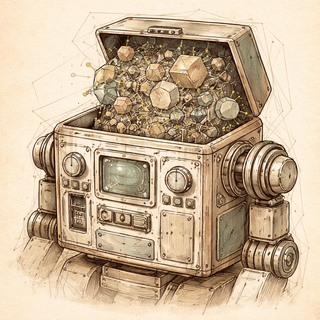
Disclaimer: This blog post is a simplified summary of published research for educational purposes. The accompanying illustration is artistic and does not depict actual model architectures, data, or experimental results. Always refer to the original paper for technical details.