A team of researchers just taught an AI to do the one thing plant scientists have been begging for: handle the entire image analysis pipeline without making anyone learn Python first.
The Problem Nobody Outside Botany Talks About
Plant phenotyping - the science of measuring physical plant traits like leaf area, growth rate, and color - is stuck in a brutal contradiction. The field desperately needs automation to keep up with modern agriculture's demands, but the tools that exist read like they were designed by software engineers who've never met a biologist. We're talking custom scripts, fragile pipelines, GPU configurations, and documentation that assumes you already know what Docker is.
The result? A lot of plant scientists either burn weeks wrestling with code or just... don't use the tools at all. A 2025 review in Food and Energy Security called out the "high costs, limited generalization, and need for large-scale annotated datasets" as persistent barriers (Kaya, 2025). Meanwhile, the data keeps piling up.
Enter PhenoAssistant: Your New Lab Partner Who Never Complains
PhenoAssistant, published in Nature Communications this April, takes a radically different approach: just talk to it (Chen et al., 2026). Type something like "extract the leaf area from these images and plot it over time," and a large language model figures out which tools to call, in what order, and hands you back results with a summary.
Under the hood, it's a multi-agent system. A central "manager" LLM reads your request, breaks it into steps, then delegates to specialized sub-agents: one for analyzing CSV data, one for generating plots, one for interpreting those plots, and coding agents for everything else. There's also a model zoo stocked with pre-trained computer vision models for common plant traits.
But here's where the skeptic in me raises an eyebrow: the system runs on OpenAI's API. So your "accessible" phenotyping tool still requires API keys, a GPU, and enough setup to make a casual user sweat. "Democratizing" is doing some heavy lifting in that abstract.
Wait, Can You Actually Trust It?
This is the question that matters, and to their credit, the authors don't dodge it entirely. They validated PhenoAssistant across several case studies - extracting phenotypes from Arabidopsis rosettes, visualizing growth data, even fine-tuning models on new datasets through conversation alone.
The catch? LLMs hallucinate. They confidently generate plausible-sounding nonsense. When your chatbot is making decisions about which computer vision model to deploy on your experimental data, a wrong tool selection isn't just annoying - it could silently corrupt your results. The paper acknowledges this but doesn't provide extensive failure-mode analysis. The Aleks system from Cornell, a similar multi-agent approach for plant disease detection, found that ablating domain knowledge and memory significantly degraded performance (Jin et al., 2025). Translation: these systems are only as good as their guardrails.
A broader survey in Briefings in Bioinformatics covering 100+ studies of biological AI agents reinforced this tension - agents enable "iterative goal-directed reasoning," but validating their autonomous decisions remains an open problem (Qi et al., 2025).
The Bigger Picture: Chatbots Are Coming for Every Lab Bench
PhenoAssistant isn't an isolated experiment. It's part of a wave. BioAgents uses fine-tuned small language models for genomics workflows (Mehandru et al., 2025). Bio AI Agent claims 200-fold speedup in CAR-T cell therapy development using six autonomous agents (Ni et al., 2025). Nature Biotechnology declared 2026 the year of "in silico team science" (Nature Biotechnology, 2026).
The pattern is clear: instead of building one monolithic AI that does everything poorly, you build a team of specialized agents coordinated by a manager. It's basically corporate middle management, except the manager is an LLM and the employees are computer vision models. Make of that what you will.
So Should Plant Scientists Care?
Yes - with caveats. PhenoAssistant genuinely lowers the barrier to entry. A researcher who's never written a line of code can now extract phenotypic measurements through conversation. The extensibility is smart too: custom tools plug in via a Python decorator, and the model zoo is configurable through a JSON file. For labs already drowning in image data, something like mapb2.io could help visualize the relationships between traits and experimental conditions that PhenoAssistant extracts.
But "conversational" doesn't mean "foolproof." Every output still needs a human eye. The 5% of cases where the LLM picks the wrong tool or misinterprets your request? That's where your experiment goes sideways. Trust, but verify. Preferably with a backup script you wrote yourself.
The code is open-source on GitHub. Go kick the tires.
References
-
Chen, F., Stogiannidis, I., Wood, A., et al. (2026). A conversational multi-agent AI system for automated plant phenotyping. Nature Communications. DOI: 10.1038/s41467-026-71090-y. arXiv: 2504.19818
-
Qi, C., Wang, W., Jiang, S., et al. (2025). Artificial Intelligence agents for biological research: a survey. Briefings in Bioinformatics. PMC: PMC12936789
-
Mehandru, N., Hall, A.K., Melnichenko, O., et al. (2025). BioAgents: Bridging the gap in bioinformatics analysis with multi-agent systems. Scientific Reports, 15. DOI: 10.1038/s41598-025-25919-z
-
Jin, D., Gunner, N., Janke, N.C., et al. (2025). Aleks: AI powered Multi Agent System for Autonomous Scientific Discovery in Plant Science. arXiv: 2508.19383
-
Ni, Y., Zhu, L., & Li, S. (2025). Bio AI Agent: A Multi-Agent AI System for Autonomous CAR-T Cell Therapy Development. arXiv: 2511.08649
-
Kaya, Y. (2025). Optimizing Crop Production with Plant Phenomics. Food and Energy Security. Link
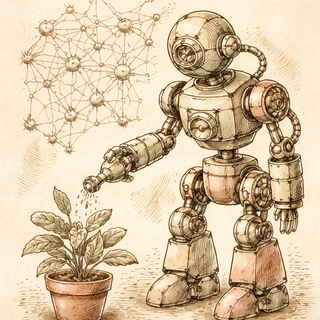
Disclaimer: This blog post is a simplified summary of published research for educational purposes. The accompanying illustration is artistic and does not depict actual model architectures, data, or experimental results. Always refer to the original paper for technical details.