Medicine's oldest bottleneck was never the scalpel or the stethoscope - it was the physician's irreplaceability. One human brain, trained for a decade-plus, holding the sum total of diagnostic authority over your body. John Lantos, writing in JAMA, argues that bottleneck was already leaking long before anyone trained a neural network on a chest X-ray (Lantos, 2026).
Walter Benjamin Walks Into a Hospital
Lantos borrows a move from cultural theory that has no business working this well in a medical journal. He reaches for Walter Benjamin, the German philosopher who argued in 1935 that photography stripped paintings of their "aura" - that unique, irreproducible quality tied to a work's physical presence and history (Benjamin, 1935). Once you could copy a Rembrandt perfectly, what made the original special?
Now swap "painting" for "physician." AI systems can now make difficult diagnoses, read medical images, detect drug interactions, predict outcomes, and even provide psychological counseling. A recent meta-analysis found AI achieving 87% sensitivity in dermatological diagnosis compared to 80% for clinicians (Browne et al., 2024). If a pattern-matching algorithm can replicate the skills you spent residency acquiring, what's your aura worth?
The Aura Was Already Fading (And That's the Real Kicker)
Here's the part that stings: Lantos isn't blaming AI. He's saying the profession did this to itself, one standardization at a time.
The erosion started in the late 18th century, when medicine adopted what Michel Foucault called the "clinical gaze" - the shift from listening to what patients said they felt toward observing what doctors could physically see (Foucault, 1963). Your symptoms became data points. You became a body to be mapped.
Then anesthesia arrived in the 19th century and, while obviously a miracle for anyone facing a bone saw, it also turned patients into silent, immobile objects on a table. Evidence-based medicine later introduced population-level guidelines, replacing individual clinical judgment with decision trees. And then came electronic health records, which turned the doctor's visit into a documentation exercise where physicians now spend roughly two hours on the computer for every one hour with patients (Arndt et al., 2017).
By the time AI showed up to auto-generate clinical notes, it wasn't disrupting anything. It was perfecting a process that had been underway for two centuries.
Supervisors of Semiautonomous Systems
Lantos frames the modern physician's emerging role with a phrase that should make every med student pause: "supervisors of semiautonomous systems, retaining responsibility with diminished autonomy." Read that again. You're still liable when the AI gets it wrong, but you have less control over how it gets things right.
This isn't theoretical hand-wringing. About 58% of U.S. adults already don't trust healthcare systems to ensure AI tools won't harm them, yet personal physicians remain the most trusted source for health decisions (Moy et al., 2025). The trust lives in the person, not the system. That's the aura - or what's left of it.
So What Survives the Reproduction?
Benjamin argued that when photography killed painting's monopoly on visual truth, painting didn't die. It found abstraction, expressionism, new reasons to exist. Lantos is essentially asking: what's medicine's expressionism?
The answer might be what researchers call "connective labor" - the empathetic listening, the eye contact, the ability to sit with someone's fear and make them feel less alone in it (AAMC, 2024). No algorithm, however sophisticated, can reproduce the experience of another human being taking your suffering seriously. Not yet. Probably not ever.
That's not a sentimental argument. It's a practical one. If physicians double down on the one thing that can't be automated - genuine human connection - then the aura doesn't disappear. It transforms. The physician stops being the all-knowing oracle and becomes something potentially more valuable: the person who translates algorithmic outputs into care that actually accounts for who you are.
The catch? Healthcare systems have to let them. Right now, physicians spend more time feeding documentation systems than talking to patients. If AI takes over the charting - and tools are already doing this - it could free doctors to do exactly what Lantos suggests: reclaim the parts of medicine that were never reproducible in the first place.
Or, you know, we could just add more checkboxes to the EHR. That's been working great so far.
References
- Lantos, J. D. (2026). The Lost Aura of the Physician in the Age of Artificial Intelligence. JAMA, 335(13), 1119-1121. DOI: 10.1001/jama.2026.0946
- Benjamin, W. (1935). The Work of Art in the Age of Mechanical Reproduction. Wikipedia
- Foucault, M. (1963). The Birth of the Clinic: An Archaeology of Medical Perception. Wikipedia
- Browne, I., et al. (2024). Diagnostic accuracy of artificial intelligence compared to family physicians and dermatologists for skin conditions: a systematic review and meta-analysis. BMC Medicine. PMC
- Moy, H. P., et al. (2025). Expectations of healthcare AI and the role of trust: understanding patient views. BMC Health Services Research. PMC
- AAMC (2024). Doctors, beware: AI threatens to weaken your relationships with patients. AAMC
- Khairat, S., et al. (2025). Impact of artificial intelligence on electronic health record-related burnouts among healthcare professionals. Frontiers in Public Health. Frontiers
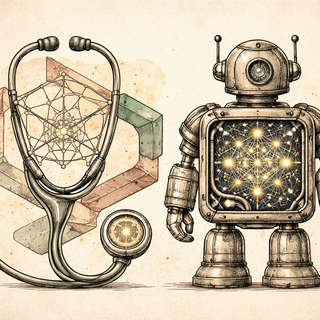
Disclaimer: This blog post is a simplified summary of published research for educational purposes. The accompanying illustration is artistic and does not depict actual model architectures, data, or experimental results. Always refer to the original paper for technical details.