Good news: cells may be more readable than we thought. Bad news: they have apparently been hiding their molecular secrets in their silhouettes this whole time, like tiny biological gossip columnists who only communicate through posture.
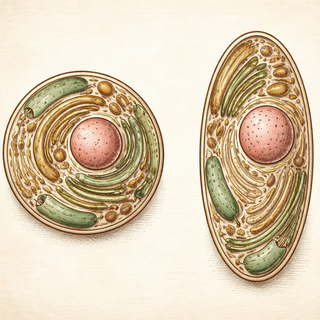
A new study from Trang Le and colleagues asks a sneaky question: if you just look at a cell's shape, can you learn something real about what is happening inside it? Not in a mystical "the mitochondria feel sad today" way. In a measurable protein-level way. Their answer is: surprisingly often, yes (Le et al., 2026).
The Cell Is Not Just Vibes
Think of it like this: if you walk into a room and see a folded-up camping chair, a bar stool, and a beanbag, you already know something about how each one behaves before sitting down. Shape carries information. Cells do that too.
Biologists have known for a while that cell geometry relates to things like movement, division, and signaling. But this paper goes bigger. The team analyzed more than 1 million single-cell images covering 11,998 proteins across 11 human cell lines from the Human Protein Atlas, a giant public resource for protein localization images (Human Protein Atlas; Uhlen et al., 2017).
Instead of treating shape as a side note, they treated it like a coordinate system. Think of it like making a map of "cell shapeness," where roundish cells live in one neighborhood, stretched cells in another, and everything in between fills the streets. That map is often called a shapespace. Under the hood, this uses dimensionality-reduction math, basically a tidy way to compress a ridiculous number of shape measurements into a smaller map humans can reason about. Yes, statistics is once again the designated adult in the room.
A Protein Atlas, But With Body Language
Here is the clever bit. The researchers found that cell and nuclear shapes across different cell lines sit on a shared continuum. In plain English: even different kinds of cells seem to remix a common set of shape themes rather than inventing brand-new geometry from scratch.
Then they checked what happened to organelles and proteins across that shapespace.
Think of it like sorting houses by roof shape and then discovering that kitchens, wiring, and furniture layouts also shift in repeatable ways. Not perfectly. Biology never misses a chance to be messy. But enough to matter.
They found that organelle organization changed across cell lines, yet stayed fairly consistent within a given cell line's own shapespace. At the single-protein level, cells with different shapes, even when in the same cell-cycle phase, showed different abundance patterns and localization patterns. That matters because it suggests shape is not just a visual side effect of the cell cycle. Sometimes shape may hint that cells are preparing for different futures.
That is the part where the paper gets spicy.
Why This Is More Than Fancy Microscopy
This work sits inside a fast-moving area called spatial proteomics, which studies where proteins are, not just whether they exist. That field has been moving quickly enough that Nature Methods named spatial proteomics its 2024 Method of the Year and then published a 2026 update because the field kept sprinting (Nature Methods, 2024; Nature Methods, 2026).
Think of it like the difference between knowing every actor in a movie versus knowing who is standing in which room during the big argument. Location changes the plot.
Recent reviews have also pointed out that single-cell spatial proteomics is becoming a serious tool for studying disease, tissue organization, and cell states, especially when paired with better computational analysis (Sun et al., 2025; Kwon et al., 2024). And newer AI work is trying to automate cell phenotyping directly from these complex images (Friedman et al., 2024 preprint).
OK, But Why Should You Care?
Because if shape helps decode molecular phenotype, then ordinary microscopy images become more useful than they look. Think of it like realizing your blurry receipt also contains tax strategy, family drama, and a recipe. Suddenly you stare at it differently.
In the best case, this could help researchers:
- spot cell states earlier
- understand how drugs shift protein localization
- compare healthy and diseased cells with less guesswork
- build more interpretable AI models for cell biology
I like the word "interpretable" here because too much AI in biology still has strong "trust me, bro" energy. This paper leans the other way. It asks the model to organize findings around shape, which humans can actually inspect and reason about.
That said, nobody should pretend cell shape is destiny. These results come from curated image datasets and cell lines, not the full chaos of living tissue. Shape can correlate with many things at once, and correlation is a notorious flirt. It shows up looking meaningful, then refuses to define the relationship. So this is not a magic decoder ring. It is more like a very promising set of subtitles.
And honestly, that is enough to be excited about. If cells keep revealing their molecular plans through geometry, then biology may turn out to be a little less like reading tea leaves and a little more like reading posture. Which is convenient, because cells have been posing dramatically under microscopes for years.
References
Le T, Leineweber WD, Viana MP, Cesnik A, Hansen JN, Ouyang W, Rafelski SM, Lundberg E. Cell shapes decode molecular phenotypes in image-based spatial proteomics. Cell Systems. 2026. DOI: 10.1016/j.cels.2026.101589
Method of the Year 2024: spatial proteomics. Nature Methods. 2024;21:2195-2196. DOI: 10.1038/s41592-024-02565-3
An update on spatial proteomics. Nature Methods. Published March 12, 2026. DOI: 10.1038/s41592-026-03046-5
Sun L, et al. Single-cell spatial proteomics. Haematologica. 2025;40(8):1173-1184. DOI: 10.14670/HH-18-861
Kwon Y, et al. Spatial Proteomics towards cellular Resolution. Expert Review of Proteomics. 2024. DOI: 10.1080/14789450.2024.2445809
Friedman N, et al. Generalized cell phenotyping for spatial proteomics with language-informed vision models. Preprint, 2024. DOI: 10.1101/2024.11.02.621624
Uhlen M, et al. The human protein atlas: A spatial map of the human proteome. Protein Science. 2017;26(11):2336-2345. PMCID: PMC5734309
Disclaimer: This blog post is a simplified summary of published research for educational purposes. The accompanying illustration is artistic and does not depict actual model architectures, data, or experimental results. Always refer to the original paper for technical details.