Your phone already tracks your steps, sleep, heart rate, and possibly your emotional collapse at 1:13 a.m. when you search "is caffeine a food group," but it still cannot casually peek under your skin and tell you what molecules are doing in real time.
That is where this new paper enters the arena, sneakers squeaking, crowd roaring, clipboard in hand: "A Portable and Dual-Button Microneedle Device Enables Intelligent Multimodal Laser Sensing" by Liu and colleagues, published in Advanced Science in 2026 (DOI: 10.1002/advs.75564, PMID: 42095509).
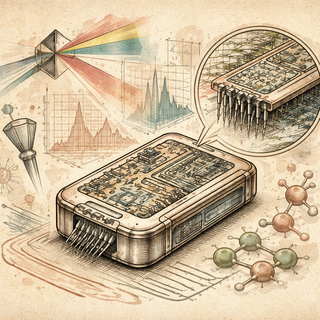
The team built a low-cost, portable microneedle device that samples interstitial fluid, the liquid hanging out between your cells like the body’s group chat nobody checks until something goes wrong. Instead of drawing blood, the device uses hollow microneedles and built-in microfluidic channels to collect fluid in about one minute. Then comes the laser-sensing double feature: molecular and elemental analysis, helped along by AI that interprets the messy spectral data without immediately throwing the clipboard into the stands.
First Quarter: Why Not Just Use Blood?
Blood testing is the reigning champion of diagnostics, but it is not exactly subtle. Needles, tubes, appointments, waiting rooms, that one poster explaining cholesterol with clip art from 2008 - the whole production.
Interstitial fluid, or ISF, offers a sneakier route. It carries metabolites and biomarkers that can reflect what is happening in the body, but it sits closer to the skin surface and can be reached with microneedles. Recent reviews describe microneedle biosensing as a promising path for point-of-care and wearable diagnostics because these tiny structures can collect or sense biomarkers with less pain and more convenience than standard sampling (Vora et al., 2024; Li et al., 2024).
The problem? A lot of microneedle systems still fumble the handoff. They can be complex, slow, expensive, hard to operate, or limited to one type of measurement. Great in the lab, less great when you imagine a tired patient trying to use the thing before breakfast.
Liu’s team goes for a cleaner play: a dual-button device that makes operation more user-friendly, with a disposable part costing under $2 in materials. That is not a clinical price tag, of course, but as a manufacturing signal, it is the research equivalent of a rookie on a cheap contract suddenly dropping 30 points.
Second Quarter: The Laser Enters the Game
Once the ISF is collected, the device does not just shrug and say, "Seems wet." It uses laser spectroscopy to read chemical signatures.
One major technique in this neighborhood is surface-enhanced Raman spectroscopy, or SERS. Raman spectroscopy looks at how light scatters from molecules, giving a kind of chemical fingerprint. Regular Raman signals can be weak, like trying to hear one nacho crunch from the upper deck. SERS boosts the signal using engineered surfaces, often involving metallic nanostructures, so the molecular whisper becomes more like a stadium chant (Surface-enhanced Raman spectroscopy background).
The paper reports a sensing module using gold nanocubes coupled with MXene, a 2D material family that sounds like a superhero team but is very real. The goal is signal enhancement for molecular and elemental analysis. A Chinese research summary of the paper notes the platform combines SERS with laser-induced breakdown spectroscopy, or LIBS, to cover both molecular and elemental sensing (WeFluidics summary).
That matters because health is rarely a single-stat sport. Glucose, ions, metabolites, proteins, inflammatory markers - the body runs a full scoreboard. Multiplexed sensing lets a device look at several signals instead of pretending one biomarker can explain the whole season.
Halftime Show: AI Reads the Spectral Chaos
Spectral data can be ugly. Peaks overlap. Signals shift. Noise crashes the party like a mascot on roller skates. This is where AI-assisted interpretation earns its roster spot.
Machine learning has become increasingly useful for Raman and SERS analysis because it can learn patterns across whole spectra instead of relying only on hand-picked peaks. Reviews in TrAC Trends in Analytical Chemistry and Nanoscale Advances describe how AI-assisted SERS can support classification, prediction, and molecular diagnostics, while also warning about the usual villains: small datasets, variable substrates, messy preprocessing, and models that make correct predictions for reasons nobody can explain without a whiteboard and a mild headache (Horta-Velazquez et al., 2023; Zhou et al., 2023).
In this study, AI-assisted processing helped interpret multimodal laser signals, and the authors report accuracies above 88% across in vitro and in vivo studies. That is a solid drive downfield, but not the trophy presentation. Accuracy in controlled experiments does not automatically mean the device is ready for hospitals, homes, gyms, or the glove compartment next to old receipts.
Fourth Quarter: What Has to Happen Next?
The promise is easy to see. A cheap, portable device that samples ISF quickly and reads multiple health signals could help with chronic disease monitoring, metabolic tracking, drug monitoring, or early warning systems. Imagine fewer blood draws and more near-real-time snapshots. Not magic. Not a tricorder. More like a very tiny lab assistant with a laser pointer and better posture.
But translation is where many shiny devices meet the defensive line. Researchers still need larger human studies, calibration across skin types and hydration levels, robust manufacturing, long-term stability, clinical validation, and clear answers about what each spectral pattern means biologically. AI also needs explainability here, because "the model said so" is not a medical strategy. It is barely a fantasy football strategy.
Still, this paper is exciting because it combines several useful pieces into one compact play: microneedle sampling, microfluidics, enhanced laser spectroscopy, low-cost fabrication, and AI-based interpretation. The win condition is not replacing doctors or turning everyone into a walking dashboard. It is making high-quality health measurements easier to collect without turning every checkup into a needle-based playoff series.
References
-
Liu, Y. et al. "A Portable and Dual-Button Microneedle Device Enables Intelligent Multimodal Laser Sensing." Advanced Science, 2026. DOI: 10.1002/advs.75564. PMID: 42095509.
-
Vora, L. K. et al. "Microneedle-based biosensing." Nature Reviews Bioengineering 2, 64-81, 2024. DOI: 10.1038/s44222-023-00108-7.
-
Li, J., Wei, M., & Gao, B. "A Review of Recent Advances in Microneedle-Based Sensing within the Dermal ISF That Could Transform Medical Testing." ACS Sensors, 2024. DOI: 10.1021/acssensors.4c00142.
-
Horta-Velazquez, A. et al. "Toward smart diagnostics via artificial intelligence-assisted surface-enhanced Raman spectroscopy." TrAC Trends in Analytical Chemistry 169, 117378, 2023. DOI: 10.1016/j.trac.2023.117378.
-
Zhou, H. et al. "Machine learning-augmented surface-enhanced spectroscopy toward next-generation molecular diagnostics." Nanoscale Advances 5, 538-570, 2023. DOI: 10.1039/D2NA00608A.
Disclaimer: This blog post is a simplified summary of published research for educational purposes. The accompanying illustration is artistic and does not depict actual model architectures, data, or experimental results. Always refer to the original paper for technical details.