Not with magic, sadly. With neural fields and resistive memory, which sounds like a prog-rock album but is actually a pretty sharp answer to a very real problem: how do you rebuild complicated signals from only a few measurements without setting your power budget on fire?
A new Nature paper by Yu and colleagues takes aim at that exact mess and says, more or less, "what if the model and the hardware actually cooperated for once?" That turns out to be a good idea.
The problem: too little data, too much math, not enough patience
A lot of modern AI systems need to reconstruct something big from something small. Think medical imaging from limited scans, or AR/VR systems trying to infer a scene without measuring every pixel and angle like a caffeinated surveyor. In embodied AI, robots also need to make sense of incomplete observations fast enough to avoid bumping into a wall with great confidence.
The old-school way usually relies on explicit signal representations. That means storing lots and lots of samples directly. It works, but it is not elegant. It is the computational equivalent of packing for a weekend trip by bringing your entire house.
Then there is the von Neumann bottleneck - the long-running feud between memory and compute. In many chips, moving data back and forth burns a shocking amount of time and energy. Your processor becomes the brilliant employee waiting for files to arrive from the basement archive.
Neural fields: the compact weirdos
The software side of this paper leans on neural fields, a family of models that represent signals as continuous functions rather than giant tables of values. Instead of storing every point in a scene or scan, a neural field learns a function that can answer: "what should the signal look like at this coordinate?"
That is why neural fields have become a big deal in graphics, vision, and 3D reconstruction. Related work on neural radiance fields, or NeRFs, showed how a network can represent a scene continuously and render new views with impressive fidelity Mildenhall et al., 2021, Tewari et al., 2022. Since then, people have pushed hard on making them faster and more practical, because gorgeous reconstructions are nice, but not if they finish rendering around the time your laptop qualifies for retirement.
What Yu and colleagues add is a co-optimization approach. They do not just design a clever model and toss it onto generic hardware with a shrug. They tailor the neural-field reconstruction method to a different kind of memory hardware from the start.
Resistive memory: letting memory do some actual work
Here is the hardware twist. The paper uses resistive memory, also called RRAM or memristive memory in related literature, to perform computation more efficiently. This matters because analog or in-memory computing can reduce the constant shuffling of data between processor and memory.
The basic pitch is delightfully practical: if moving numbers around is expensive, stop moving them around so much.
Resistive memory has been studied for accelerating neural workloads because it can do matrix operations where the data already lives Xia and Yang, 2019, Li et al., 2024. That makes it attractive for edge systems where energy and latency matter - exactly the settings this paper cares about.
According to the Nature abstract, the authors combine software and hardware design to reconstruct signals accurately from sparse inputs while avoiding the usual energy and latency tax. That is the key idea here. Not "AI but bigger." More like "AI that stops wasting half its life carrying data across the room."
Why this is actually kind of brilliant
The fun part is that this paper tackles two annoyances at once.
First, sparse-input reconstruction is hard because missing information is, by definition, missing. The model has to infer structure rather than just copy it. Neural fields help because they encode smooth, continuous relationships in a compact way.
Second, even if your method works in theory, ordinary digital hardware can make it slow and power-hungry in practice. Resistive memory helps by collapsing some of the distance between storage and computation.
Put those together and you get something that could matter for portable medical scanners, AR glasses, robotics, and edge AI systems. Those are all places where "just use a bigger GPU cluster" is not a serious plan. A headset cannot wear a data center like a backpack. Well, not comfortably.
And yes, this also connects to broader industry interest in compute-in-memory and efficient AI hardware, especially as people keep discovering that state-of-the-art models have the electricity habits of a small town.
The catch, because there is always a catch
Before we all start engraving "problem solved" onto a silicon plaque, a few caveats.
Analog and resistive-memory systems can be noisy and variable. Device non-idealities, drift, and manufacturing challenges are not minor footnotes - they are the boss battle. Getting reliable, reproducible performance outside a tightly controlled research setup is hard Sebastian et al., 2020.
Also, neural-field methods can be compact, but they are not automatically cheap in every usage pattern. A continuous representation still has to be queried and optimized, and real-world deployment often turns elegant papers into wrestling matches with latency constraints, calibration issues, and whatever cursed corner case users invent on day one.
Still, this is exactly the kind of paper worth paying attention to because it treats algorithms and hardware as a package deal. That sounds obvious until you remember how often computing advances happen by making one side do all the work and then acting surprised when the bill arrives.
References
- Yu Y, Zhang X, Wang S, et al. Efficient and accurate neural-field reconstruction using resistive memory. Nature. 2026. DOI: 10.1038/s41586-026-10646-w. PubMed: PMID 42271058
- Mildenhall B, Srinivasan PP, Tancik M, Barron JT, Ramamoorthi R, Ng R. NeRF: Representing Scenes as Neural Radiance Fields for View Synthesis. Communications of the ACM. 2021. DOI: 10.1145/3503250
- Tewari A, Thies J, Mildenhall B, et al. Advances in Neural Rendering. 2022. arXiv: 2206.07683
- Xia Q, Yang JJ. Memristive crossbar arrays for brain-inspired computing. Nature Materials. 2019. DOI: 10.1038/s41928-019-0270-2
- Sebastian A, Le Gallo M, Khaddam-Aljameh R, Eleftheriou E. Memory devices and applications for in-memory computing. Nature Nanotechnology. 2020. DOI: 10.1038/s41565-020-0655-z
- Li Y, et al. Recent progress in compute-in-memory hardware for AI acceleration. 2024. arXiv: 2402.10612
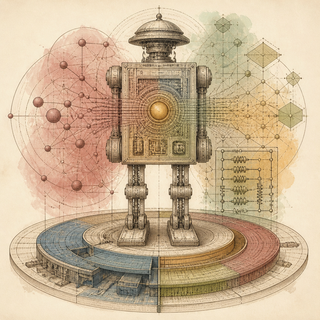
Disclaimer: This blog post is a simplified summary of published research for educational purposes. The accompanying illustration is artistic and does not depict actual model architectures, data, or experimental results. Always refer to the original paper for technical details.