“Physics-informed spatiotemporal transformer for groundwater contamination source identification” is exactly the kind of phrase that makes normal humans slowly close the laptop and go touch grass. Fair. But beneath the jargon pile is a genuinely useful question: if some industrial site leaks something nasty underground, can we figure out where it came from before the pollution plume turns into a slow-motion crime scene?
Yuanbo Ge, Weihong Zhang, Wenxi Lu, and Jun Dong tackle that problem in Water Research with a model called Pi-STT, short for Physics-informed Spatiotemporal Transformer. Yes, even groundwater has transformer models now. Attention really did become the duct tape of machine learning. Somewhere, a GPU is sighing.
The Mystery Is Underground, Which Is Rude
Groundwater contamination source identification, or GCSI, is environmental detective work with terrible visibility. You do not get a neat CCTV clip of the leak. You get a handful of monitoring wells, some noisy concentration readings, maybe gaps in time, and a subsurface geology situation that behaves like a lasagna assembled during an earthquake.
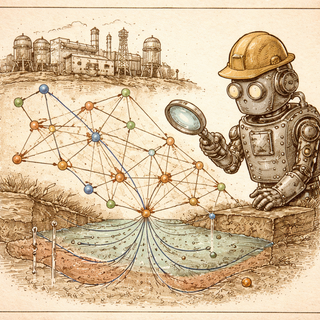
Traditional approaches often use numerical inversion. In plain English: build a groundwater flow and transport simulator, guess a possible source, run the simulator, compare the result to observations, then repeat until your computer and your patience both need a nap. Methods like simulation-optimization, stochastic/statistical inversion, and filtering can work, but they get expensive and wobbly when observations are sparse, noisy, or discontinuous.
That is the mess Pi-STT walks into wearing a tiny machine-learning hard hat.
What Pi-STT Is Actually Doing
Transformers are famous because of language models, but the core trick is not “writing suspiciously confident emails.” It is attention: the model learns which pieces of input matter to other pieces. In text, that means connecting words across a sentence. In groundwater, it means connecting measurements across space and time.
Pi-STT uses that idea to look at monitoring data from multiple wells over multiple times. Instead of treating each reading like an isolated little spreadsheet cell with abandonment issues, it tries to learn the larger pattern: how contamination spreads, when signals appear, and how the plume’s history points backward to the source.
The “physics-informed” part matters because pure neural networks can be brilliant little pattern goblins. Sorry, pattern machines. They can fit data beautifully while quietly violating the laws of transport physics like a teenager ignoring curfew. Pi-STT adds physical constraints into the loss function, so the model is rewarded not just for matching observations, but for staying consistent with groundwater behavior.
That is the central bet: use deep learning for speed and pattern recognition, but keep physics in the room so the model does not start inventing hydrology fan fiction.
Why Sparse Data Is the Whole Problem
The paper focuses on sparse and discontinuous monitoring scenarios. That is not a niche inconvenience. It is the default setting for real sites. Wells cost money. Sampling campaigns miss dates. Sensors get noisy. Industrial layouts hide pipes, tanks, and underground structures in ways that make “just collect more data” sound adorable.
Ge and colleagues compare Pi-STT against three indirect inversion pipelines using a ResNet surrogate model paired with different algorithms: GOA for simulation-optimization, DREAM for stochastic statistics, and EnKF for simulation-filtering. That comparison is useful because it does not merely ask, “Can our neural network beat a straw man?” Oh wonderful, another paper dunking on a baseline from 2009. Instead, the baselines represent serious families of inversion methods.
Across hypothetical and real enterprise cases, Pi-STT reportedly achieved the lowest mean relative errors and the shortest computational times. In noise and sparsity tests for steady-flow and transient-flow cases, relative errors stayed below 10 percent even when noise increased and temporal observation windows shrank. That is the sort of robustness claim worth paying attention to, with the usual adult supervision: replication, broader field validation, and uncertainty analysis still matter.
The Bigger Pattern: Physics Plus Learning
This paper fits a broader movement in environmental modeling: do not make AI choose between “learn from data” and “respect equations.” Recent reviews of physics-informed neural networks in groundwater science describe the field moving from tidy synthetic examples toward messier heterogeneous aquifer problems, while still wrestling with training stability, boundary conditions, uncertainty, and generalization across sites.
Related work is heading in the same direction. A 2025/2026 Journal of Hydrology study used physics-informed deep learning for sparse groundwater source identification and reported about 20 m mean spatial errors in simulation and field-based cases. Another 2026 paper in Journal of Contaminant Hydrology applied transformer models to identify time-varying contaminant discharge rates. A 2024 Water paper explored two-stage inversion with deep-learning surrogates. Everyone is basically circling the same practical dream: make source identification faster, less brittle, and less dependent on having a monitoring network designed by billionaires.
What This Could Change
If methods like Pi-STT hold up, they could help environmental engineers triage contaminated sites faster. That means quicker source localization, better remediation planning, and less time spent running endless inversion loops while the plume continues its underground sightseeing tour.
The real-world impact is not “AI saves groundwater,” because please, let us all unclench. The impact is more practical: better decision support when data are incomplete and the clock matters. Regulators, site managers, and remediation teams could use tools like this to narrow likely source zones, test scenarios, and decide where additional wells or cleanup actions should go.
There are still hard questions. How does Pi-STT behave on radically different geology? How well does it quantify uncertainty? Can it handle multiple overlapping sources, weird chemicals, fractured media, or monitoring networks designed by someone’s cousin in 1987? Those are not footnotes. They are the difference between a promising research model and something you would trust near drinking water.
Still, the idea is strong: give the model both memory and manners. Let attention connect the sparse clues. Let physics keep the story plausible. For groundwater detective work, that is a pretty good upgrade from “guess, simulate, repeat, cry quietly.”
References
-
Ge, Y., Zhang, W., Lu, W., & Dong, J. “Critical elements for groundwater contamination source identification (GCSI) in sparse/discontinuous data scenarios: Physical constraints and spatiotemporal information.” Water Research, 2026. DOI: 10.1016/j.watres.2026.126080. PMID: 42114475
-
Zhang, L. et al. “Physics-informed deep learning for groundwater contamination sources identification under sparse monitoring.” Journal of Hydrology, 2026. DOI: 10.1016/j.jhydrol.2025.134691
-
“Identification of time-varying contaminant discharge rates using a data-driven Transformer model.” Journal of Contaminant Hydrology, 2026. DOI: 10.1016/j.jconhyd.2026.104847
-
Xu, Z. et al. “Groundwater Contamination Source Recognition Based on a Two-Stage Inversion Framework with a Deep Learning Surrogate.” Water, 2024. DOI: 10.3390/w16131907
-
Ma, Q. et al. “Physics-informed neural networks for groundwater: evidence, limits, and a roadmap.” Environmental Earth Sciences, 2026. DOI: 10.1007/s12665-026-12866-9
-
Vaswani, A. et al. “Attention Is All You Need.” arXiv: 1706.03762, 2017.
Disclaimer: This blog post is a simplified summary of published research for educational purposes. The accompanying illustration is artistic and does not depict actual model architectures, data, or experimental results. Always refer to the original paper for technical details.