A couple of years from now, the overnight radiology shift at a small hospital might feel less like a bottleneck and more like a well-run garage: one human expert at the lift, an AI standing beside them with a flashlight, already pointing at the loose belt, the oil leak, and the weird rattle before the next case even rolls in. That is the future this new chest X-ray paper is trying to tune up, and for once the authors did not just rev the engine in the lab. They took it onto the road. [1]
Pop the Hood
The system is called Janus-Pro-CXR, and its job is simple to describe but annoyingly hard to do well: look at a chest radiograph, recognize important findings, and help produce a proper clinical report. Chest X-rays are one of medicine’s everyday workhorses. They are fast, cheap, and everywhere, but reading them still takes trained eyes and time. Both are in short supply, especially outside big academic centers. [1][2]
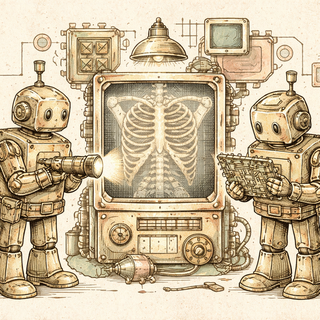
Under the hood, Janus-Pro-CXR is a lightweight multimodal model. In plain English, that means it has to mesh two moving parts: image understanding and medical language. Think of it like an engine mated to a transmission. One side turns pixels into useful signals, the other turns those signals into report text a clinician can actually use. If that coupling slips, you get the AI version of a stripped gear: pretty sentences attached to the wrong finding. [1][6]
The paper’s main pitch is not “look, our model can write fancy prose.” Radiologists do not need Shakespeare with a stethoscope. They need something that spots the important stuff, stays structured, and does not wander off inventing nonsense like a dashboard warning light wired to the coffee maker.
What They Actually Tested
This is the part that makes the study worth paying attention to. The authors did not stop at retrospective benchmarks, where AI often posts suspiciously good numbers and then develops stage fright in a real clinic. They ran a multicenter prospective study involving 296 patients and looked at what happened when junior radiologists used the system in practice. [1]
The result: with AI assistance, report quality scores improved, and interpretation time dropped by 18.3%, from about 147.6 seconds to 120.6 seconds on average. That is not sci-fi. That is a few dozen seconds per case, over and over, across a packed worklist. In workflow terms, that is less idling and better fuel efficiency. [1]
The model also showed strong diagnostic performance for key thoracic findings such as pneumonia, pleural effusion, and pneumothorax, though the paper is clear that subtler findings like fractures remain tougher terrain. That honesty matters. A system that nails common, high-value abnormalities but still struggles on edge cases is a useful shop tool. A system advertised as flawless is usually selling chrome, not torque. [1]
Why This One Feels Different
Radiology AI has had plenty of concept cars. Some looked sleek, then face-planted on generalization, workflow fit, or trust. This paper tries to address the usual breakdown points.
First, the model is small by current standards, built on a 1B-parameter base rather than a hulking giant that needs a data center and three prayers to boot. That matters for hospitals running ordinary hardware, and especially for resource-limited settings where “just add eight more GPUs” is not a real plan. [1]
Second, this study leans into human-AI collaboration, not replacement. That lines up with other recent work. A 2025 Nature Medicine paper showed clinician-AI collaboration can improve radiology report generation, especially when the model acts like an assistive draft partner rather than an unsupervised ghostwriter. A 2025 Radiology study likewise found a domain-specific generative model could produce chest X-ray reports with high acceptability, clearly beating a general-purpose model on clinical usefulness. [3][4]
That broader trend matters because general-purpose vision-language models are clever, but in medicine they can still overheat, hallucinate, or miss the weird little gasket leak that ends up being the whole problem. Reviews of medical vision-language models keep landing on the same theme: specialized training, careful evaluation, and clinical validation are not optional extras. They are the brakes. [5][6]
The Part Nobody Should Skip
This does not mean radiologists are getting replaced by a chatbot in scrubs. If anything, the current moment looks more like power steering than full self-driving. Recent RSNA coverage has emphasized workflow integration, reliability, and AI literacy as the real issues, not robot takeover fantasies. [2][7]
The practical upside is still big. If a lightweight model can consistently help produce faster, cleaner reports in smaller hospitals and busy primary settings, that could reduce delays, standardize reporting, and free human experts to focus on the messy cases where judgment matters most. In mechanic terms, let the machine handle the routine diagnostics faster so the experienced tech can spend time on the engine that sounds like it swallowed a spoon.
That is the real appeal of this paper. It is not magic. It is shop-floor engineering. The authors took a general model, tuned it for one job, tested it where the oil stains actually are, and showed a modest but real improvement. In AI medicine, that counts as progress with a torque wrench instead of a fog machine.
References
- Bai Y, Zhang R, Lei Y, et al. A DeepSeek-powered AI system for automated chest radiograph interpretation in clinical practice. Nature Communications. 2026. DOI: 10.1038/s41467-026-72680-6. PubMed: 42098114.
- RSNA. Using LLMs in Radiology. July 2025. https://www.rsna.org/news/2025/july/using-llms-in-radiology.
- Tanno R, Cuadros J, Ke J, et al. Collaboration between clinicians and vision-language models in radiology report generation. Nature Medicine. 2025;31:599-608. DOI: 10.1038/s41591-024-03302-1. PubMed: 39511432.
- Hong EK, Ham J, Roh B, et al. Diagnostic Accuracy and Clinical Value of a Domain-specific Multimodal Generative AI Model for Chest Radiograph Report Generation. Radiology. 2025;314(3):e241476. DOI: 10.1148/radiol.241476. PubMed: 40131111.
- Hartsock I, Rasool G. Vision-language models for medical report generation and visual question answering: a review. Frontiers in Artificial Intelligence. 2024;7:1430984. DOI: 10.3389/frai.2024.1430984. PMCID: PMC11611889.
- Zambrano Chaves JM, Huang SC, Xu Y, et al. A clinically accessible small multimodal radiology model and evaluation metric for chest X-ray findings. Nature Communications. 2025. DOI: 10.1038/s41467-025-58344-x. PMCID: PMC11962106.
- Mirak SA, Tirumani SH, Ramaiya N, Mohamed I. The Growing Nationwide Radiologist Shortage: Current Opportunities and Ongoing Challenges for International Medical Graduate Radiologists. Radiology. 2025;314:e232625. DOI: 10.1148/radiol.232625.
Disclaimer: This blog post is a simplified summary of published research for educational purposes. The accompanying illustration is artistic and does not depict actual model architectures, data, or experimental results. Always refer to the original paper for technical details.