Magnets remembering things is nothing new - that's literally how your hard drive works. But magnets that can learn? That fire in patterns mimicking actual brain cells? Researchers at Beihang University just pulled that off with devices smaller than a virus, and the implications are wilder than they sound.
The Problem with Digital Brains
Here's the awkward truth about AI: for all our talk of "neural networks," the hardware running them is about as brain-like as a calculator is to a dolphin. Traditional chips shuttle data back and forth between memory and processing units like a very tired postal worker, burning through electricity the whole time. Your brain, meanwhile, runs on roughly 20 watts - enough to power a couple LED bulbs - while casually recognizing faces, composing poetry, and deciding what to have for lunch.
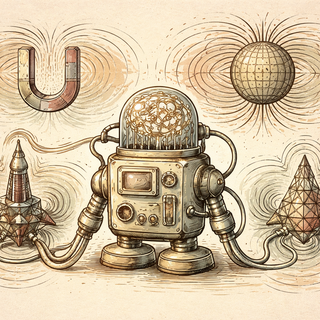
The quest for genuinely brain-inspired hardware has led researchers to neuromorphic computing, where the goal is building physical devices that actually behave like neurons and synapses. The dream? Chips that only compute when something interesting happens, rather than constantly crunching numbers whether they need to or not.
Enter the Spintronic Synapse
The team behind this study (Chen et al., 2026) tackled a particularly stubborn problem: magnetic tunnel junctions. These nanoscale sandwiches of magnetic layers are beloved by hardware engineers for being fast, energy-efficient, and basically immortal in terms of write cycles. The catch? They're stubbornly binary - like light switches that only know "on" and "off."
Real synapses don't work that way. When neurons fire together repeatedly, the connection between them strengthens (or weakens) in smooth, analog gradations. This is how learning happens - through spike-timing-dependent plasticity, or STDP, where the precise timing of neural spikes determines whether a connection gets stronger or weaker.
The breakthrough here involves what's called "exchange bias" - a phenomenon where antiferromagnetic materials pin ferromagnets in specific orientations. By carefully engineering the spatial distribution of antiferromagnets within their 100-nanometer devices, the researchers coaxed these junctions into exhibiting smooth, continuous resistance states. No more binary on-off switching - these magnets learned to be analog.
Neurons That Actually Spike
But wait, there's more. The same exchange-bias magnetic tunnel junctions (EB-MTJs, if you want to sound smart at parties) can also mimic actual neuron behavior.
Real neurons don't just passively receive signals - they accumulate incoming electrical activity until they hit a threshold, then fire a spike and reset. This "leaky-integrate-and-fire" behavior is fundamental to how biological neural networks process information. Previous spintronic devices struggled to replicate this because they lacked the right switching dynamics.
The EB-MTJs pulled it off with 0.4-nanosecond pulses, operating at gigahertz frequencies. That's fast enough to handle real-time processing of sensory data - like, say, recognizing hand gestures from a camera feed.
96% Accuracy on Gestures (No GPUs Harmed)
To prove this wasn't just a lab curiosity, the team built a convolutional spiking neural network using their EB-MTJ synapses and neurons, then trained it to recognize hand gestures. Using a hybrid learning approach combining backpropagation with STDP, they hit 96% accuracy.
For context, recent work on spiking neural networks for gesture recognition has achieved similar accuracy, but typically on power-hungry conventional hardware. The promise here is doing it with devices that consume a fraction of the energy.
Why This Matters Beyond the Lab
The AI industry has an energy problem. Training GPT-4 reportedly consumed enough electricity to power a small town for a year, and that's just for training - running inference on millions of queries daily adds up fast. IBM's NorthPole chip showed that brain-inspired designs can achieve massive efficiency gains, but we're still searching for the right physical building blocks.
Spintronic devices like these EB-MTJs offer something unique: non-volatility (they remember without power), near-unlimited endurance, and now - thanks to this work - both analog synaptic behavior and realistic neuronal dynamics in a single platform. The co-integration of artificial synapses and neurons on the same chip is a significant step toward practical neuromorphic systems.
Could this eventually help power more efficient AI tools? It's not unreasonable to imagine future versions of on-device processing - the kind that might make browser-based image enhancement or local AI inference faster and greener - benefiting from similar spintronic advances.
The Road Ahead
This isn't a finished product you'll find in your phone next year. Scaling up from proof-of-concept to manufacturable chips requires solving integration challenges, variability issues, and training algorithms optimized for these specific device physics. But the fundamentals are promising: tiny, fast, energy-efficient, and - finally - genuinely brain-like in behavior.
The era of neuromorphic hardware is still dawning, but the magnets are learning.
References
-
Chen, Z., Zhu, D., Du, A., et al. (2026). Nanoscale exchange-bias magnetic tunnel junctions enabled memristive synapse and leaky-integrate-fire neuron for neuromorphic computing. Nature Communications. DOI: 10.1038/s41467-026-70802-8
-
Zhou, J., et al. (2024). Domain wall magnetic tunnel junction-based artificial synapses and neurons for all-spin neuromorphic hardware. Nature Communications, 15, 4649. DOI: 10.1038/s41467-024-48631-4. PMID: 38806482
-
Grollier, J., et al. (2020). Neuromorphic spintronics. Nature Electronics, 3, 360-370. PMC: PMC7754689
-
Chen, X., et al. (2023). Room-temperature magnetoresistance in an all-antiferromagnetic tunnel junction. Nature, 613, 490-495. DOI: 10.1038/s41586-022-05461-y. PMID: 36653565
-
Ceoletta, G., et al. (2024). Efficient Gesture Recognition on Spiking Convolutional Networks Through Sensor Fusion of Event-Based and Depth Data. arXiv: 2401.17064
Disclaimer: This blog post is a simplified summary of published research for educational purposes. The accompanying illustration is artistic and does not depict actual model architectures, data, or experimental results. Always refer to the original paper for technical details.