What if your skin could wear a tiny, breathable control panel that drains sweat like a sci-fi rain gutter and lets your muscle twitches drive a robot dog? That sounds like something a prop builder rejected for being too much, but Li and colleagues just built a version of it in Nano-Micro Letters DOI: 10.1007/s40820-026-02252-2.
The jobsite problem is simple: electronic skin sounds great until the worker starts sweating. Then the whole system turns into a soggy blueprint. Sweat pools between the sensor and skin, signal quality drops, adhesives loosen, and the data starts wobbling around like a ladder on gravel.
This paper tackles that failure point head-on. Not with a bigger battery. Not with a fancy neural network wearing a hard hat and pretending to be the whole solution. The foundation here is materials engineering.
The Pitcher Plant Did the Plumbing
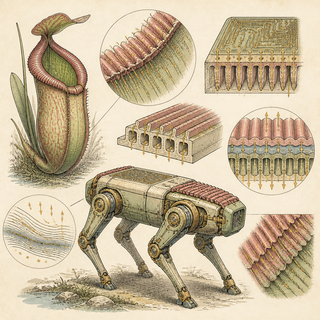
The team copied a trick from Nepenthes, the pitcher plant. Its rim, called the peristome, has microstructures that move liquid in one preferred direction. Nature built a one-way drainage channel because insects apparently needed another bad day.
The researchers turned that idea into SPTL, a Janus bilayer electronic skin. "Janus" just means the two sides behave differently: one side is hydrophobic SBS, facing the skin, and the other is hydrophilic PAN/TPU, facing outward. Put together, the layers create what the authors call a liquid diode. Like an electrical diode lets current move mostly one way, this membrane pushes sweat outward and resists backflow.
On the spec sheet, it is not just decorative flashing. The device reached a cumulative one-way transport index of 956.36, stretched to 627%, showed air permeability of 20.02 mm s^-1, and hit pressure sensitivity of 7.39 kPa^-1. That is a lot of performance packed into something roughly behaving like breathable tape with a graduate degree.
Good Signals Need a Dry Foundation
Electronic skin has been chasing the same checklist for years: soft, stretchy, thin, durable, skin-safe, sensitive, and able to collect useful data without annoying the person wearing it. Reviews in the field keep circling the same load-bearing requirements: conformability, breathability, adhesion, and stable electrical behavior over time DOI: 10.1146/annurev-bioeng-103122-032652, DOI: 10.1038/s42256-023-00760-z.
SPTL aims at the ugly middle of that Venn diagram. It is not only a sweat-management membrane. It also acts as a multimodal sensor. The authors report Morse-code pressure sensing, non-contact capacitive sensing, and electrophysiology recordings: EEG, EMG, ECG, and EOG.
EMG, short for electromyography, records electrical activity from muscles. Think of it as listening to the wiring behind a movement before the drywall goes up. Surface EMG is already used for gesture interfaces and prosthetic control, but sweat and shifting skin contact can make the signal messy. If the electrode loses grip, your "move left" command can start looking like "maybe order tacos." Machines hate ambiguity, except language models, which seem to collect it recreationally.
The paper says SPTL captured cleaner physiological signals than commercial Ag/AgCl electrodes in their tests. That is the part with real scaffolding underneath the robot demo. Better electrodes mean better input data. Better input data means the model has less junk to sort through. Every ML engineer knows this rule: if the sensor feed is sludge, the model becomes an expensive sludge interpreter.
The Machine Learning Is the Site Supervisor
For the teleoperation setup, SPTL electrodes captured EMG signals from hand gestures. The pipeline cleaned the data, trimmed artifact-heavy segments, used a Butterworth band-pass filter from 0.1 to 50 Hz, normalized the signals, and fed sliding windows into a lightweight Transformer encoder. Nothing mystical. Just a practical workflow: clean the lumber, measure twice, cut once.
The system classified five robot commands: up, down, left, right, and home. After fine-tuning, the reported accuracy exceeded 99% after 50 epochs, with 100% accuracy for up/down and home, and under 3% confusion between left and right. The same e-skin also recognized handwritten letters A-D with over 95% accuracy.
That is a neat demonstration because it ties the whole structure together: sweat routing, flexible circuits, clean EMG, and ML classification. Remove one load-bearing layer and the building starts making noises you do not want to hear.
Where This Could Actually Matter
If this holds up beyond lab conditions, the use cases are easy to see: rehabilitation robots, prosthetic control, remote machine operation, long-duration health monitoring, and wearable interfaces for hot or humid workplaces. The quadruped robot demo is flashy, sure, but the practical value is quieter: a wearable sensor that keeps working while the person wearing it behaves like a person, meaning they move, sweat, and occasionally ignore ideal laboratory protocol.
The limits are still real. The study needs broader validation across more users, longer wear times, messier environments, and repeated real-world cleaning or reuse. Lab demos are blueprints, not occupied buildings. You still need inspections.
But the core idea is solid: stop treating sweat as an afterthought. Build drainage into the foundation.
References
-
Li, Y., Zheng, K., Zhang, G. et al. "Intelligent Breathing Electronic Skin Inspired by Nepenthes for Active Sweat Management, Multimodal Sensing and High-Fidelity Electromyographic Teleoperation Using Machine Learning." Nano-Micro Letters 18, 401, 2026. https://doi.org/10.1007/s40820-026-02252-2
-
Koo, J. H. et al. "Electronic Skin: Opportunities and Challenges in Convergence with Machine Learning." Annual Review of Biomedical Engineering 26, 331-355, 2024. https://doi.org/10.1146/annurev-bioeng-103122-032652
-
Xu, C., Solomon, S. A., Gao, W. "Artificial Intelligence-Powered Electronic Skin." Nature Machine Intelligence 5, 1344-1355, 2023. https://doi.org/10.1038/s42256-023-00760-z
-
Min, J., Tu, J., Xu, C., Gao, W. "Skin-Interfaced Wearable Sweat Sensors for Precision Medicine." Chemical Reviews 123, 5049-5138, 2023. https://doi.org/10.1021/acs.chemrev.2c00823
-
Zhang, P. et al. "A Three-Dimensional Liquid Diode for Soft, Integrated Permeable Wearable Electronics." Nature, 2024. PubMed PMID: 38538792
Disclaimer: This blog post is a simplified summary of published research for educational purposes. The accompanying illustration is artistic and does not depict actual model architectures, data, or experimental results. Always refer to the original paper for technical details.