Ladies and gentlemen of the jury, the evidence shows that deep-tissue imaging has a classic problem. Light is useful, tissue is rude, and water behaves like the courtroom heckler nobody invited.
Sun and colleagues tackle this in Deep-Learning-Enhanced Bioimaging Via Energy Traps Regulated Lanthanide Nanoparticles, published in Angewandte Chemie International Edition in 2026. Their witnesses are lanthanide-doped nanoparticles, tiny optical agents that can emit near-infrared light. Near-infrared, especially the NIR-II window around 1000-1700 nm, matters because tissue scatters it less and produces less annoying background glow. Translation: the flashlight sees farther through the fog.
But Exhibit A is the trade-off. Erbium ions, Er3+, can emit around 1530 nm, which gives high optical resolution. Unfortunately, water absorbs around there, and biological tissue is basically a complicated water balloon with opinions. Meanwhile, probes emitting around 980 or 1060 nm can be brighter and penetrate deeper, but those shorter wavelengths scatter more, so the picture loses crispness. You get depth or sharpness. Pick one. Science loves a false choice almost as much as reviewers love asking for “one more experiment.”
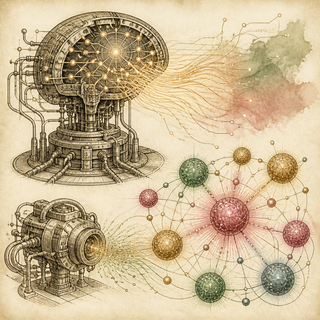
Exhibit B: Energy Traps
The authors submit a clever materials strategy: regulate energy flow inside the nanoparticles using “energy traps.” That sounds like something Wile E. Coyote would order from a photonics catalog, but the idea is sensible.
Lanthanide nanoparticles contain ions that can act like sensitizers and activators. Sensitizers, such as Yb3+ and Nd3+, absorb excitation energy. Activators, such as Er3+, emit useful light. By switching excitation wavelengths and steering directional energy transfer, the team can emphasize different emission channels. In plain English: the same tiny particle can be coaxed to glow in different useful ways, depending on how you poke it with light.
This matters because the system tries to combine the best witnesses from both sides. The short-wavelength channels bring brightness and penetration. The 1530 nm erbium channel brings spatial detail. Then deep learning steps in as the expert witness who has read the whole file and, unlike your phone autocomplete, does not immediately suggest “ducking.”
The AI Does Not Replace the Microscope
The deep-learning part is not magic glitter sprinkled over bad physics. The model uses information from multiple emission channels to reconstruct better images. The paper reports a 93% enhancement in imaging performance for short-wavelength probes. That is the claim on the record, and I submit to you that the interesting part is not just the number. It is the hybrid strategy: engineer the probe, then let computation fuse signals that no single channel can deliver alone.
This fits a broader trend. Bioimaging AI has moved beyond “throw a neural network at the pixels and hope the GPU interns survive.” Recent work argues for data-centric bioimage AI, where dataset quality, monitoring, and deployment behavior matter as much as model architecture. Cellpose3, for example, trains restoration models to make images more segmentable rather than merely prettier. Segment Anything for Microscopy adapts foundation models for microscopy segmentation. The field is learning a hard lesson: pretty pixels are nice, but usable biological evidence pays the bills.
If you have ever cleaned up a noisy photo, the analogy is familiar. Tools like combb2.io use AI image enhancement to denoise, deblur, and upscale images in everyday contexts. Bioimaging raises the stakes: the goal is not a sharper vacation photo, but a clearer view of vessels, tumors, biomarkers, or tissue structure.
The Cross-Examination
Now, counsel for skepticism may approach.
First, deep learning can hallucinate structure if trained poorly. In medicine-adjacent imaging, that is not a cute quirk. That is a potential false lead wearing a lab coat. Any method like this needs careful validation against ground truth, multiple tissue types, and imaging conditions it did not meet during training.
Second, nanoparticles need biological safety work. Brightness and clever energy transfer do not automatically answer questions about biodistribution, clearance, toxicity, dosing, or regulatory translation.
Third, point-of-care diagnostics sound appealing, but the road from elegant mouse imaging or phantom experiments to rugged clinical use is long. It includes hardware cost, calibration, operator variability, and the universal law that anything used in a clinic must survive real-world chaos, including someone placing the cable exactly where it should not go.
Verdict
I submit to you that this paper is compelling because it refuses to choose between chemistry and computation. The nanoparticle design improves what the camera can physically receive. The deep-learning network improves how those signals get interpreted. That pairing feels like the future of bioimaging: not AI replacing optics, but AI sitting beside better optical probes, taking notes, and occasionally whispering, “Objection, that blur is misleading.”
The verdict: promising, technically interesting, and worth watching - with the usual condition that reproducibility, safety, and broad validation must survive appeal.
References
-
Sun, R., Lu, M., Wang, Z., Gao, W., Chen, J., Liu, X., Zhang, H., Bednarkiewicz, A., Zhang, F., & Sun, L. “Deep-Learning-Enhanced Bioimaging Via Energy Traps Regulated Lanthanide Nanoparticles.” Angewandte Chemie International Edition (2026). DOI: 10.1002/anie.3293945. PMID: 42360008.
-
Li, H., Liu, H., Wong, K., & All, A. H. “Lanthanide-doped upconversion nanoparticles as nanoprobes for bioimaging.” Biomaterials Science 12, 4650-4663 (2024). DOI: 10.1039/D4BM00774C.
-
Bandyopadhyay, K., Singh, S., Chaturvadi, V. K., Singh, A. K., & Verma, A. “Recent advances in NIR-II emitting nanomaterials.” Journal of Materials Chemistry B 13, 9720-9744 (2025). DOI: 10.1039/D5TB00911A.
-
Stringer, C., & Pachitariu, M. “Cellpose3: one-click image restoration for improved cellular segmentation.” Nature Methods 22, 592-599 (2025). DOI: 10.1038/s41592-025-02595-5.
-
Archit, A. et al. “Segment Anything for Microscopy.” Nature Methods 22, 579-591 (2025). DOI: 10.1038/s41592-024-02580-4.
Disclaimer: This blog post is a simplified summary of published research for educational purposes. The accompanying illustration is artistic and does not depict actual model architectures, data, or experimental results. Always refer to the original paper for technical details.