Before: a porous cloak works only when the background behaves. After: it changes its tiny plumbing on command.
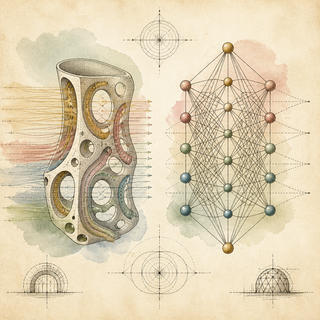
That is the trick in “Programmable Hydrodynamic Invisibility Enabled by Machine-Learning-Guided Metamaterials” by Zhang and colleagues, a paper about making objects harder to “see” through fluid flow in porous media. Not invisible to your eyeballs. Invisible to pressure and flow patterns. Which is somehow nerdier and cooler, like a spy movie written by a groundwater engineer with excellent grant funding.
The Cloak Is Not Magic. It Is Plumbing With Boundary Issues.
Hydrodynamic invisibility means fluid moves around an object as if the object were not there. In porous materials, that usually means controlling permeability, the “how easily can fluid get through this stuff?” property. Darcy’s law, the old reliable of porous-media flow, says flow depends on pressure gradients and permeability. Basically: push water through a sponge, and the sponge’s internal structure decides whether the water strolls through politely or files a complaint.
Metamaterials enter the scene because their behavior comes less from what they are made of and more from how they are structured. Tiny holes, channels, layers, and geometries can make the bulk material steer flow in strange ways. Think of it as architecture for liquids. The fluid does not know it is being manipulated. It just follows the hallway signs.
Earlier hydrodynamic cloaks could guide flow around hidden regions, but many were static. They were designed for one background permeability. Change the surrounding medium, and the cloak starts acting like a fake mustache in a high-resolution security camera. Technically present. Not persuasive.
Machine Learning Gets the Wrench
Zhang et al. tackle that brittleness with a tunable-permeability shell and a machine-learning-guided inverse-design framework. The cloak is the model system. The broader idea is bigger: instead of hand-designing a special geometry every time you want a certain permeability response, train a model to map “desired flow behavior” to “manufacturable structure.”
This is where machine learning earns its snacks. Inverse design is hard because many microstructures can produce similar macroscopic behavior, and the design space is enormous. It is like asking, “What exact maze shape gives me this exact traffic pattern?” except the cars are water molecules and the city planner is a neural network wearing safety goggles.
The paper reports that the shell maintains cloaking across high, medium, and low background permeabilities, and can also perform hydrodynamic camouflage, matching prescribed exterior reference flows. That matters because real porous environments do not politely stay constant. Soil, tissue, filters, membranes, gels, and microfluidic materials vary. Static cloaks are neat demos. Adaptive ones are closer to useful tools.
Why This Is More Than a Party Trick for Fluids
If the results reproduce and scale, programmable hydrodynamic metamaterials could matter in places where flow must be controlled without causing a mess. The authors point to separation science, microfluidics, flow-network engineering, soft-matter biomechanics, and poroelastic systems.
Translation: better filters, smarter lab-on-a-chip devices, less disruptive sensors, controlled transport through soft biological-like materials, and maybe new ways to route fluids through complex networks. Not “the ocean can no longer perceive your kayak.” Calm down, Aquaman.
The bigger research trend is also worth noticing. Recent reviews show machine learning is becoming a serious tool for metamaterial and porous-media design, especially when physics simulations are expensive or when researchers need inverse mappings from desired properties back to structures. ML is not replacing fluid mechanics here. It is more like the intern who can search 40,000 design options before lunch while the physicist checks whether any of them violate reality.
Good arrangement. Nobody wants a neural network free-soloing Navier-Stokes.
The Catch, Because Science Has Rent Due
This work still lives in controlled experimental settings. Hydrodynamic cloaking depends heavily on flow regime, geometry, fabrication tolerances, and whether the simplified physics still applies once things get messy. Many cloaking methods work best in low-Reynolds-number or Darcy-like conditions, where equations behave nicely. Real fluids, unfortunately, love turbulence, clogging, deformation, and other forms of workplace drama.
There is also the manufacturability question. A machine-learning model can suggest geometry, but someone has to build it reliably, tune it repeatedly, and keep it working under changing conditions. The paper’s experimental validation across different permeabilities is the good part. The next hard part is seeing how rugged this strategy becomes outside the tidy sandbox.
Still, the direction is excellent: use physics to define what the material should do, use machine learning to find structures that can do it, and use experiments to keep everyone honest. That last step is key. Otherwise, you just have a model confidently designing a magical sponge, and we already have enough confident nonsense in the world.
References
-
Lili Zhang, Yiyang Zhang, Jinrong Liu, Fubao Yang, Peng Jin, and Jiping Huang. “Programmable Hydrodynamic Invisibility Enabled by Machine-Learning-Guided Metamaterials.” Advanced Materials, 2026. DOI: 10.1002/adma.73690. PMID: 42274026.
-
M. Delpisheh et al. “Leveraging machine learning in porous media.” Journal of Materials Chemistry A, 2024, 12, 20717-20782. DOI: 10.1039/D4TA00251B.
-
F. Tabassum et al. “Machine intelligence in metamaterials design: a review.” Oxford Open Materials Science, 2024, 4(1), itae001. DOI: 10.1093/ooms/itae001.
-
J. Lee, D. Park, M. Lee, H. Lee, K. Park, I. Lee, and S. Ryu. “Machine learning-based inverse design methods considering data characteristics and design space size in materials design and manufacturing: a review.” Materials Horizons, 2023, 10, 5436-5456. DOI: 10.1039/D3MH00039G.
-
“On-demand zero-drag hydrodynamic cloaks resolve D’Alembert paradox in viscous potential flows.” Microsystems & Nanoengineering, 2024. DOI: 10.1038/s41378-024-00824-z.
Disclaimer: This blog post is a simplified summary of published research for educational purposes. The accompanying illustration is artistic and does not depict actual model architectures, data, or experimental results. Always refer to the original paper for technical details.