Metallurgists have spent centuries perfecting alloys by adding tiny pinches of this and that to a main ingredient - a dash of carbon to iron, a sprinkle of chromium for corrosion resistance. But what happens when you throw out the rulebook entirely and mix five or more elements in roughly equal amounts? You get multi-principal element alloys (MPEAs), and they're proving to be absurdly good at surviving conditions that would make conventional materials weep.
A new review published in Advanced Science takes a deep dive into MPEA-based films and coatings, and the findings read like a materials science wish list [1]. These coatings can handle extreme heat, shrug off corrosive chemicals, resist wear, and still maintain impressive mechanical strength. The catch? Getting them to behave predictably requires understanding a level of atomic chaos that makes quantum mechanics look straightforward.
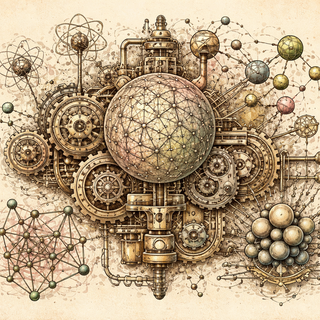
The Cocktail Party Effect, But For Atoms
Here's what makes MPEAs weird and wonderful: when you mix five or more elements together in near-equal proportions, the resulting atomic structure becomes almost deliberately disordered. This "high configurational entropy" - a fancy way of saying the atoms arrange themselves in maximally unpredictable ways - actually creates stability. It's counterintuitive, like a party where everyone being slightly lost somehow makes everything run smoothly.
This disorder creates what researchers call "lattice distortion." Imagine a brick wall where every tenth brick is slightly too big or too small. That sounds like a structural nightmare, but for MPEAs, these atomic size mismatches create internal stresses that actually strengthen the material. Dislocations - the defects that normally let metals bend and eventually fail - have a much harder time moving through this atomic obstacle course.
The atoms in MPEAs also diffuse sluggishly compared to conventional alloys. When you heat most metals, atoms start migrating around like restless commuters, which eventually degrades the material's properties. MPEA atoms, meanwhile, seem content to stay put, giving these materials exceptional thermal stability [2].
From Bulk to Films: Thinking Small Gets Big Results
The review focuses specifically on thin films and coatings made from MPEAs, which is where things get really interesting. When you deposit these materials as nanoscale layers, you gain additional tools for tuning their properties.
Researchers have developed techniques to create "heterostructures" - alternating layers of different compositions or phases, sometimes just a few atoms thick. These interfaces between layers act as barriers to crack propagation and dislocation movement, boosting hardness without sacrificing flexibility. Some teams have achieved hardness values exceeding 40 GPa (for reference, that's harder than most ceramics) while maintaining reasonable plasticity [1].
The manufacturing methods read like a materials science greatest hits album: magnetron sputtering, arc deposition, pulsed laser deposition, and electrochemical techniques all make appearances. Each method offers different advantages for controlling grain size, texture, and composition gradients.
The Machine Learning Revolution Arrives
Perhaps the most exciting development is the integration of machine learning into MPEA design. With potentially millions of possible element combinations to explore, traditional trial-and-error experimentation would take centuries. ML models trained on existing experimental data can now predict which compositions might yield specific properties, dramatically narrowing the search space [3].
High-throughput synthesis methods complement this approach, allowing researchers to create and test hundreds of compositions on a single substrate. The combination of computational prediction and rapid experimental validation is accelerating discovery in ways that would have seemed like science fiction a decade ago.
Where These Coatings Actually Matter
The applications list for MPEA coatings reads like an extreme environments checklist. Aerospace components face simultaneous demands for heat resistance, oxidation protection, and mechanical strength - MPEAs can deliver all three. Biomedical implants need to resist corrosion from body fluids while maintaining biocompatibility, and certain MPEA compositions show promise here too. Nuclear reactors, cutting tools, and tribological surfaces in harsh environments are all potential beneficiaries [1].
The review also highlights emerging work on thermal barrier coatings, where the sluggish diffusion characteristics of MPEAs could extend component lifetimes significantly compared to conventional yttria-stabilized zirconia coatings.
The Road Ahead
Challenges remain, naturally. The parameter space for MPEA optimization is enormous, and our understanding of how composition maps to properties is still developing. Manufacturing scale-up from laboratory demonstrations to industrial production presents its own hurdles.
But the trajectory is clear: by embracing atomic complexity rather than fighting it, materials scientists have unlocked a new design paradigm. The next generation of extreme-environment coatings may well be born from this beautiful chemical chaos.
References
-
Cao, J., Sun, J., Li, H., Wu, Z., & An, X. (2025). Mastering Complexity toward High-Performance Multi-Principal Element Alloy-Based Films and Coatings: A Review on Microstructural Regulation and Property Optimization. Advanced Science. DOI: 10.1002/advs.202514258
-
Miracle, D. B., & Senkov, O. N. (2017). A critical review of high entropy alloys and related concepts. Acta Materialia, 122, 448-511. DOI: 10.1016/j.actamat.2016.08.081
-
Hart, G. L. W., Mueller, T., Tober, C., & Curtarolo, S. (2021). Machine learning for alloys. Nature Reviews Materials, 6(8), 730-755. DOI: 10.1038/s41578-021-00340-w
Disclaimer: This blog post is a simplified summary of published research for educational purposes. The accompanying illustration is artistic and does not depict actual model architectures, data, or experimental results. Always refer to the original paper for technical details.