The weather report for aggressive drone flight used to read like a permanent storm warning. Heavy turbulence, low visibility, near-certain crashes when a quadrotor tried to squeeze through a gap narrower than a mail slot. Skies stayed closed. Then a team led by Tianyue Wu and Fei Gao rolled in like a high-pressure front and cleared the whole forecast - their drone now tilts itself sideways and shoots through a 5-centimeter gap it has never seen before, with no map, no GPS coordinates for the hole, and absolutely no chill.
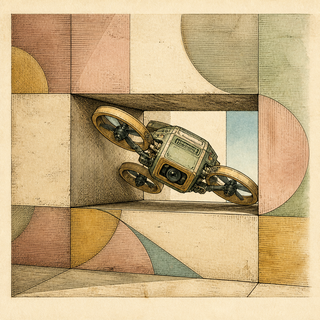
Roll for initiative. The party has entered the dungeon.
The Quest: One Gap, Zero Information
Here is the encounter our adventuring quadrotor faces. There is a rectangular gap in a wall. It might be rotated up to 90 degrees, standing on its end like a coin slot. The clearance is 5 centimeters - basically the width of a polite handshake. The drone does not know where the gap is. It does not know which way it is turned. It just has onboard cameras (its Perception check) and proprioception, meaning its internal sense of where its own limbs are (its Wisdom save).
To get through, the quadrotor has to do something genuinely athletic: tilt to a momentary banked attitude and exploit the asymmetry of its own airframe, slipping the narrow profile of its body through the opening. This is the special Euclidean group SE(3) flexing on us - position and orientation both have to be perfect at the same instant. Miss the timing and you take fall damage against a concrete wall.
Aggressive gap traversal has been a known boss fight for years. Falanga and colleagues pulled off versions of it back in 2017, but with external motion-capture systems doing the heavy navigation lifting (Falanga et al., ICRA 2017, DOI:10.1109/ICRA.2017.7989679). This new work, published in Science Robotics, does it all from the drone's own lightweight sensors. No party member standing outside the dungeon shouting directions.
Leveling Up Through Reinforcement Learning
So how do you train a flying murder-frisbee to thread a needle? The team used reinforcement learning with end-to-end policy distillation, all in simulation. Think of RL as the world's most patient (and most expensive) tabletop campaign: the agent tries an action, the GPU dungeon master narrates the consequences, and rewards trickle in for progress. Over millions of attempts, a good policy emerges.
The catch is exploration. The solution space here is brutally restricted - almost every random flap of the rotors ends in a crash, so a naive model-free agent wanders the dungeon forever rolling natural 1s and learning nothing. Their fix is the clever bit: they seeded the training with trajectories from a model-based planner, basically handing the rookie adventurer a few pages of a strategy guide before throwing it into the boss room. With a sensible starting point, the RL agent could actually discover the tilted, knife-edge maneuvers instead of dying repeatedly in the tutorial zone.
The result is a sensorimotor policy - a single network mapping raw vision and proprioception straight to low-level control commands. No hand-labeled "this is the correct pose to enter the gap," no manually engineered visual features. The architecture even generalized to geometrically diverse gaps without anyone defining traversal poses by hand. That is the difference between a fixed quest script and a DM who can improvise.
The Boss Battle: Sim-to-Real
Anyone who has trained a model in simulation knows the final boss: reality. The infamous sim-to-real gap is where polished policies go to faceplant, because the real world has wind, sensor noise, motor lag, and physics that the simulator approximated like a tired DM hand-waving the rules at 2am.
Careful sim-to-real design got the policy across that gap (the metaphorical one and the literal one). The drone hit high repeatability on real hardware, ran tracks of narrow, closely placed gaps, and - in a genuine plot twist nobody trained for - reactively servoed itself through a moving gap. It was never shown dynamic gaps in training. It just looked at the world, recalculated, and adjusted. Critical hit.
The onboard-vision angle is what makes this practical. The whole pipeline leans on what the drone can perceive in real time, and crisp perception is half the battle for any vision system - the same reason browser tools like combb2.io lean on denoising and sharpening to pull signal out of messy images. Clean inputs, better decisions, fewer walls met at speed.
Why This Matters After the Loot Drop
Drones that fit through gaps they have never measured open up search-and-rescue in collapsed buildings, inspection of cramped industrial spaces, and exploration where no external tracking exists. The broader storyline - using model-based planners to bootstrap reinforcement learning, then distilling everything into one onboard policy - echoes the agile-flight work of Loquercio et al. (Science Robotics, 2021, DOI:10.1126/scirobotics.abg5810) and the champion-level drone racing of Kaufmann et al. (Nature, 2023, DOI:10.1038/s41586-023-06419-4). The campaign continues, and the skies are looking clear.
References
- Wu, T., Xu, G., Wang, Z., Lin, J., Chen, T., Wu, Y., Han, Z., Liu, Z., & Gao, F. (2026). Precise aggressive aerial maneuvers with sensorimotor policies. Science Robotics. DOI:10.1126/scirobotics.aeb0180. PMID:42268942
- Falanga, D., Mueggler, E., Faessler, M., & Scaramuzza, D. (2017). Aggressive quadrotor flight through narrow gaps with onboard sensing and computing using active vision. ICRA 2017. DOI:10.1109/ICRA.2017.7989679
- Loquercio, A., Kaufmann, E., Ranftl, R., Müller, M., Koltun, V., & Scaramuzza, D. (2021). Learning high-speed flight in the wild. Science Robotics, 6(59). DOI:10.1126/scirobotics.abg5810
- Kaufmann, E., Bauersfeld, L., Loquercio, A., Müller, M., Koltun, V., & Scaramuzza, D. (2023). Champion-level drone racing using deep reinforcement learning. Nature, 620, 982-987. DOI:10.1038/s41586-023-06419-4
Disclaimer: This blog post is a simplified summary of published research for educational purposes. The accompanying illustration is artistic and does not depict actual model architectures, data, or experimental results. Always refer to the original paper for technical details.