This paper has the energy of The Red Wedding, except the surprise guest is a dental hydrogel and the casualty is gum bacteria.
Periodontitis is not “your gums are a little grumpy.”
It is a chronic infection and inflammation problem. Bacterial biofilms move in. The immune system shows up with a flamethrower. Bone around teeth starts paying rent somewhere else.
Bad scene.
The usual treatment playbook can help: cleaning, antibiotics, surgery, better hygiene. But the mouth is wet, busy, weird, and full of microscopic freeloaders. Getting a drug to stay where it should is like taping a Post-it note to a waterfall.
That is where hydrogels enter.
Hydrogels are soft, water-rich materials. Think medical Jell-O with a PhD. They can sit in a local tissue pocket, hold active ingredients, and release them over time.
The new study by Li and colleagues asks a sharper question:
Can machine learning help design a hydrogel that already knows its job?
The Tiny Molecules With Side Hustles
The team focused on nucleosides.
You know nucleosides from DNA and RNA. They are the molecular alphabet pieces life uses to write instructions. Very serious. Very biological. Tiny office supplies for existence.
But nucleoside derivatives can also self-assemble into supramolecular hydrogels.
“Supramolecular” means the molecules are not locked together by permanent covalent bonds. They hold together through weaker interactions, like hydrogen bonding and stacking. Less welded steel. More very committed Velcro.
That flexibility matters.
A useful periodontal hydrogel should form reliably, stay put, avoid poisoning nearby cells, and fight bacteria such as Porphyromonas gingivalis, a usual suspect in gum disease.
That is a lot to ask from one molecule.
So the researchers built a screening system.
Not one model.
Nine.
They trained models for biological activities using molecular descriptors: numeric fingerprints of chemical structure. Then they used familiar tools: logistic regression, decision trees, random forests, and XGBoost.
No giant chatbot in a lab coat. No “AI discovered dentistry.” Just models doing the unglamorous work of ranking candidates. The overworked spreadsheet intern finally got promoted.
Two Scores Walk Into a Lab
The paper introduces two scoring ideas.
First: Molecular Bioactivity Specificity Index, or MBSI.
This asks: what is this molecule mostly good at?
Second: Composite Molecular Attribute Score, or CMAS.
This asks: overall, how attractive is this molecule when we care about gel formation, safety, and antibacterial action?
That matters because drug discovery is rarely about finding the molecule with one perfect trait. It is about finding the one that does not face-plant elsewhere.
A molecule that kills bacteria but also wrecks host cells is not medicine. It is a tiny chemical tantrum.
Using their models and scores, the team narrowed the field.
Two candidates rose to the top: GMP and dGMP hydrogels.
GMP is guanosine monophosphate. dGMP is deoxyguanosine monophosphate. Both are nucleotide-related molecules, which is a deeply unsexy sentence until you remember they formed gels that worked in disease models.
Did the Gel Actually Do Anything?
Yes, in the study.
The researchers tested physical properties first. The gels formed stable porous networks. They showed useful mechanical behavior, including shear-thinning and self-healing traits.
Translation: the gel can handle being pushed around and still behave like a gel afterward. Very relatable.
Then came biology.
In lab tests, GMP and dGMP hydrogels showed antibacterial activity and acceptable biocompatibility. In periodontitis models, the hydrogels reduced signs of bone loss and inflammation compared with disease controls.
The team looked at micro-CT bone measurements, tissue staining, and inflammatory markers such as TNF-alpha and TGF-beta.
That gives the work more weight than a pure screening paper. The model did not just print a pretty leaderboard. Someone took the candidates into the lab and made them prove they were not just LinkedIn molecules with inflated credentials.
Why This Is Neat
The neat part is not simply “AI found a material.”
The neat part is the loop.
Data to model.
Model to candidate.
Candidate to hydrogel.
Hydrogel to biological test.
That is the dream version of ML in materials medicine: not replacing chemistry, but making the search less like wandering through a warehouse blindfolded while holding a pipette.
It also fits a larger trend. Recent work has used machine learning to predict nucleoside hydrogel formation, peptide gelation, antimicrobial candidates, and broader preclinical drug properties. The pattern is clear: models are becoming useful triage systems for messy chemical spaces.
Not magic.
Triage.
That distinction matters.
The Catch, Because Biology Always Brings One
This is still early.
The models depend on available datasets. Small or biased datasets can make confident predictions with the emotional stability of your phone’s autocorrect.
Animal and lab models do not guarantee human success. Periodontal disease varies across patients, microbiomes, immune states, habits, and clinical settings.
Also, silver ions were involved in gel formation. Silver can help antibacterial activity, but dose, release, safety, and long-term tissue effects need careful study.
The result is promising.
It is not a dentist-approved goo you should ask for next Tuesday.
The Bigger Picture
If this line of work holds up, dentists and biomaterials researchers could get a better way to design local therapies.
Less guessing.
Fewer failed syntheses.
More candidates that arrive with a decent resume before the first experiment.
For patients, the dream is simple: local treatments that stay where they belong, fight infection, calm inflammation, and protect bone.
For researchers, the dream is also simple: stop making every molecule one at a time just to discover it has the therapeutic personality of wet cardboard.
Machine learning will not save your gums by itself.
But it may help chemists find the kind of material that can.
And honestly, for a field where the villain is plaque, that is a pretty good plot twist.
References
-
Li W, Wen Y, Huang Z, et al. “Machine learning-driven discovery of therapeutic nucleoside hydrogels for periodontitis.” International Journal of Oral Science 18, 41 (2026). DOI: 10.1038/s41368-026-00438-3. PMID: 42115209. PMCID: PMC13161228.
-
Li W, et al. “Developing a machine learning model for accurate nucleoside hydrogels prediction based on descriptors.” Nature Communications 15, 2603 (2024). DOI: 10.1038/s41467-024-46866-9.
-
Catacutan DB, Alexander J, Arnold A, et al. “Machine learning in preclinical drug discovery.” Nature Chemical Biology 20, 960-973 (2024). DOI: 10.1038/s41589-024-01679-1.
-
Xu T, Wang J, Zhao S, et al. “Accelerating the prediction and discovery of peptide hydrogels with human-in-the-loop.” Nature Communications 14, 3880 (2023). DOI: 10.1038/s41467-023-39648-2.
-
Zhang Y, et al. “Advances in Hydrogels for Periodontitis Treatment.” ACS Biomaterials Science & Engineering (2024). DOI: 10.1021/acsbiomaterials.4c00220.
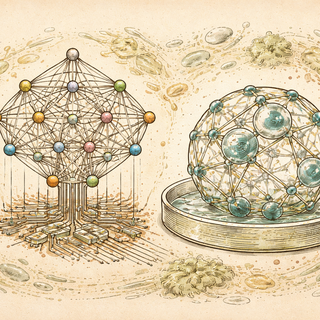
Disclaimer: This blog post is a simplified summary of published research for educational purposes. The accompanying illustration is artistic and does not depict actual model architectures, data, or experimental results. Always refer to the original paper for technical details.