This paper has big Mad Max energy: in the male C. elegans nervous system, the mating circuit basically grabs the steering wheel, floors it, and tells the rest of behavior to deal with it. Not in a poetic, film-studies way. In a graph-theory, synapse-counting, tiny-worm-brain way.
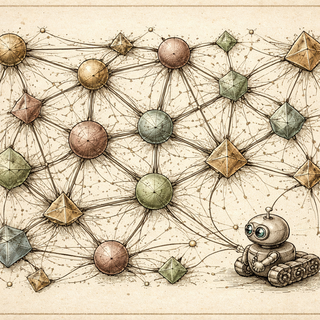
The paper, "Dimorphic neural network architecture prioritizes sexual-related behaviors in male Caenorhabditis elegans", asks a sneaky good question: if two animals share a lot of the same neurons, why do they behave so differently? Male and hermaphrodite C. elegans overlap heavily in their nervous systems, but males spend a lot more time acting like the biological version of a guy checking every room at a party for someone interesting. The authors wanted to know whether the overall wiring pattern itself pushes the male brain toward sex-related behavior.
Tiny Worm, Huge Spreadsheet
A little background. C. elegans is the celebrity fruit fly of worm neuroscience. It is transparent, tiny, and absurdly well mapped. Its connectome, meaning a wiring diagram of which neuron talks to which, is one of the cleanest in biology. That makes it a great place to ask a very old neuroscience question with very modern tools: how much does structure shape function? Think of the connectome as the brain’s transit map. Same stations, different express lines, very different commute.
Wang and colleagues turned the male and hermaphrodite nervous systems into directed, weighted graphs. In normal-person language, they treated neurons like nodes and synapses like roads, while also keeping track of direction and traffic volume. Then they asked which neurons looked especially influential. One key measure was node strength, basically how heavily connected a neuron is.
And here’s the punchline: a relatively small set of male-specific neurons had outsized influence in the male network. The male nervous system was not just "slightly tweaked." It looked organized in a way that gives sex-related behavior priority seating. Not the whole bus. Just the seats closest to the exit, which matters when evolution wants you to find a mate before you get eaten by something larger and ruder.
The Brain Is Shared. The Agenda Is Not.
One of the neatest parts of this paper is that the authors do not frame the male worm as having a completely separate brain. A lot of the action happens because shared neurons get wired differently, or get pulled into different local circuits. Same cast, different script. Hollywood does this all the time.
They predict that these wiring differences should shift behavior, then actually test one case. In males, a circuit involving the neurons DVC, RIC, and AVA helps drive stronger spontaneous local search behavior, which likely supports mate-searching. Translation: the male worm is more inclined to poke around nearby instead of behaving like a perfect little food-optimizing robot. Honestly, relatable. Biology loves tradeoffs, and this one basically says reproduction can outrank lunch.
That idea lines up with other recent work. A 2024 Science Advances paper showed that sex-specific cadherin expression can create sexually dimorphic synaptic connectivity in C. elegans, with developmental experience helping shape the final circuit map (Liao et al., 2024). Another 2024 study in Current Biology found that male worms make mate-choice decisions using a pile of sensory cues, including pheromones and contact signals, which is a lot of sophistication for an animal that looks like a living comma (Luo et al., 2024). Recent atlas work also keeps reinforcing the same theme: the nervous systems are shared, but the chemistry and gene expression are not identical, and that matters for behavior (Chen Wang et al., 2024; Weinstein et al., 2024).
Why This Is Cool Beyond Worm Drama
The broader point is bigger than worm dating strategy. This paper is a clean example of how behavior can emerge from network architecture, not just from single "important" neurons. Neuroscience sometimes gets reduced to a hunt for one magic cell or one magic molecule. Real brains are usually messier. More committee meeting, less royal decree.
That matters for AI and network science too. If you care about how large systems produce different outputs from slightly different wiring, this is catnip. You can almost feel the bridge between connectomics and machine learning here: same parts, different topology, different behavior. If you’re the kind of person who likes drawing boxes and arrows until an idea finally stops looking haunted, a tool like mapb2.io would not be the worst sidekick for visualizing what this paper is doing.
There are limits, of course. A connectome is not the whole story. Neuromodulators, gene expression, development, and current state all matter. Recent whole-brain response data in both sexes make that point nicely: sensory activity can diverge in ways that the raw wiring diagram alone does not fully explain (Kaplan et al., 2025 preprint). So no, this is not "we solved behavior." It is more like "we found one of the levers, and it is attached to a surprisingly opinionated network."
Which, honestly, is often how good biology works. Not with grand declarations. With a small worm, a lot of careful math, and the discovery that even a tiny nervous system can have priorities.
References
Wang X, Liu H, Yang W, et al. (2026). Dimorphic neural network architecture prioritizes sexual-related behaviors in male Caenorhabditis elegans. eLife, 14:RP102309. DOI: 10.7554/eLife.102309
Liao CP, Majeed M, Hobert O. (2024). Experience-dependent, sexually dimorphic synaptic connectivity defined by sex-specific cadherin expression. Science Advances, 10(46):eadq9183. DOI: 10.1126/sciadv.adq9183. PMCID: PMC11529107
Luo J, Bainbridge C, Miller RM, Barrios A, Portman DS. (2024). C. elegans males optimize mate-choice decisions via sex-specific responses to multimodal sensory cues. Current Biology, 34(6):1309-1323.e4. DOI: 10.1016/j.cub.2024.02.036. PMCID: PMC10965367
Wang C, Vidal B, Sural S, et al. (2024). A neurotransmitter atlas of C. elegans males and hermaphrodites. eLife, 13:RP95402. DOI: 10.7554/eLife.95402. PMCID: PMC11488851
Weinstein N, Ish-Shalom D, Itskovits E, et al. (2024). Sex-specific developmental gene expression atlas unveils dimorphic gene networks in C. elegans. Nature Communications, 15, Article 4103. DOI: 10.1038/s41467-024-48369-z. PMCID: PMC11106331
Kaplan HS, Bayer EA, Schneider M, et al. (2025). Whole-brain chemosensory responses of both C. elegans sexes. bioRxiv preprint. DOI: 10.1101/2025.05.15.654129
Disclaimer: This blog post is a simplified summary of published research for educational purposes. The accompanying illustration is artistic and does not depict actual model architectures, data, or experimental results. Always refer to the original paper for technical details.