3.
That is the number of biological celebrities Ducoli and colleagues put right up front: the spliceosome, the ribosome, and RNA-dependent membraneless organelles. Three messy molecular assemblies where RNA is not just the message on the clipboard, but part scaffold, part foreman, part suspiciously underpaid project manager. On one hand, this is beautiful. On the other hand, your cells are apparently run by wet nanomachines that assemble themselves in real time, which feels like something HR should have disclosed.
The review, published in Nature Reviews Genetics, asks a deceptively simple question: how do we understand RNA-protein assemblies when they are dynamic, crowded, context-sensitive, and allergic to behaving like tidy textbook diagrams? The authors argue that the next leap will come from pairing newer experimental tools with machine-learning models, then letting each improve the other through prediction, testing, and correction Ducoli et al., 2026.
RNA Is Not Just the Middleman
If DNA is the archive and proteins are the workers, RNA used to get cast as the courier. A very busy courier, sure, but still mostly “take this message to the ribosome and try not to get degraded in traffic.”
That picture is too small. RNA can fold into shapes, recruit proteins, help build molecular machines, and organize droplets inside cells that do not even have membranes. The ribosome itself is a ribonucleoprotein machine: RNA plus proteins, turning messenger RNA into protein. The spliceosome, another RNA-protein contraption, edits pre-mRNA by removing introns before translation. These are not little Post-it notes floating around the cell. These are logistics hubs with chemistry problems.
The trouble is that RNA-protein assemblies are not frozen sculptures. They form, rearrange, fall apart, and respond to cellular conditions. Trying to study them can feel like trying to photograph a jazz band during an earthquake while one saxophonist is also the building.
The Lab Bench Meets the Pattern Gobbler
Traditional tools like CLIP-based assays, cryo-EM, mass spectrometry, sequencing, and microscopy each reveal slices of the story. Some tell you which proteins touch which RNAs. Others give structural snapshots. Others track dynamics. Each is powerful, but incomplete. Biology, because it has a flair for drama, rarely hands over the full spreadsheet.
Machine learning enters because this field is drowning in partial clues. Recent RNA models show why researchers are excited. RNAErnie, for example, uses transformer-style pretraining with RNA motifs to handle multiple RNA analysis tasks from one pretrained model Wang et al., 2024. ZHMolGraph combines graph neural networks and unsupervised language models to predict RNA-protein interactions, including difficult cases involving unknown RNAs and proteins, reporting 79.8% AUROC and 82.0% AUPRC on a hard benchmark Liu et al., 2025.
On one hand, that is genuinely impressive. On the other hand, the model is still learning from data humans collected using experiments that have noise, bias, missing context, and the occasional “why is this sample glowing?” moment. AI does not magically delete biology's messiness. It just gives us a better mop.
Closed Loops, Open Questions
The review's most interesting idea is the closed-loop system: models propose hypotheses, experiments test them, new data improve the models, and the cycle repeats. That sounds clean. In reality, it is more like teaching a very caffeinated lab assistant to make guesses, then making it clean up after itself with evidence.
This matters because RNA-protein assemblies sit near disease biology. Misregulated RNA-binding proteins and abnormal condensates show up in cancer, neurodegeneration, viral infection, and developmental disorders. If scientists can predict which RNA-protein interactions matter, they may eventually design molecules that tune harmful assemblies rather than smashing entire pathways with the subtlety of a bowling ball.
There is also a design angle. Functional RNA design could benefit from models that understand not only RNA sequence or structure, but also the proteins likely to gather around it. AlphaFold 3 expanded the public imagination around biomolecular interaction prediction by modeling proteins with DNA, RNA, ligands, and more Abramson et al., 2024. But RNA-protein assembly biology still has hard problems: flexible RNA, transient contacts, cell-type-specific behavior, and condensates whose “structure” may be more weather system than Lego set.
Why This Feels Both Hopeful and Weird
The hopeful version: AI helps biologists connect scattered experimental views into a moving picture. We learn how RNA scaffolds cellular machines, how assemblies go wrong, and how to repair them. Better maps lead to better therapies. Everyone gets a small, tasteful parade.
The weird version: we are building models to understand molecular machines that already build us. The overworked GPUs chew through sequences and structures, while the cell quietly says, “Cute. I have been doing this since before spines were fashionable.”
The honest version is both. This review is not claiming that AI has solved RNA biology. It is saying the old split between “wet lab” and “computational biology” is starting to look artificial. The future may belong to systems where experiments and models argue productively, like roommates who finally learned to label their food.
References
-
Ducoli, L., Srinivasan, S., Amjadi, E. et al. “Bridging technical innovation and computational advances in studies of RNA-protein assemblies.” Nature Reviews Genetics 27, 462-484 (2026). DOI: 10.1038/s41576-026-00931-9. PMID: 41699382
-
Wang, N., Bian, J., Li, Y. et al. “Multi-purpose RNA language modelling with motif-aware pretraining and type-guided fine-tuning.” Nature Machine Intelligence 6, 548-557 (2024). DOI: 10.1038/s42256-024-00836-4
-
Liu, H., Jian, Y., Zeng, C. et al. “RNA-protein interaction prediction using network-guided deep learning.” Communications Biology 8, 247 (2025). DOI: 10.1038/s42003-025-07694-9
-
Hwang, H., Jeon, H., Yeo, N. et al. “Big data and deep learning for RNA biology.” Experimental & Molecular Medicine 56, 1293-1321 (2024). DOI: 10.1038/s12276-024-01243-w
-
Zeng, C., Zhuo, C., Gao, J. et al. “Advances and Challenges in Scoring Functions for RNA-Protein Complex Structure Prediction.” Biomolecules 14, 1245 (2024). DOI: 10.3390/biom14101245. PMCID: PMC11506084
-
Abramson, J. et al. “Accurate structure prediction of biomolecular interactions with AlphaFold 3.” Nature 630, 493-500 (2024). DOI: 10.1038/s41586-024-07487-w
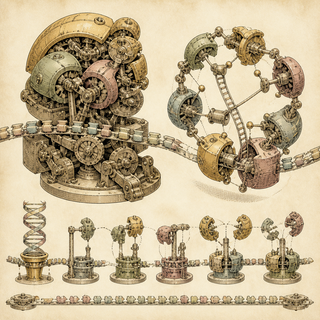
Disclaimer: This blog post is a simplified summary of published research for educational purposes. The accompanying illustration is artistic and does not depict actual model architectures, data, or experimental results. Always refer to the original paper for technical details.