A few years from now, your doorbell camera may not "send video to the cloud" so much as glance at the world, do a little light-speed reasoning in its own tiny optical brain, and decide whether that blur is a delivery person, a raccoon-sized package, or your neighbor once again treating the driveway like a shared hallucination.
That is the near-future energy behind Reimagining machine vision with optical computing, a Nature Research Briefing about Jiayong Peng and colleagues' new paper, Optical metasurfaces for general vision processing on the edge (DOI: 10.1038/s41586-026-10635-z). The VC translation: this paper is basically a Series A deck disguised as a PDF. The TAM is every camera that currently burns watts turning pixels into decisions.
The Pitch: Let Light Do the First Draft
Modern computer vision usually works like this: a camera captures an image, converts it into electronic data, then a processor runs neural-network math on it. That pipeline works, but it can be slow, power-hungry, and frankly a little needy. It wants chips, memory, bandwidth, cooling, and probably a sparkling water.
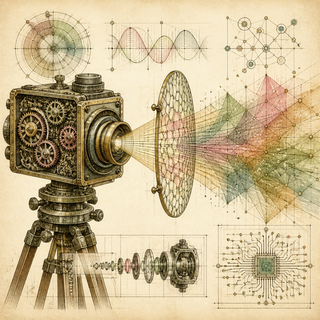
Peng et al. try a different move. They use an optical metasurface, a very thin engineered material that reshapes incoming light, as the front end of a vision system. Instead of waiting for software to process every pixel from scratch, the hardware itself performs useful transformations as light passes through it.
Think of it as giving the camera lens a tiny MBA and asking it to pre-filter the market opportunity before the GPU shows up in a Patagonia vest.
The system combines a huge optical front end, described as a 41-million-parameter metasurface, with a much smaller digital back end of about 87,000 parameters. According to the Nature abstract, it handled tasks including object detection, segmentation, 3D reconstruction, and video understanding, while aiming for real-time edge deployment. That "edge" part matters: phones, drones, robots, factory cameras, medical devices, and autonomous sensors all want vision that is fast, local, and not constantly texting a data center for emotional support.
Why This Is Not Just Fancy Glass
Computer vision is the field that lets machines extract meaning from images and video: detecting objects, tracking motion, segmenting regions, estimating depth, and generally pretending pixels are not absolute chaos. Machine vision is the factory-floor cousin: inspection, sorting, robot guidance, quality control. Wikipedia-level summary: it is about turning raw visual data into decisions.
Optical computing asks: what if some of that computation happens physically, using photons instead of only electrons? Photons are fast, parallel, and excellent at moving through optical systems without generating the same kind of heat drama as electronic circuits. Optical neural networks have been around conceptually for decades, but the hard part has been scaling them beyond cute demos. Many optical systems do one narrow task well, then look deeply uncomfortable when asked to generalize.
That is why this paper is interesting. It does not just say "we made light do matrix multiplication, please clap." It embeds computer-vision ideas directly into the optics: similarity-based recognition, attention-guided perception, and detail-context fusion. In startup language, the moat is not merely photonics. The moat is co-design: physics and algorithms splitting the cap table.
The Market Problem: AI Vision Is Getting Expensive
Large vision models can be powerful, but they often carry the energy profile of a small espresso machine with tenure. Running serious vision on edge devices is tough because edge devices have limited power, memory, and cooling. A drone cannot tow a data center. A wearable cannot ask for a nuclear plant. A factory sensor should not need a cloud subscription just to notice a defective widget.
Recent work points in the same direction. Chen et al. built an all-analog photoelectronic chip for high-speed vision tasks in Nature (DOI: 10.1038/s41586-023-06558-8). Zheng et al. used multichannel meta-imagers to accelerate machine vision (DOI: 10.1038/s41565-023-01557-2). Bernstein et al. showed a single-shot optical neural network in Science Advances (DOI: 10.1126/sciadv.adg7904). Xu et al.'s Taichi photonic chiplet hit 160 TOPS/W in Science (DOI: 10.1126/science.adl1203). And Fu et al.'s 2024 review in Light: Science & Applications lays out the promise and pain points of optical neural networks: low latency, lower heat, massive parallelism, but real challenges in scalability, nonlinearity, and integration (DOI: 10.1038/s41377-024-01590-3).
The punchline: the field is not one lonely founder in a garage yelling "photons!" at a whiteboard. It is a whole category forming.
The Fine Print Before We All Buy Matching Fleece Vests
This is still research. Optical systems can be sensitive to fabrication errors, lighting conditions, alignment, and the awkward reality that photons and digital software do not always want the same workflow. Also, "fewer digital parameters" does not automatically mean "free lunch." The optical front end has to be manufactured, calibrated, tested, and integrated with real sensors.
But if the results reproduce and scale, the upside is obvious: faster on-device vision, less energy use, lower latency, and less dependence on sending raw visual data to remote servers. That could help robotics, smart cameras, AR devices, industrial inspection, medical imaging, and autonomous navigation.
And speaking of making images behave better locally, tools like combb2.io already point toward the same practical appetite: sharper, cleaner image processing without turning every photo into a cloud road trip. Different layer of the stack, same vibe: do more useful visual work closer to where the pixels live.
References
- Nature Research Briefing. Reimagining machine vision with optical computing. Nature, 2026. DOI: 10.1038/d41586-026-01891-0
- Peng, J. et al. Optical metasurfaces for general vision processing on the edge. Nature, 2026. DOI: 10.1038/s41586-026-10635-z
- Fu, T. et al. Optical neural networks: progress and challenges. Light: Science & Applications, 2024. DOI: 10.1038/s41377-024-01590-3
- Chen, Y. et al. All-analog photoelectronic chip for high-speed vision tasks. Nature, 2023. DOI: 10.1038/s41586-023-06558-8
- Zheng, H. et al. Multichannel meta-imagers for accelerating machine vision. Nature Nanotechnology, 2024. DOI: 10.1038/s41565-023-01557-2
- Bernstein, L. et al. Single-shot optical neural network. Science Advances, 2023. DOI: 10.1126/sciadv.adg7904
- Xu, Z. et al. Large-scale photonic chiplet Taichi empowers 160-TOPS/W artificial general intelligence. Science, 2024. DOI: 10.1126/science.adl1203
Disclaimer: This blog post is a simplified summary of published research for educational purposes. The accompanying illustration is artistic and does not depict actual model architectures, data, or experimental results. Always refer to the original paper for technical details.