Medicine has a data integration problem that nobody talks about at cocktail parties but drives clinicians quietly insane every day. The X-ray is in one system. The blood work is in another. The clinical notes are buried in a third. The pathology slides live on a separate server. A radiologist reads images. A pathologist reads slides. A clinician reads notes and labs. Everyone sees their piece of the puzzle, and the patient is the puzzle nobody has time to fully assemble.
Multimodal AI models - systems that can process images, text, lab values, and structured data simultaneously - are trying to be the person in the room who's actually looked at everything.
What "Multimodal" Actually Means
In AI, a modality is a type of input data - text, images, structured data, audio. A "multimodal" model reasons across multiple types at once. For medicine, that means X-rays, clinical notes, lab results, vital signs, and genomic data all going in together.
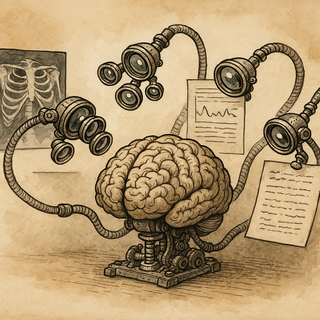
A truly multimodal medical AI could look at a chest X-ray, read the radiologist's report, check the white blood cell count, note three months of immunosuppressants, and synthesize a differential diagnosis. That's what a good clinician does. It's what no single-modality AI can do.
The Architecture Behind the Curtain
Most systems use separate encoders for each modality (a Vision Transformer for images, a BERT variant for text, dedicated encoders for structured data), followed by a fusion layer that combines the representations into something a classification or generation head can use.
Newer models, inspired by GPT-4V and Gemini, use a single transformer backbone processing interleaved images and text natively. Cleaner architecture, more natural cross-modal attention - but it requires enormous amounts of paired multimodal training data, which is exactly what medicine doesn't have a lot of.
Why This Is Harder Than It Looks
Building multimodal medical AI hits several walls that don't exist in general-domain multimodal AI:
Paired data scarcity. Training requires datasets where multiple modalities exist for the same patient encounter. These are rare and expensive. MIMIC-CXR (chest X-rays paired with radiology reports) is one of the few large-scale resources, and it covers exactly one body part.
Modality imbalance. Text data is abundant. Medical images are moderately available. Genomic data paired with imaging and clinical text? Almost nonexistent. Models lean on whichever modality has the most training signal, effectively ignoring the others.
Temporal alignment. Monday's X-ray, Tuesday's labs, and Wednesday's physician note describe slightly different snapshots of the same evolving picture. Aligning temporal windows is hard, and getting it wrong means combining information that shouldn't be combined.
Where It's Actually Working
Despite the challenges, there are bright spots. Models combining chest X-rays with clinical notes have shown improved pneumonia detection compared to image-only systems. Multimodal models in pathology that combine whole-slide images with genomic profiles are improving cancer subtyping accuracy. ICU prediction models that fuse vital signs, lab trends, and nursing notes outperform single-modality baselines on mortality and deterioration prediction.
Google's Med-PaLM M demonstrated that a single generalist model could handle medical question answering, radiology report generation, and dermatological image classification. It wasn't the best at any single task, but the fact that one model could do all three - reasonably well - signaled where the field is heading.
The Clinical Workflow Problem
The hardest challenge isn't technical - it's practical. Doctors don't sit down and carefully feed data into a system. They're moving between patients, glancing at results, making quick decisions. A multimodal AI that requires curated inputs and thirty seconds of processing time won't get used, no matter how good its accuracy numbers are.
The winners will be models that plug into existing EHR systems and surface insights at the right moment. Think less "upload and wait" and more "this patient's labs plus imaging plus medication history suggest you should consider X."
For healthcare teams managing multimodal clinical data across web portals, scoutb2.io can help audit those EHR interfaces, making sure accessibility and performance aren't bottlenecks in the workflow. - ## References
- Acosta JN, et al. Multimodal biomedical AI. Nature Medicine. 2022. DOI: 10.1038/s41591-022-01981-2
- Singhal K, et al. Towards Expert-Level Medical Question Answering with Large Language Models. arXiv: 2305.09617. 2023.
- Xu S, et al. Multimodal Learning with Transformers: A Survey. IEEE TPAMI. 2023. DOI: 10.1109/TPAMI.2023.3275156
- Johnson AEW, et al. MIMIC-CXR, a de-identified publicly available database of chest radiographs with free-text reports. Scientific Data. 2019. DOI: 10.1038/s41597-019-0322-0