Cancer papers love the phrase "precision medicine" the way startups love "disruptive." Everyone says it. Fewer people show receipts. This new 2026 study on muscle-invasive bladder cancer, though, comes with an unusually practical idea: instead of asking one test, one slide, or one gene signature to predict who will benefit from chemotherapy, it combines several views of the same tumor and lets machine learning do the sorting [1].
That matters because muscle-invasive bladder cancer is not a tidy disease. Two patients can look similar on paper and then respond very differently to neoadjuvant chemotherapy, which is the chemo given before surgery. Some tumors fold. Some shrug. Cisplatin, the standard drug here, is not exactly a vitamin gummy, so guessing wrong has consequences [2].
The Tumor Is Sending Mixed Signals
The core trick in this paper is integration. The researchers pulled transcriptomic data from four independent cohorts totaling 399 patients. Transcriptomics, in plain English, is a readout of which genes are active and how loudly they are yelling. It is less "the tumor's blueprint" and more "the tumor's current playlist," which can be more useful when you want to know what it is about to do.
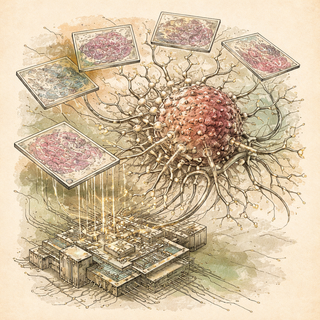
Then they paired that with digital pathology. That means taking pathology slides, scanning them, and using computational methods to measure patterns that a human pathologist can see in part, but not at industrial spreadsheet speed. If a microscope is the detective, digital pathology is the detective with fifty interns and no sleep requirement.
The model found molecular features linked to chemo response, especially around stress responses, immunity, and cell adhesion. Then the team validated 74 markers in tissue using spatial protein expression and reduced the whole mess to a much smaller, clinic-friendlier antibody panel for immunohistochemistry [1]. This is the part I liked. A lot of AI-in-medicine work ends with "the model was accurate in our lab, good luck everyone." This one at least tries to end at something a hospital could conceivably use.
Why This Is More Than a Fancy Spreadsheet
The big problem in bladder cancer has not been a shortage of possible biomarkers. It has been a shortage of biomarkers that survive contact with reality. Reviews over the last few years have made the same point repeatedly: predicting who will truly benefit from neoadjuvant chemotherapy remains hard, and single-feature predictors tend to wobble when moved across cohorts or institutions [2,3].
That is why this paper fits a broader trend rather than appearing from the sky in a lab coat. Other recent work has tried combining mRNA signatures with subtype information and clinicopathologic data [4]. Reviews in computational pathology have also argued that digitized slides can extract useful signals for diagnosis, prognosis, and therapy response, but the field still needs better validation and cleaner paths into clinical workflows [3,5]. In late 2024, another study showed AI could even pre-screen FGFR3 mutation status from routine histology slides, potentially cutting down molecular testing burden [6]. The machines, apparently, are now reading tissue for clues the way your friend reads a group chat for subtext.
This new paper pushes that idea into a more clinically annoying question: who is going to resist chemo before we spend months finding out the hard way?
The Most Interesting Bit Lives in the Chemistry
The authors did not stop at prediction. They followed one pathway, KEAP1-NRF2, that seemed tied to chemoresistance. NRF2 is part of the cell's stress-response machinery. In healthy settings, that is useful. In cancer, useful sometimes becomes obnoxious. If tumor cells keep NRF2 activity high, they can get better at handling oxidative stress and drug-induced damage, which is an elegant way of saying they become harder to kill.
In the paper, targeting this pathway reduced glutathione dynamics, proliferation, stem-like behavior, and invasiveness in cisplatin-resistant bladder cancer cells. In mouse models, combining cisplatin with KEAP1-NRF2 pathway inhibitors suppressed tumor growth more than either treatment alone [1]. Translation: the model did not just identify who might resist chemo. It pointed toward a possible reason and a possible workaround. That is a better ending than "the algorithm achieved an AUC and everyone went home."
What To Be Careful About
This is still not a plug-and-play hospital test. Multi-cohort data are better than single-cohort data, but prospective validation still matters. Digital pathology pipelines can be fussy about staining, scanners, site-to-site differences, and all the glamorous realities of clinical deployment [3,5]. A "small" biomarker panel is encouraging, not magical. And mouse tumor regression, while welcome, is not the same as a treatment guideline.
Still, the paper has the right kind of ambition. It is not trying to replace pathologists or oncologists with a mystical black box. It is trying to give them a better weather forecast before they send a patient into a storm.
That is a much more reasonable use of machine learning. Rare. Refreshing. Almost suspicious.
References
-
Jeong J, Jeong G, Kim Y, et al. Machine learning-based integration of transcriptome and digital pathology for predicting chemoresistance in muscle-invasive bladder cancer. Experimental & Molecular Medicine. Published May 8, 2026. DOI: 10.1038/s12276-026-01718-y. PubMed: 42104016
-
Miyagi H, Kwenda E, Ramnaraign BH, et al. Predicting Complete Response to Neoadjuvant Chemotherapy in Muscle-Invasive Bladder Cancer. Cancers. 2023;15(1):168. DOI: 10.3390/cancers15010168
-
Khoraminia F, Fuster S, Kanwal N, et al. Artificial Intelligence in Digital Pathology for Bladder Cancer: Hype or Hope? A Systematic Review. Cancers. 2023;15(18):4518. DOI: 10.3390/cancers15184518
-
Font A, Domenech M, Ramirez JL, et al. Predictive signature of response to neoadjuvant chemotherapy in muscle-invasive bladder cancer integrating mRNA expression, taxonomic subtypes, and clinicopathological features. Frontiers in Oncology. 2023;13:1155244. DOI: 10.3389/fonc.2023.1155244
-
Lobo J, Zein-Sabatto B, Lal P, Netto GJ. Digital and Computational Pathology Applications in Bladder Cancer: Novel Tools Addressing Clinically Pressing Needs. Modern Pathology. 2024. DOI: 10.1016/j.modpat.2024.100631
-
Bannier PA, Saillard C, Mann P, et al. AI allows pre-screening of FGFR3 mutational status using routine histology slides of muscle-invasive bladder cancer. Nature Communications. 2024;15:10914. DOI: 10.1038/s41467-024-55331-6
Disclaimer: This blog post is a simplified summary of published research for educational purposes. The accompanying illustration is artistic and does not depict actual model architectures, data, or experimental results. Always refer to the original paper for technical details.