Breaking news: a fleet of robot boats learned to split its brain in two, and apparently that helped it stop crashing while saving energy.
The humans have built little surface vessels and asked them to cross messy water together without bumping into anything, which is bold behavior from a species that still forms traffic jams in straight tunnels. In Autonomous Path Planning for USV Swarm Based on Dual-Module Learning MATD3, Zhou and colleagues propose DML-MATD3, a multi-agent reinforcement learning system for unmanned surface vessel swarms - robot boats, if we are speaking like normal carbon-based beings.
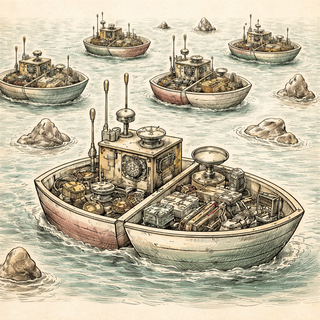
The surprising trick is not “make the AI bigger.” A mercy. Instead, the paper divides the job into two learning modules: one for motion generation and one for collision avoidance. The vessels learn where to go and how not to play bumper boats as related but separate problems.
Reinforcement learning is the ritual where humans reward a machine for doing useful things and punish it for doing foolish things until it develops what looks, from a distance, like judgment. In multi-agent reinforcement learning, several machines learn at once. This is where the comedy begins.
A single robot learning to move is already a toddler with propellers. A swarm of robots learning together is a group project where every student keeps changing strategy mid-sentence. Multi-agent systems have a known problem: the environment becomes non-stationary because every learner is also part of the environment. Wikipedia says this breaks the cozy assumptions behind the Markov property, which is academic-speak for “the floor keeps moving because your teammates are also renovating it.”
Now put that chaos on water. Wind shoves. Waves heckle. Currents provide unsolicited advice. A USV cannot simply brake like a Roomba encountering a chair leg. It has inertia, dynamics, energy limits, and a physical relationship with the ocean that looks suspiciously like negotiation.
Two Brains, Fewer Boat Crimes
The authors build on MATD3, the multi-agent version of Twin Delayed Deep Deterministic Policy Gradient. TD3 itself was designed to make continuous-control reinforcement learning less overconfident by using twin critics, delayed policy updates, and smoothing. Humans noticed that one critic can flatter a policy like a bad manager, so they added another critic to keep the first one honest.
DML-MATD3 adds a more practical idea: split the reward design. One module learns how to generate motion toward the goal. The other learns collision avoidance. This matters because reward functions in reinforcement learning are tiny moral systems, and tiny moral systems are easy to ruin. Reward the wrong thing and your robot may discover that spinning in circles is technically “activity.” Congratulations, you have invented aquatic bureaucracy.
To guide learning, the paper uses a potential field method. Imagine the goal as gently pulling the vessel in, while obstacles push it away. It is not a full navigation brain by itself, more like a smell trail for robots. The authors use it to provide denser feedback, so the agents are not wandering around waiting for a rare “good job” sticker from the universe.
They also add an adaptive energy consumption reward. This is sensible. Ocean robots do not run on vibes, and a path that looks short on a chart may become expensive when currents start acting like a gym trainer with unresolved issues.
Exploration, But Make It Less Random
Early in training, the system uses an Ornstein-Uhlenbeck noise-based action enhancement strategy. That sounds like something discovered in a locked cabinet, but the idea is simple enough: add temporally correlated noise so actions explore smoothly instead of twitching like a caffeinated spreadsheet.
The paper reports experiments against seven baseline algorithms and says DML-MATD3 converged faster, trained more stably, produced shorter paths, reduced task execution time, and performed better overall in complex maritime environments. The alien observer records this as: “The boats became less embarrassing more quickly.”
Why This Matters Outside the Simulation Tank
If these results reproduce and survive harsher real-world testing, the payoff could be serious. USV swarms could help with search and rescue, harbor patrol, environmental monitoring, seabed mapping, and disaster response. A coordinated fleet can cover more area than one vessel, tolerate individual failures better, and operate where sending humans is costly or dangerous.
The wider field is moving this way. Recent reviews of USV path planning point to dynamic environments, obstacle avoidance, realistic disturbances, and multi-vessel coordination as major open problems. Deep reinforcement learning for multi-agent pathfinding also keeps attracting attention because classical planners can struggle when the world becomes crowded, moving, and rude.
There is also a communication benefit. Swarm planning can get visually tangled fast, like spaghetti gaining sentience. For researchers or builders sketching reward designs, routes, and agent roles, a visual mapping tool like mapb2.io can help turn “many small boats making many small decisions” into something a human brain can inspect without making the emergency tea.
The Fine Print From Orbit
This is still research, not a marina-ready magic box. Simulation performance does not guarantee real-ocean reliability. Sensors fail. Weather changes. Vessels drift. Communication links get weird. Reward functions may behave politely in the lab and then discover loopholes outdoors, because machine learning systems are excellent interns and terrible philosophers.
Still, the paper’s design choice feels valuable: instead of asking one monolithic learner to juggle goal-seeking, collision avoidance, energy use, disturbances, and swarm coordination all at once, it gives the learning problem a cleaner internal structure. The humans have discovered, once again, that complicated things become less cursed when separated into parts. A remarkable finding from a species that also invented junk drawers.
References
-
Yuhang Zhou, Xiang Wu, Jiacun Wang, Yuan Li, Dejin Tao, Lifeng Ma, and Yuming Bo. “Autonomous Path Planning for USV Swarm Based on Dual-Module Learning MATD3.” IEEE Transactions on Cybernetics, 2026. DOI: 10.1109/TCYB.2026.3689944. PMID: 42118638
-
Kaizhou Gao, Minglong Gao, Mengchu Zhou, and Zhenfang Ma. “Artificial intelligence algorithms in unmanned surface vessel task assignment and path planning: A survey.” Swarm and Evolutionary Computation, 86, 101505, 2024. DOI: 10.1016/j.swevo.2024.101505
-
Jaehoon Chung et al. “Learning team-based navigation: a review of deep reinforcement learning techniques for multi-agent pathfinding.” Artificial Intelligence Review, 57, 41, 2024. DOI: 10.1007/s10462-023-10670-6
-
“Evolution of Unmanned Surface Vehicle Path Planning: A Comprehensive Review of Basic, Responsive, and Advanced Strategic Pathfinders.” Drones, 8(10), 540, 2024. DOI: 10.3390/drones8100540
-
Scott Fujimoto, Herke van Hoof, and David Meger. “Addressing Function Approximation Error in Actor-Critic Methods.” ICML 2018. arXiv: 1802.09477
Disclaimer: This blog post is a simplified summary of published research for educational purposes. The accompanying illustration is artistic and does not depict actual model architectures, data, or experimental results. Always refer to the original paper for technical details.