A robot walks into a bar and tries to pick up a glass. It shatters. The robot tries again with a different glass. Also shatters. This isn't a joke setup - it's basically the state of robotic touch sensing for the past few decades. But a team of researchers just figured out how to give machines a sense of touch so sensitive it makes your fingertips look like oven mitts.
The Problem With Electronic Skin (It's Complicated)
Electronic skin - e-skin if you're cool - has been the holy grail of robotics and wearable tech for years. The dream? Wrap a robot (or a prosthetic limb, or your entire body) in a flexible material that can feel pressure, texture, and temperature just like biological skin.
The reality has been messier. Most high-sensitivity e-skin relies on ionic systems, which are basically fancy salt water sandwiches. They work great in the lab, then you take them outside and they dry out, freeze, leak, or just generally throw a tantrum. Non-ionic alternatives - the ones that don't need liquid electrolytes - have been stable but about as sensitive as trying to feel a mosquito landing while wearing winter gloves.
Until now.
The Fiber Trick Nobody Thought Of
Researchers led by Junlong Yang at Sichuan University just published work in Nature Communications describing what they call a "dielectric-gradient all-fiber" sensor [1]. That's a mouthful, so let's break it down: they wove together special fibers that change their electrical properties in two different ways when you press on them.
Here's the clever bit. In a normal capacitive sensor (the same tech in your phone's touchscreen), you squeeze two plates closer together, and the capacitance goes up. Simple physics, limited gains. But these researchers created fibers with a gradient of dielectric materials - essentially, the electrical insulation properties change along the fiber's structure. When pressure deforms the fibers, it doesn't just squeeze plates together. It also reduces the resistance at fiber-to-fiber contact points, which releases previously "trapped" electrical polarization.
Think of it like a dam holding back water. Normal sensors just make the riverbed narrower. This sensor opens the floodgates.
Numbers That Actually Matter
The sensitivity they achieved? 169.8 kPa⁻¹. For context, most non-ionic capacitive sensors struggle to hit single digits. This is like going from a flip phone camera to a professional DSLR. The sensor can detect pressures as light as 0.5 Pa - roughly the weight of a mosquito actually landing on it.
But sensitivity alone isn't enough. The sensor also demonstrated a response time of around 30 milliseconds (fast enough for real-time touch feedback), worked reliably over 10,000 compression cycles, and - crucially - didn't care much about temperature or humidity swings. No ionic liquids means no evaporation anxiety.
Why Should You Care?
Beyond the obvious "robots that don't crush everything they touch" application, this technology opens doors for:
Prosthetics that actually feel. Current prosthetic hands can grip objects, but users get zero tactile feedback. Imagine regaining the ability to feel a handshake or know when you're holding an egg versus a rock.
Health monitoring that doesn't suck. Flexible pressure sensors could track pulse, respiration, and subtle body movements without the discomfort of rigid devices. The researchers demonstrated real-time pulse wave monitoring with their prototype.
Soft robotics. Robots designed to work alongside humans need to be gentle and aware. An assembly robot with this kind of touch sensitivity could handle delicate electronics or work in food preparation without the "terminator grip" problem.
The Bigger Picture
This work fits into a broader push toward practical e-skin that's been accelerating since the mid-2010s. Previous approaches using microstructured elastomers [2] and textile-based sensors [3] made incremental progress, but the sensitivity ceiling remained stubbornly low for non-ionic systems. By rethinking the problem as an impedance-matching challenge rather than just a geometry optimization, this team found a way around the fundamental limitations.
The all-fiber construction also matters for manufacturing. Fibers can be woven on existing textile equipment, potentially making large-scale production far cheaper than lithography-based approaches. Your future pressure-sensing shirt might actually be affordable.
What's Next?
The researchers note that their current prototype handles pressure beautifully but doesn't yet distinguish between different types of mechanical input - shear forces, twisting, or multi-point contact. Future versions might incorporate multiple fiber types to create a more complete tactile picture.
There's also the integration challenge. A sensor this sensitive generates a lot of data, and processing that information in real-time requires smart algorithms. Machine learning approaches for tactile signal interpretation are still catching up to the hardware.
But for now, we're one significant step closer to machines that can feel the world the way we do. Just, you know, better.
References
-
Li W, Xi L, Lu M, et al. Impedance-driven capacitance amplification in dielectric gradient all-fiber non-ionic electronic skin. Nature Communications. 2025. DOI: 10.1038/s41467-026-71173-w
-
Schwartz G, Tee BC-K, Mei J, et al. Flexible polymer transistors with high pressure sensitivity for application in electronic skin and health monitoring. Nature Communications. 2013;4:1859. DOI: 10.1038/ncomms2832
-
Lee S, Reuveny A, Reeder J, et al. A transparent bending-insensitive pressure sensor. Nature Nanotechnology. 2016;11:472-478. DOI: 10.1038/nnano.2015.324
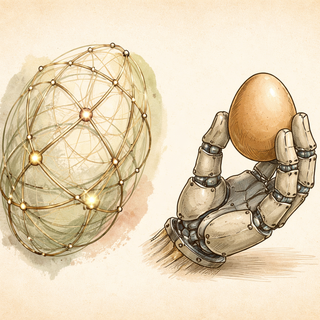
Disclaimer: This blog post is a simplified summary of published research for educational purposes. The accompanying illustration is artistic and does not depict actual sensor architectures, data, or experimental results. Always refer to the original paper for technical details.