Like an ant colony that reroutes its traffic the instant rain begins, a cell is forever rearranging which proteins shake hands, lock arms, or quietly refuse to acknowledge one another. It is with considerable delight that Tavis J. Reed's 2026 review reminds us that protein-protein interaction maps are not fixed atlases carved into stone tablets - they are weather reports for molecular society, and the weather changes constantly (Reed, 2026).
For years, biologists built giant "interactomes" - maps of which proteins can interact with which. Useful? Very. Complete? Not remotely. A global interactome is a bit like a city map that marks every possible road but tells you nothing about rush hour, roadworks, or the regrettable parade blocking downtown. Reed's central point is that the interactions that matter depend on context: cell type, disease state, stress, treatment, time, and location inside the cell.
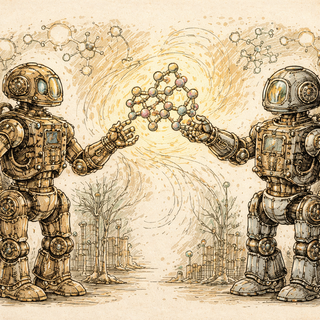
That matters because proteins rarely work alone. They form teams, temporary alliances, and occasionally what looks suspiciously like molecular office politics. One protein might interact in an immune cell but not in a neuron. Another may bind only after a chemical modification flips it from "quiet librarian" to "alarmed security guard." A context-free network can therefore be true in the blandest possible sense while being biologically useless for the actual question in front of you.
Recent benchmarking work has made this painfully clear. A broad evaluation of 45 human interactomes found that different networks excel at different jobs, which is a polite scientific way of saying there is no single magic map and anyone claiming otherwise should perhaps step away from the podium (Wright et al., 2025; PMCID: PMC11697402).
Catching Proteins in the Act
Reed surveys two grand strategies. First, the computational camp starts with existing interaction maps and refines them using expression data, literature curation, or machine learning. This helps infer which interactions are plausible in a particular tissue or condition. It is efficient, scalable, and sometimes a little like deducing a dinner party guest list from grocery receipts and overheard gossip.
Second, the experimental camp goes out and catches the proteins red-handed. Crosslinking mass spectrometry can chemically "freeze" nearby proteins together before measuring them. Cofractionation mass spectrometry watches which proteins travel together through separation steps, much as one might infer friendship from who keeps arriving at the pub in the same carriage. Denaturation-based methods probe how proteins change stability when their companions appear or vanish. These approaches give direct physical evidence, which is precious because biology, like certain uncles at holidays, is prone to making grand claims on limited evidence (Veale and Clarke, 2024).
The computational side is also getting cleverer. Deep learning models such as hierarchical graph approaches can learn from protein structure and network topology together, while newer context-aware systems aim to represent the same protein differently depending on the cell type in which it operates (Gao et al., 2023; Li et al., 2024). That is the right instinct. A protein in a T cell and the same protein in liver tissue are not living the same life.
The Machine Is Clever, but Mind the Trapdoor
Now for the necessary bucket of cold water. Machine learning in this area can cheat without meaning to. A 2024 analysis warned that PPI models often benefit from data leakage, hub bias, and benchmark design quirks, which can make a model look prophetic when it is merely good at spotting famous proteins everyone already studies (Lannelongue and Inouye, 2024). Another 2023 community benchmark likewise showed that strong, relatively simple network methods can outperform flashier alternatives in many settings (Wang et al., 2023).
In plainer terms: if your model "discovers" that the most heavily studied proteins are important, congratulations, you have reinvented academic popularity.
Why Anyone Outside the Lab Should Care
Because this is how you get from giant lists of molecules to actual medicine. Context-specific interaction maps can reveal which protein complexes appear in cancer but not healthy tissue, which signaling modules flare during infection, and which drug targets matter in one cell state but not another. That can improve biomarker discovery, sharpen drug development, and reduce the old habit of treating the body like a uniform blob when it is really a bustling archipelago of different cellular republics.
There is also a practical reason this field feels lively right now: biology has mountains of transcriptomic, proteomic, and structural data, and we are finally building tools that can combine them without collapsing into elegant nonsense. If you have ever tried to sketch one of these networks yourself, you may find humble relief in visualization tools like mapb2.io, because real interactomes can look less like a neat diagram and more like someone dropped spaghetti into a clock.
Reed's review does not promise a perfect map. Sensibly, it argues for richer data, better spatial and temporal resolution, and AI used as interpreter rather than oracle. That seems wise. Nature is under no obligation to arrange her proteins for our convenience. We must catch them in context, compare notes, and resist the temptation to declare victory after one handsome heat map.
References
-
Reed TJ. Methods for Mapping and Analyzing Context-Specific Protein-Protein Interaction Networks. Annual Review of Biomedical Data Science. 2026;9:In press. DOI: 10.1146/annurev-biodatasci-092724-033748. PMID: 42013464
-
Wright SN, Colton S, Schaffer LV, Pillich RT, Churas C, Pratt D, Ideker T. State of the interactomes: an evaluation of molecular networks for generating biological insights. Molecular Systems Biology. 2025;21(1):1-29. DOI: 10.1038/s44320-024-00077-y. PMCID: PMC11697402
-
Wang XW, Madeddu L, Spirohn K, et al. Assessment of community efforts to advance network-based prediction of protein-protein interactions. Nature Communications. 2023;14:1582. DOI: 10.1038/s41467-023-37079-7
-
Veale CGL, Clarke DJ. Mass spectrometry-based methods for characterizing transient protein-protein interactions. Trends in Chemistry. 2024. DOI: 10.1016/j.trechm.2024.05.002
-
Lannelongue L, Inouye M. Pitfalls of machine learning models for protein-protein interaction networks. Bioinformatics. 2024;40(2):btae012. DOI: 10.1093/bioinformatics/btae012
-
Gao Z, Jiang C, Zhang J, et al. Hierarchical graph learning for protein-protein interaction. Nature Communications. 2023;14:1093. DOI: 10.1038/s41467-023-36736-1
-
Li Y, et al. Contextual AI models for single-cell protein biology. Nature Methods. 2024. DOI: 10.1038/s41592-024-02341-3
Disclaimer: This blog post is a simplified summary of published research for educational purposes. The accompanying illustration is artistic and does not depict actual model architectures, data, or experimental results. Always refer to the original paper for technical details.