As of early 2025, the best anyone could do to classify a rare pediatric sarcoma was ship tissue slides across the country to one of a handful of specialist pathologists, wait weeks for results, and maybe order a $5,000 genetic test on top. This paper changes that.
A team led by researchers at The Jackson Laboratory and UConn just built an AI system that can sort pediatric sarcoma subtypes from standard microscope slides - the kind every hospital already makes - with near-expert accuracy. And here's the kicker: it runs on a regular laptop. No GPU required. Your MacBook Air could literally help diagnose childhood cancer between your Netflix sessions.
Pediatric sarcomas are the diagnostic equivalent of being asked to identify a specific species of mushroom in a dark forest while wearing oven mitts. These cancers are rare to begin with, and they come in a dizzying array of subtypes that look maddeningly similar under a microscope. The two big ones - embryonal rhabdomyosarcoma (ERMS) and alveolar rhabdomyosarcoma (ARMS) - need different treatment plans, but telling them apart requires a pathologist who has seen enough of both to spot the differences. Most community hospitals just don't have that person on staff.
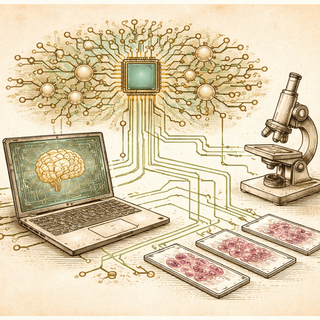
So slides get mailed to academic medical centers. Reports trickle back. Meanwhile, a kid and their family are waiting.
Teaching an AI to Read the Slides
The researchers collected 867 whole-slide images (WSIs) from three different medical centers plus the Children's Oncology Group - basically the Avengers of pediatric cancer data. This multi-center approach is the unglamorous but absolutely essential part of the work. An AI trained on slides from just one hospital tends to learn that hospital's quirks (staining protocols, scanner brands, the way their lab tech makes coffee) rather than actual tumor biology. By mixing data from multiple sources and harmonizing the images, the team forced their model to learn what actually matters.
For the AI backbone, they used a method called SAMPLER, which converts massive whole-slide images into compact statistical representations. Think of it like this: instead of asking the AI to read an entire novel and summarize it, SAMPLER has it read every paragraph independently and then builds a fingerprint of what those paragraphs looked like as a collection. It's shockingly efficient.
They then tested a lineup of feature extractors - the part of the AI that actually "sees" the tissue - ranging from older convolutional neural networks to the latest vision transformer (ViT) foundation models. The winners, by a significant margin, were UNI and CONCH, two pathology-specific foundation models developed at Harvard's Mahmood Lab. These models were pre-trained on millions of pathology images, so they arrived at the sarcoma task already knowing what tissue looks like - sort of like hiring a chef who already knows how to hold a knife instead of training someone from scratch (Chen et al., 2024, Nature Medicine; Lu et al., 2024, Nature Medicine).
The Numbers That Matter
The optimized pipeline hit an AUC of 0.969 for distinguishing rhabdomyosarcoma from non-RMS soft tissue sarcomas, and 0.961 for telling ARMS from ERMS. For the statisticians in the room: that's really, really good. For everyone else: imagine a system that gets the right answer roughly 96-97% of the time on a task that trips up non-specialist pathologists regularly.
They also built a two-stage pipeline that identified Ewing sarcoma - an even rarer subtype - with an AUC of 0.929. Finding Ewing sarcoma in a pile of other soft tissue sarcomas is like picking out a specific shade of beige from a paint swatch book, so 0.929 is genuinely impressive.
And the speed? The SAMPLER-based classifiers trained a thousand times faster than conventional transformer-encoder approaches for WSI analysis. The final model weighs in at 0.111 MB. That's smaller than most of the memes on your phone.
Why This Actually Matters Beyond the Benchmarks
The real story here isn't the AUC numbers - it's accessibility. Pediatric sarcoma expertise is concentrated in a few dozen academic centers worldwide. Kids in rural America, sub-Saharan Africa, or Southeast Asia often don't have access to the pathologists or the genetic tests needed for accurate subtyping. A system that runs on commodity hardware using standard H&E-stained slides (the cheapest, most universal type of tissue preparation) could fundamentally change that equation.
The researchers were also refreshingly honest about what this isn't: a replacement for pathologists. It's a decision support tool - a really fast, really consistent second opinion that never gets tired and doesn't need to fly business class to your hospital. As lead author Adam Thiesen put it, the AI learns to recognize tumor patterns "the way your phone recognizes faces in photos" (JAX, 2025).
The Bigger Picture
This work sits at the intersection of two trends reshaping pathology: foundation models getting scary good at understanding tissue, and lightweight inference methods making deployment practical. The SAMPLER approach (Mukashyaka et al., 2023, eBioMedicine) paired with pre-trained ViT models like UNI means you don't need a server room to do cutting-edge computational pathology anymore. That's the kind of boring infrastructure win that actually saves lives.
The multi-center validation is also a template other rare cancer researchers should steal liberally. Harmonizing data across institutions is tedious, thankless work - the data-cleaning equivalent of scrubbing grout - but it's what separates models that work in one lab from models that work in the real world.
For a field where getting enough training data is always the bottleneck, showing that careful curation of under 900 slides can produce clinically useful classifiers is a big deal. Not every rare disease needs a million-image dataset. Sometimes you just need the right images, the right preprocessing, and foundation models that already learned what cells look like.
References:
-
Thiesen AH, Domanskyi S, Foroughi Pour A, et al. Multicenter Histology Image Integration and Multiscale Deep Learning Support Machine Learning-Enabled Pediatric Sarcoma Classification. Cancer Research. 2026;86(7):1797-1810. DOI: 10.1158/0008-5472.CAN-25-2275. PMID: 41481196.
-
Mukashyaka P, Sheridan TB, Foroughi pour A, Chuang JH. SAMPLER: unsupervised representations for rapid analysis of whole slide tissue images. eBioMedicine. 2023. DOI: 10.1016/j.ebiom.2023.104908. PMCID: PMC10733087.
-
Chen RJ, Ding T, Lu MY, et al. Towards a general-purpose foundation model for computational pathology. Nature Medicine. 2024. DOI: 10.1038/s41591-024-02857-3.
-
Lu MY, Chen B, et al. A visual-language foundation model for computational pathology. Nature Medicine. 2024. DOI: 10.1038/s41591-024-02856-4. PMCID: PMC11384335.
-
Jackson Laboratory. "Seeing what's hidden: Using AI to transform pediatric cancer care." September 2025. jax.org.
Disclaimer: This blog post is a simplified summary of published research for educational purposes. The accompanying illustration is artistic and does not depict actual model architectures, data, or experimental results. Always refer to the original paper for technical details.