Somewhere in a hospital lab right now, a technician is waiting. And waiting. They took a sputum sample from a pneumonia patient three days ago, and the bacteria are still leisurely growing on their little agar plates like they're at a spa retreat. Meanwhile, the doctor has already prescribed broad-spectrum antibiotics - basically carpet-bombing the patient's microbiome because nobody knows which specific bug crashed the party.
What if bacteria could just... show their ID instead?
The Bottleneck Nobody Talks About
Here's a number that should make you uncomfortable: only about 29% of pneumonia patients get a positive bacterial culture result. That means for most people with a serious lung infection, doctors are essentially playing "guess the pathogen" with a prescription pad. Traditional culture methods - the gold standard since your great-grandmother's time - take 48 hours minimum, and some stubborn bugs like tuberculosis need six to eight weeks to show up.
Meanwhile, antibiotic-resistant infections kill 35,000 Americans annually, and that number is climbing faster than GPU prices at a crypto conference.
Enter FinFISH: Giving Bacteria Fingerprints
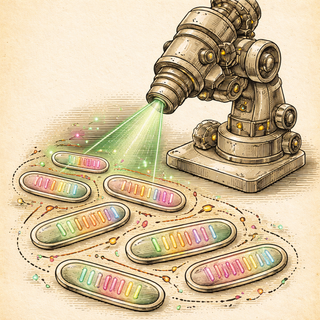
Researchers publishing in ACS Nano have developed something delightfully clever. They call it FinFISH - Fingerprinting Fluorescence In Situ Hybridization - and it works by essentially assigning each bacterial species its own unique "color code" made from combinations of three fluorescent dyes.
The trick relies on DNA self-assembly. When you combine just three fluorophores (FAM, Cy3, and Cy5) in different patterns, you can generate distinct fluorescent "fingerprints" for multiple bacterial species. It's like giving each type of bacteria its own barcode tattoo that glows under the right light.
Traditional FISH - the non-fingerprinting kind - has been around since the 1980s. It's great at identifying bacteria without waiting for cultures, but it hits a wall quickly: you can only detect as many species as you have fluorescence channels. Most microscopes have maybe four or five channels. That's fine if you're looking for one or two bugs, but respiratory infections often involve multiple pathogens throwing a mixer in your lungs.
Why This Actually Matters
The genius of combinatorial encoding is that it breaks through that channel limit. With three fluorophores, you're not limited to three targets - you can create distinct combinations for many more species. The researchers tested this on respiratory pathogens using simulated sputum and urine samples, and then moved to actual clinical specimens. The results held up.
But here's what gets really interesting: FinFISH doesn't just say "yes, this bacteria is present." It provides semiquantitative data about mixed infections. Knowing that a patient has both Streptococcus pneumoniae AND Haemophilus influenzae - and roughly how much of each - changes treatment decisions.
The Bigger Picture of Bacterial Barcoding
This research fits into a broader movement toward multiplexed pathogen detection. Other groups have used DNA nanobarcodes to identify pathogens with attomole sensitivity in under a minute, and machine learning-aided approaches are achieving over 80% accuracy in identifying bacterial biofilms.
DNA self-assembly techniques are getting remarkably sophisticated. Recent advances in DNA origami have created biosensing platforms that can detect everything from antimicrobial resistance genes to SARS-CoV-2 markers. The field is converging on a future where pathogen identification is fast, multiplexed, and doesn't require waiting for anything to grow.
What's Next?
The team behind FinFISH hints at integrating expanded probe designs with AI-assisted analysis. This makes sense - when you're generating complex fluorescent patterns, machine learning becomes your friend for pattern recognition at scale.
For now, FinFISH represents a proof of concept that combinatorial encoding can dramatically expand what's possible with standard fluorescence microscopy equipment. No exotic hardware required, just clever molecular design.
The bacteria have been evading identification for too long. Time to check their fingerprints.
References:
-
Li, W., Wu, L., Liu, C., et al. (2025). Fingerprinting Fluorescent Bacteria. ACS Nano. DOI: 10.1021/acsnano.5c18844
-
Li, Y., et al. (2005). Multiplexed detection of pathogen DNA with DNA-based fluorescence nanobarcodes. Nature Biotechnology, 23(7), 885-889. https://www.nature.com/articles/nbt1106
-
Xu, L., et al. (2024). Recent Advances in DNA Origami-Enabled Optical Biosensors for Multi-Scenario Application. Nanomaterials, 14(23), 1968. https://www.mdpi.com/2079-4991/14/23/1968
-
Hoenes, K., et al. (2021). Fighting Antibiotic Resistance in Hospital-Acquired Infections. Frontiers in Microbiology. PMC8334188
-
Moter, A., & Gobel, U. B. (2000). Fluorescence in situ hybridization (FISH) for direct visualization of microorganisms. Journal of Microbiological Methods, 41(2), 85-112.
Disclaimer: This blog post is a simplified summary of published research for educational purposes. The accompanying illustration is artistic and does not depict actual model architectures, data, or experimental results. Always refer to the original paper for technical details.