Admitting you’re reading about AI-designed high-voltage battery electrolytes is socially risky, like announcing you have opinions about elevator shaft ventilation, but stay with me: this is a surprisingly good building critique.
The Battery Has a Plumbing Problem
A lithium battery is a tiny chemical high-rise. The cathode and anode are the towers, lithium ions are the commuters, and the electrolyte is the lobby, elevator bank, sprinkler system, and snack machine all at once. Push the voltage higher and you can store more energy, which is why battery researchers keep eyeing high-voltage cathodes like ambitious developers eyeing a waterfront lot.
The catch: ordinary carbonate electrolytes start oxidizing above about 4.3 V, according to Zhan, Chen, Li, Wu, and Chen’s 2026 review in Chemical Society Reviews (DOI: 10.1039/D4CS01250J, PMID: 42300014). In architectural terms, the facade looks sleek until the weather arrives, then the cladding sheds panels onto the sidewalk.
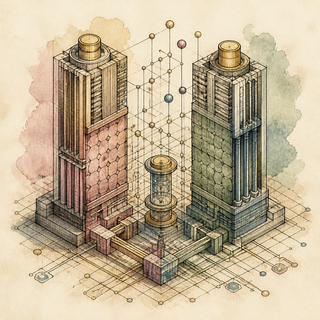
High-voltage batteries need electrolytes that conduct lithium ions, resist decomposition, form protective interphases, stay safe, stay affordable, and avoid turning into a frothy chemical complaint department. That is not one design requirement. That is a zoning board hearing with molecules.
AI as the Overcaffeinated Junior Architect
The review proposes an “AI for batteries” framework, or AI4B, for moving electrolyte discovery beyond old-school trial and error. Traditional battery R&D often works like testing every possible brick, mortar, window angle, and HVAC duct by hand. Noble, exhausting, and a little Victorian.
Machine learning changes the workflow. Models can screen candidate solvents, salts, additives, and diluents; predict properties like oxidative stability and ionic conductivity; and help simulate messy interfacial chemistry. Active learning and Bayesian optimization act like a project manager who keeps asking, “Which experiment teaches us the most before we spend the rest of the grant money?”
Recent work shows why this matters. Kumar and colleagues built “Electrolytomics,” a big-data framework for electrolyte design, but found the model performed best near familiar chemistry and struggled farther out in the chemical wilderness (DOI: 10.1021/acs.chemmater.4c03196). Ma et al. used active learning to screen electrolyte solvents for anode-free lithium metal batteries (DOI: 10.1038/s41467-025-63303-7). Wang et al. trained models to suggest additives for 5 V LiNi0.5Mn1.5O4 cathodes, where the voltage is less “phone charger” and more “tiny thunderstorm in a pouch” (DOI: 10.1038/s41467-025-57961-w).
Load-Bearing Data, Not Decorative AI
The smartest part of the AI4B idea is that it treats the electrolyte as a whole building, not a pretty molecule on a brochure. A solvent’s molecular structure matters, but so do solvation shells, electrode surfaces, SEI and CEI layers, gas evolution, transition-metal dissolution, viscosity, thermal behavior, and manufacturing reality. Great sight lines, terrible plumbing? Still a bad building.
That is where cross-scale modeling comes in. The review argues for connecting molecular-level descriptors to macroscopic battery behavior. Machine-learning molecular dynamics can help model atom-scale movement without waiting until the sun becomes a red giant. Physics-informed models can keep predictions from wandering off like an AI making up restaurant recommendations for Atlantis.
This is also where interpretability earns its rent. A black-box model that says “try this electrolyte” is useful. A model that explains why it likes the electrolyte is better. That is the difference between a mysterious starchitect and an engineer who can show you where the flying buttresses go.
If you were mapping these relationships by hand, the diagram would quickly look like a subway map designed during a power outage. A visual tool like mapb2.io actually fits this topic well: electrolyte design is less a checklist than a network of tradeoffs, constraints, and feedback loops.
The Pretty Rendering Still Needs Inspection
There is a sober bit under the watercolor wash: AI is not magic. Battery datasets remain small, inconsistent, and biased toward chemistries humans already liked enough to publish. Models can overfit to familiar structures, miss rare failure modes, or optimize one metric while quietly setting another on fire. Very modern. Very open-plan office.
The review is strongest when it frames AI as scaffolding, not the finished tower. The future points toward self-driving labs, automated synthesis, high-throughput testing, and closed-loop optimization, where algorithms propose candidates and experiments push back. That feedback is the structural inspection. Without it, “AI-discovered electrolyte” is just an expensive rendering with nice shadows.
If this works, the payoff is serious: safer high-energy batteries, longer-lasting electric vehicles, better grid storage, and faster discovery of chemistries that can survive high voltage without tantrums. The aesthetic verdict? AI4B has clean lines, ambitious load distribution, and a promising central atrium. But the building still needs better materials databases, stronger interpretability, and many more real-world stress tests before anyone should move in.
References
-
Zhan, Y.; Chen, N.; Li, L.; Wu, F.; Chen, R. “AI for battery-accelerated discovery of high-voltage electrolytes for advanced lithium batteries.” Chemical Society Reviews 2026, 55, 6625-6674. DOI: 10.1039/D4CS01250J. PMID: 42300014.
-
Kumar, R.; Vu, M. C.; Ma, P.; Amanchukwu, C. V. “Electrolytomics: A Unified Big Data Approach for Electrolyte Design and Discovery.” Chemistry of Materials 2025, 37, 2720-2734. DOI: 10.1021/acs.chemmater.4c03196.
-
Wang, B.; Doan, H. A.; Son, S.-B.; Abraham, D. P.; Trask, S. E.; Jansen, A.; Xu, K.; Liao, C. “Data-driven design of electrolyte additives supporting high-performance 5 V LiNi0.5Mn1.5O4 positive electrodes.” Nature Communications 2025, 16, 3413. DOI: 10.1038/s41467-025-57961-w.
-
Ma, P.; Kumar, R.; Wang, K.-H.; Amanchukwu, C. V. “Active learning accelerates electrolyte solvent screening for anode-free lithium metal batteries.” Nature Communications 2025, 16, 8396. DOI: 10.1038/s41467-025-63303-7.
-
Yan, Y.; Hai, F.; Wang, B.; Cao, W.; Li, M.; Wang, C.; Li, N.; Zhao, D. “Machine learning accelerates high-voltage electrolyte discovery for lithium metal batteries.” Energy Storage Materials 2025, 79, 104312. DOI: 10.1016/j.ensm.2025.104312.
Disclaimer: This blog post is a simplified summary of published research for educational purposes. The accompanying illustration is artistic and does not depict actual model architectures, data, or experimental results. Always refer to the original paper for technical details.