There's a special kind of horror that comes from watching an AI system generate a perfectly formatted, citation-laden, medically authoritative response that is completely wrong. Not vaguely wrong. Not "well, there's some debate" wrong. Wrong like citing a clinical trial that never happened, referencing a drug that doesn't exist, or recommending a dosage that would stop a human heart.
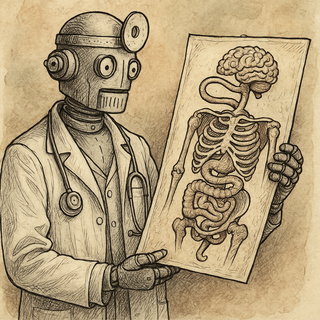
This is the hallucination problem, and in medicine, it's not an amusing quirk - it's a patient safety issue.
What Exactly Is a Hallucination?
The term "hallucination" in AI refers to outputs that are fluent, confident, and entirely fabricated. The model isn't lying - lying requires knowing the truth and choosing to say otherwise. The model has no concept of truth. It generates statistically likely sequences of tokens based on patterns in its training data. When those patterns produce something that happens to be false, the model has no internal alarm bell that goes off.
In non-medical contexts, this is annoying. Ask ChatGPT for a biography and it might invent a book the person never wrote. Mildly embarrassing if you repeat it at a dinner party. In medical contexts, the same mechanism can produce fake drug interactions, imaginary contraindications, or nonexistent treatment protocols. The stakes are different by several orders of magnitude.
The Greatest Hits of Medical AI Hallucinations
Researchers have been cataloging these failures with a mix of alarm and morbid curiosity. Some highlights from the literature:
Phantom citations. LLMs frequently generate citations that look real - correct journal format, plausible authors, reasonable dates - but correspond to papers that never existed. One study found up to 47% of GPT-3.5's medical citations were fabricated.
Invented medications. Models have recommended drug names that don't exist, or suggested brand names for the wrong generic compounds.
Confident dosing errors. The scariest category. The model states a specific dosage with zero hedging, and the number is wrong - sometimes by an order of magnitude. "500mg twice daily" delivered with the confidence of a seasoned clinician, except the correct dose is 50mg.
Fabricated guidelines. LLMs have generated treatment recommendations attributed to the WHO or AHA that those organizations never published. Perfect formatting. Fictional content.
Why Medical Hallucinations Are Especially Dangerous
Three features of medical AI use create a perfect storm:
Authority bias. People trust computers, and they especially trust computers that speak in medical terminology. A hallucinated response dressed in clinical language gets more deference than the same nonsense in plain English. Patients and even some clinicians may not question a confident, well-structured AI response.
Verification difficulty. Checking whether "amoxicillin interacts with lisinopril via CYP3A4 inhibition" is true requires domain expertise. A layperson can't fact-check it by feel. And a busy clinician might not have time to verify every statement when using an AI tool for quick reference.
Compounding errors. In clinical decision-making, one wrong fact can cascade. If the AI hallucinates a drug allergy that doesn't exist, the clinician might avoid the best treatment option and choose a less effective alternative. The patient suffers not from the hallucination directly, but from the downstream decisions it caused.
What's Being Done About It
The field is attacking this from multiple angles. Retrieval-augmented generation (RAG) grounds outputs in actual databases - looking up facts instead of generating them from memory. Uncertainty quantification tries to flag low-confidence outputs for human review, though current models are poorly calibrated and often most confident when most wrong. Structured output validation checks AI content against drug databases and guidelines before presenting it to users. And domain-specific fine-tuning on curated medical datasets reduces hallucination rates, though "lower" is still not "zero."
The Uncomfortable Bottom Line
No current AI system is reliable enough to be the sole source of medical information for clinical decisions. Full stop. The hallucination problem is not solved, and it may be inherent to how these models work. Token prediction doesn't respect truth - it respects probability.
The practical solution is layers: AI generates, databases verify, humans decide. Any medical AI deployment that skips the verification and human oversight steps is playing a game of Russian roulette with patient safety.
For healthcare professionals building clinical workflows that include AI tools, keeping thorough documentation is more important than ever. pdfb2.io can help you annotate, redact, and organize the clinical documents and AI audit trails that responsible deployment requires. - ## References
- Athaluri SA, et al. Exploring the Boundaries of Reality: Investigating the Phenomenon of Artificial Intelligence Hallucination in Scientific Writing. Cureus. 2023. DOI: 10.7759/cureus.37432
- Thirunavukarasu AJ, et al. Large language models in medicine. Nature Medicine. 2023. DOI: 10.1038/s41591-023-02448-8
- Singhal K, et al. Large language models encode clinical knowledge. Nature. 2023. DOI: 10.1038/s41586-023-06291-2