Good news: scientists may have found a much sharper way to tell when rivers are getting pushed around by nitrogen pollution. Bad news: the organisms doing the tattling are slime-coated microbial biofilms, which means the heroes of this story are basically river snot with a PhD.
That is the setup in Discovery of nitrogen-responsive microbial indicators as metrics of freshwater ecosystem health, where researchers analyzed bacterial DNA from 1,574 freshwater biofilm samples collected at 694 river sites across England (Warren et al., 2026). The big idea is pretty slick: instead of judging river health only by chemistry snapshots or the usual larger organisms, ask the microbes. They are already down there riding the nutrient waves, reacting fast, and keeping receipts.
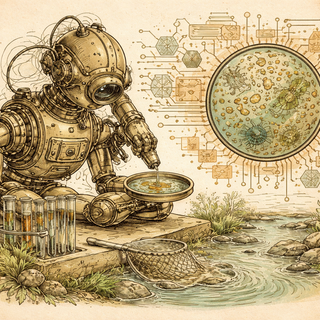
The River’s Weird Little Dashboard
A freshwater biofilm is a thin microbial community coating rocks, plants, and other surfaces in rivers. It is not glamorous. It is, however, busy doing the invisible labor that keeps ecosystems running - cycling nutrients, feeding food webs, and generally acting like the overworked backstage crew for the whole river.
That matters because nitrogen is a troublemaker. In water, oxidized nitrogen compounds like nitrate can build up from fertilizer runoff, sewage, and other human activities. Too much of it can shove ecosystems toward eutrophication, where you get algal booms, oxygen problems, and a general ecological wipeout. Nitrification itself is a microbe-driven process that converts ammonia to nitrite and then nitrate, so microbes are not just watching this movie - they are in the cast (Wikipedia: Nitrification).
Europe’s monitoring rules under the Water Framework Directive aim for “good” ecological status in rivers and lakes, but the standard toolkit has historically leaned on fish, plants, algae, and invertebrates more than microbes (Wikipedia: Water Framework Directive). That is a bit like inspecting a bakery by interviewing the customers but never checking the kitchen.
Machine Learning, but for Pond Gunk
The researchers used 16S rRNA gene sequencing to profile bacterial communities in those biofilms, then trained tree-based machine learning models to predict oxidized nitrogen levels from the microbial mix. Think XGBoost and random forests, not robot overlords. More “pattern-finding bloodhound,” less “Skynet but with waders.”
Their best models explained about 65% of the variance in nitrate and total oxidized nitrogen concentrations. In ecology, where everything is noisy and half the system is trying to hide behind weather, geology, and upstream land use, that is a pretty respectable ride. The team then used SHAP values to see which bacterial genera mattered most, and threshold indicator analysis to find where the community really starts to flip.
The payoff: they identified 156 bacterial genera that behaved like predictive threshold indicators for oxidized nitrogen. Sensitive taxa showed a strong community change point around 0.30 mg/L, while tolerant taxa clustered around 3.78 to 3.97 mg/L. Translation: below one zone, some microbes are happy; above another, a different crowd starts paddling in like they own the break.
Why This Is Cooler Than It Sounds
This paper is interesting because it pushes biomonitoring away from “measure the water, shrug, come back later” and toward “track the living system that integrates what happened over time.” Biofilms do not just capture a single afternoon’s chemistry. They reflect the recent history of the river, which is exactly what you want if pollution comes in pulses.
It also helps with a long-running freshwater headache: nitrogen often matters a lot, but ecological thresholds for it can be fuzzy. Traditional monitoring has been better at linking phosphorus to biological change than nitrogen. These microbial indicators could help close that gap and give regulators something closer to an ecosystem-level speedometer instead of a dashboard light that only blinks after the engine is smoking.
Recent work lines up with that broader direction. A 2026 national-scale study similarly argued that river microbiomes act as sentinels of freshwater condition across England (Thorpe et al., 2026). A 2024 Mekong River study found distinct microbial communities could serve as bioindicators under different environmental pressures (Liu et al., 2024). A 2025 review on watershed microorganisms also emphasized that microbes sit right in the middle of carbon and nitrogen cycling, making them useful for tracking ecological stress before bigger organisms fully crash the party (Wang et al., 2025).
The Catch, Because There Is Always a Catch
Nobody should read this as “we solved river health, dudes.” The model is promising, but it is still a framework, not a magic referee whistle. Microbial communities respond to lots of things at once - pH, conductivity, temperature, organic matter, flow conditions, land use. Nitrogen is one wave in a messy sea.
There is also a practical hurdle: turning DNA-based indicators into routine policy tools means standardizing sampling, sequencing, analysis, and interpretation so different labs are not all surfing slightly different forecasts.
Still, this feels like a smart next move. Microbes are fast, abundant, and deeply tied to the chemistry we care about. If you want an early-warning system for freshwater stress, asking the tiniest workers in the river makes a lot more sense than waiting for the bigger stuff to start visibly falling apart.
References
Warren J, de Vries C, Hunt LH, Thorpe AC, Busi SB, Kelly MG, Simons DL, Taylor JD, Read DS, Walsh K. Discovery of nitrogen-responsive microbial indicators as metrics of freshwater ecosystem health. Water Research. 2026;300:125959. DOI: 10.1016/j.watres.2026.125959. PubMed: 42025417
Thorpe AC, et al. River Microbiomes as Sentinels of National-Scale Freshwater Ecosystems. Global Change Biology. 2026. PMC: PMC12998506
Liu Y, et al. Elucidating potential bioindicators from insights in the diversity and assembly processes of prokaryotic and eukaryotic communities in the Mekong River. Science of the Total Environment. 2024;243:117800. PubMed: 38056615
Wang X, et al. The interplay of carbon and nitrogen cycling driven by watershed microorganisms. Frontiers in Microbiology. 2025. DOI: 10.3389/fmicb.2025.1696238
Sheikholeslami R, Hall JW. Global patterns and key drivers of stream nitrogen concentration: A machine learning approach. Science of the Total Environment. 2023;868:161623. DOI: 10.1016/j.scitotenv.2023.161623. PMCID: PMC10933795
Abrantes GH, et al. Epilithic biofilms provide large amounts of nitrogen to tropical mountain landscapes. Environmental Microbiology. 2023;25(12):3592-3603. DOI: 10.1111/1462-2920.16515. PubMed: 37816630
Disclaimer: This blog post is a simplified summary of published research for educational purposes. The accompanying illustration is artistic and does not depict actual model architectures, data, or experimental results. Always refer to the original paper for technical details.