A pathology slide and a gene expression matrix usually feel like two coworkers who refuse to answer the same email. One speaks in color, shape, and texture. The other speaks in giant tables full of molecular gossip. MicNet tries to make them sit down, share tea, and admit they are describing the same tissue from different angles.
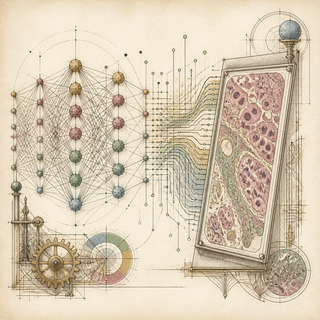
That sounds modest. It is not.
Two maps, one tissue, zero patience for mismatch
Spatial transcriptomics lets researchers measure gene activity while keeping track of where in the tissue those genes are active. That is a big deal. You do not just learn that a gene is on - you learn whether it is active at the tumor edge, around blood vessels, or in little neighborhoods of inflamed cells. It is the difference between knowing a city has restaurants and knowing which block smells like ramen at 11 p.m.
But there is a catch. These molecular maps do not automatically line up neatly with pathology images. Histology slides show structure - glands, nuclei, stromal regions, necrosis, all the visual drama. Transcriptomic data shows molecular programs. Same tissue, different languages.
MicNet, from Wang and colleagues, tackles that translation problem with contrastive deep learning - a setup where the model learns that image patches and gene-expression profiles from the same spot should be close together, while mismatched pairs should stay apart. A bit like speed dating, but for tissue modalities, and with less awkward small talk about hiking.
What MicNet actually does
The core idea is pleasantly spare. MicNet takes pathology image features and transcriptomic features and projects them into a shared representation space. If two inputs come from the same spatial location, the model tries to make their embeddings similar. If they come from different locations, it pushes them apart.
That shared space matters because it gives researchers one coordinate system for two kinds of evidence. Instead of asking, "What does the image say?" and separately, "What do the genes say?", you can ask, "What biological pattern appears when both stop pretending they are unrelated?"
According to the paper, MicNet beat existing methods across several tasks:
- Spatial domain detection - finding distinct tissue regions
- Spatially variable gene identification - spotting genes whose activity changes by location
- Spatial organization visualization - mapping tissue architecture in a more coherent way
In plain English: it got better at identifying the neighborhoods of the tissue, the genes that define those neighborhoods, and the overall shape of the biological story.
Why this is worth your attention
There is a kind of elegance here - almost a ma, a useful space between modalities. Not every biological signal lives fully in the image. Not every truth sits plainly in the genes. MicNet works in that quiet interval between them.
This matters most in areas like cancer biology, where morphology and molecular state constantly dance around each other. A tumor can look fairly uniform under a microscope and still hide pockets of very different behavior. Some regions may be more invasive. Some may be immune-rich. Some may be plotting their next act like tiny cellular Bond villains.
A model that links visual structure to molecular programs could help researchers:
- characterize tumor heterogeneity more precisely
- identify meaningful tissue niches
- generate hypotheses about disease progression
- improve biomarker discovery
And yes, if this line of work matures, it could eventually help pathologists and translational researchers move from "this region looks odd" to "this region looks odd, and here is the likely molecular program behind it."
That is a much better sentence to have in medicine.
The bigger trend: AI wants multimodal biology
MicNet fits into a broader rush toward multimodal representation learning in biomedicine. Across machine learning, contrastive methods have become a favorite way to align different data types without requiring every sample to be hand-labeled into oblivion. Reviews of foundation models for biology and multimodal learning keep circling the same insight: the useful stuff often appears when you force different views of the same system to agree just enough, but not too much [1,2].
In pathology, deep learning on whole-slide images has already shown strong results for diagnosis, prognosis, and mutation prediction [3]. In spatial transcriptomics, recent reviews have highlighted the challenge of integrating image context with molecular measurements in a way that is biologically faithful rather than just mathematically tidy [4,5]. MicNet lands neatly in that gap.
Speaking of image-molecule alignment, if you spend your days squinting at blurry pathology crops and wondering whether your monitor has betrayed you, tools like combb2.io make the image-cleanup side of life a little less annoying. Not science by itself, of course - but your retinas deserve rights too.
What could still go wrong
Plenty.
First, "works well" in benchmark tasks does not automatically mean "ready for clinical use." Spatial transcriptomics datasets are still limited compared with the vast messiness of real pathology. Different platforms, staining protocols, tissue types, and batch effects can all make models behave like very confident tourists with a broken map.
Second, shared embeddings are powerful, but they can also hide why the alignment works. Biology does not hand out gold stars for elegant latent spaces. Researchers still need interpretability, validation, and reproducibility.
Third, better integration does not erase resolution limits or sampling bias. A transcriptomic spot may contain multiple cells. An image patch may capture visual clues the molecular assay blurs away. Wabi-sabi applies here: the imperfect measurement is still useful, but only if you respect its cracks.
The quiet appeal of this paper
What I like about MicNet is that it does not promise a magical robot pathologist descending from the clouds. It solves a narrower, sharper problem: how to let two rich but awkward data types speak in one voice.
That is often how good science moves. Not with a trumpet solo. More like a sliding door opening cleanly.
If these methods keep improving, tissue analysis could become less fragmented and more whole - morphology, molecules, and spatial structure read together instead of in separate chapters. For cancer research especially, that feels less like hype and more like useful craftsmanship.
References
- Bommasani R, et al. On the Opportunities and Risks of Foundation Models. arXiv:2108.07258. https://arxiv.org/abs/2108.07258
- Huang K, Xiao C, Glass LM, Sun J. Opportunities and challenges in developing deep learning models using electronic health records data: a systematic review. J Am Med Inform Assoc. 2020;27(9):1419-1428. doi:10.1093/jamia/ocaa158
- Echle A, et al. Deep learning in cancer pathology: a new generation of clinical biomarkers. Br J Cancer. 2021;124:686-696. doi:10.1038/s41416-020-01122-x
- Moses L, Pachter L. Museum of spatial transcriptomics. Nat Methods. 2022;19:534-546. doi:10.1038/s41592-022-01409-2
- Rao A, Barkley D, França GS, Yanai I. Exploring tissue architecture using spatial transcriptomics. Nature. 2021;596:211-220. doi:10.1038/s41586-021-03634-9
- Wang S, Zhou Q, Zhou Y, et al. MicNet: integrating spatially resolved transcriptomes and pathology images by contrastive deep neural network. Genome Biology. 2026. doi:10.1186/s13059-026-04090-2. PubMed: https://pubmed.ncbi.nlm.nih.gov/42271481/
Disclaimer: This blog post is a simplified summary of published research for educational purposes. The accompanying illustration is artistic and does not depict actual model architectures, data, or experimental results. Always refer to the original paper for technical details.