Every animal is playing a survival game where the same level can secretly become a boss fight after one tiny context swap. A hallway is safe until it smells like a predator. A route to food is great until the rules change. Your brain has to ask, constantly: "Same map, new mode?" Miss that cue and you are basically speedrunning bad decisions.
Ito and Toyoizumi's new eLife paper, Modeling flexible behavior with remapping-based hippocampal sequence learning, tries to model how the hippocampus helps with that clutch context switch. Their answer: maybe flexible behavior comes from learning different neural "routes" through experience, then remapping those routes when the situation changes. In gamer terms, the hippocampus is not just storing the minimap. It is also updating the quest logic.
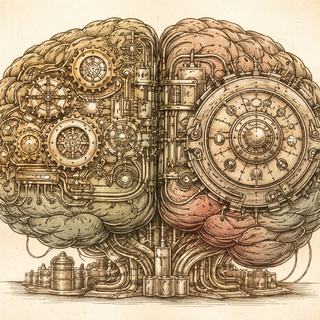
The Build: Sequence Composer Plus Context Selector
The model has two main players. First is the "Sequence composer," meant to resemble hippocampal sequence activity. Think of it as the part of the system that strings together events: room A, cue B, choice C, reward D. It is built with an Amari-Hopfield-style recurrent network, the classic attractor-network family where activity settles into stable patterns like a marble rolling into one of several bowls. Old-school architecture, still viable. Respectable A-tier.
Second is the "Context selector." This component decides which context is active and nudges the sequence system toward the right behavioral script. If the same sensory input means different things in different situations, the Context selector is the teammate yelling, "Wrong loadout, swap builds!"
That matters because hippocampal neurons often "remap." Place cells can change their firing patterns when an animal enters a different environment or context. A 2024 Nature Reviews Neuroscience perspective by Fenton argues that remapping is not just a cute neuroscience side quest, but central to how the hippocampus represents different spaces and situations (DOI: 10.1038/s41583-024-00817-x).
Why This Paper Is Playing the Objective
The problem Ito and Toyoizumi tackle is not "Can a model learn a sequence?" That is bronze lobby stuff. The harder problem is: can a model learn context-dependent sequences and switch behavior flexibly when the rules change?
Their model learns through reinforcement. Rewards shape the sequential activity, and context signals help decide which sequence should run. The system can form different activity patterns for different contexts, even when sensory inputs overlap. That is the OP move: same screen, different strategy.
This connects neatly to recent work on hippocampal replay and planning. Jensen, Hennequin, and Mattar showed that a recurrent network model can explain hippocampal replay and aspects of human planning behavior, giving the hippocampus a role in mentally simulating possible futures before acting (DOI: 10.1038/s41593-024-01675-7). Meanwhile, Chen and colleagues modeled predictive sequence learning in the hippocampal formation, showing how hippocampal subregions might learn temporal structure and support remapping (DOI: 10.1016/j.neuron.2024.05.024).
So this paper enters a hot meta: the hippocampus as a sequence-learning, future-sampling, context-sensitive engine. Not just "memory storage," which sounds like a dusty filing cabinet. More like a tactical replay system with a questionable UI and excellent latency.
The Schizophrenia and Autism Angle: Handle With Care
The boldest part of the paper is its clinical prediction. The authors propose that imbalances between sensory and contextual representations in the Context selector could produce schizophrenia-like or autism spectrum disorder-like behaviors.
Translated: if the system overweights context, it may infer hidden meanings too aggressively. If it underweights context, it may struggle to flexibly adjust behavior when the situation changes. That is an interesting hypothesis, but it needs the big caution sticker. This is a computational model, not a diagnostic machine. Nobody should walk away thinking a few network weights explain complex human conditions. That would be like blaming your entire ranked losing streak on one nerfed weapon. Tempting, emotionally satisfying, probably wrong.
Still, models can be useful without being the whole story. They give researchers testable predictions: what happens if context signals are weakened, strengthened, or mistimed? Could neural recordings, optogenetic experiments, or fMRI patterns line up with those predictions? The authors argue their model reproduces findings from neural activity, optogenetic inactivation, human fMRI, and clinical research, which is why the eLife assessment calls it a valuable modeling study with solid evidence (DOI: 10.7554/eLife.106506).
The Tier List Verdict
For explaining context-dependent flexible behavior, this model is a strong A-tier theorycrafting build. It combines biologically plausible reinforcement learning, remapping, and hippocampal sequences into one framework that actually tries to fight the boss instead of farming easy mobs.
Weaknesses? It is still a model. The brain has more interacting systems than any clean diagram wants to admit: prefrontal cortex, dopamine, sensory systems, social context, development, sleep, stress, the whole cursed expansion pack. Also, mapping model components onto psychiatric symptoms is high-risk terrain. Good hypothesis generator, bad final answer machine.
But the core idea lands: flexible behavior may depend on learning not just what happened, but which version of the world you are currently in. The hippocampus might help your brain maintain multiple strategy guides and swap between them when the match changes. And honestly, that is a pretty clutch mechanic for a wet computer running on snacks and sleep debt.
References
Ito, Y., & Toyoizumi, T. (2026). Modeling flexible behavior with remapping-based hippocampal sequence learning. eLife, 14, RP106506. https://doi.org/10.7554/eLife.106506
Fenton, A. A. (2024). Remapping revisited: how the hippocampus represents different spaces. Nature Reviews Neuroscience, 25, 428-448. https://doi.org/10.1038/s41583-024-00817-x
Jensen, K. T., Hennequin, G., & Mattar, M. G. (2024). A recurrent network model of planning explains hippocampal replay and human behavior. Nature Neuroscience, 27, 1340-1348. https://doi.org/10.1038/s41593-024-01675-7
Chen, Y., Zhang, H., Cameron, M., & Sejnowski, T. (2024). Predictive sequence learning in the hippocampal formation. Neuron, 112, 2645-2658. https://doi.org/10.1016/j.neuron.2024.05.024
Duvelle, E., Grieves, R. M., & van der Meer, M. A. A. (2023). Temporal context and latent state inference in the hippocampal splitter signal. eLife, 12, e82357. https://doi.org/10.7554/eLife.82357
Disclaimer: This blog post is a simplified summary of published research for educational purposes. The accompanying illustration is artistic and does not depict actual model architectures, data, or experimental results. Always refer to the original paper for technical details.